
When You Need Tape That Won’t Melt During Soldering, Rework, or Reflow

If you’ve ever watched a piece of electrical tape curl up and melt under a hot air gun, you already know why high-temp tape exists. Polyimide tape — often called Kapton tape — is the one I reach for when soldering, reflow, or any kind of heat is involved. It’s thin, it’s tough, and it doesn’t leave a sticky mess behind.
But not all polyimide tape is the same. The backing film is pretty consistent, but the adhesive layer changes everything. Using the wrong adhesive for the job is the fastest way to ruin a good piece of tape — or a board.
Here’s where polyimide tape actually earns its place on an electronics bench, and which adhesive type makes sense for each situation.
Masking Gold Fingers Without Leaving a Sticky Mess
Gold fingers on PCBs need protection during wave soldering or selective soldering. If solder gets onto them, the board is often scrapped. Regular masking tape can’t handle the temperature, and cheaper tapes leave residue that is a pain to clean.
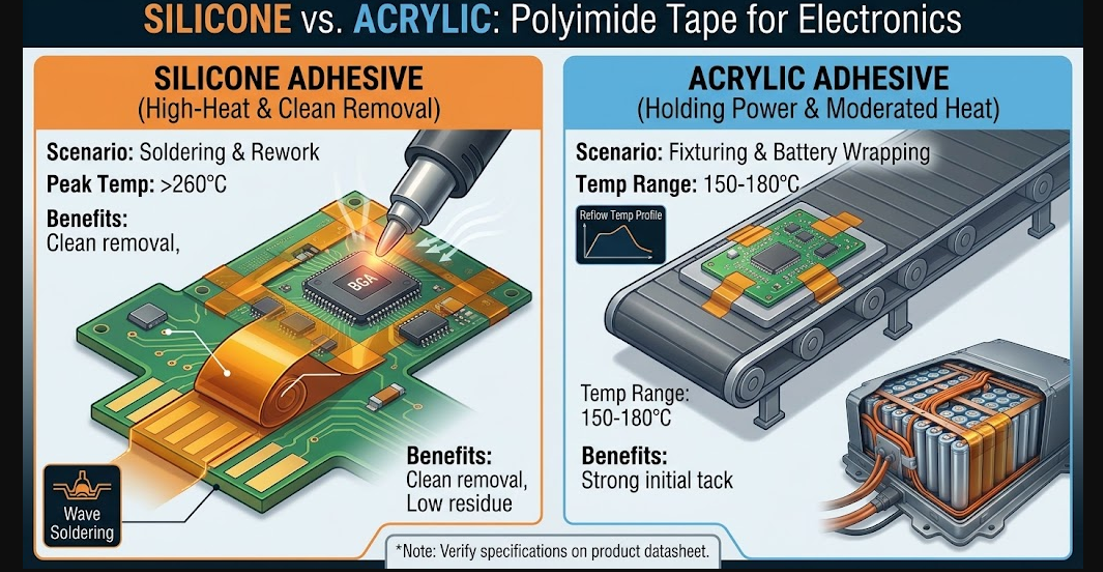
This is where a silicone adhesive polyimide tape is the right choice. Silicone adhesive handles short-term temperatures above 260°C without breaking down, and it peels away cleanly after the process. It doesn’t have the aggressive initial tack of an acrylic tape, but for masking gold fingers that’s exactly what you want — strong enough to stay put, clean enough to remove without a fight.
One thing people often overlook is that gold finger masking isn’t just about temperature resistance. The tape edge also needs to be sharp and stable. If the adhesive bleeds or the backing wrinkles under heat, solder can sneak underneath and ruin the plating. That’s another reason silicone-based polyimide tape is preferred: it tends to hold a clean edge through the thermal cycle.
This is one of the most common uses in PCB assembly, and it’s also a big part of what a proper PCB & Electronics Masking Solutions setup covers. When you look at how many different masking materials are used in a single production line, polyimide tape is usually the one that shows up again and again.
Keeping Heat Away From Components You Don’t Want to Touch
When you’re removing a BGA or reworking a QFN with a hot air gun, the heat spreads. Small capacitors and connectors nearby can get blown right off the board or damaged. A simple way to reduce that risk is to cover surrounding areas with polyimide tape.
Again, silicone adhesive polyimide tape is the better choice here. It tolerates the hot air stream without curling or shrinking, and it doesn’t transfer adhesive to the board when you peel it off. Acrylic adhesive can soften and ooze under sustained hot air, which creates a residue problem on pads you’re about to resolder.
The tape acts as a local mask, not as a heat shield. It won’t stop heat from moving through the board, but it protects small parts from direct airflow and splash. If you need actual heat shielding, you’re looking at thermal insulation materials, not tape. That distinction matters because a lot of people assume Kapton tape will somehow block heat. It won’t. What it does is stay stable while everything around it gets hot.
For rework technicians, this is one of those small habits that separates clean jobs from messy ones. Taking thirty seconds to mask off a nearby connector with polyimide tape can save an hour of repair work later.
Holding Small Boards in Place When They Go Through the Oven
For prototyping or small-batch work, you sometimes need to hold a small PCB or flex board flat on a carrier while it goes through a reflow oven. The tape has to survive the oven profile, hold the board steady, and release cleanly afterward.
Here, many engineers actually prefer acrylic adhesive polyimide tape, with an important caveat: make sure it’s rated for the peak reflow temperature you’re using. Acrylic adhesive has stronger initial tack, which helps hold parts down during conveyor movement. But its long-term temperature limit is typically lower than silicone — often around 150–180°C continuous, with short excursions depending on the product.
If your profile pushes past 240°C, silicone is the safer choice. If your profile is lower and you need more holding force, acrylic works well. The key is knowing your oven profile before you pick the tape.
It’s also worth paying attention to how the tape responds to the cooling stage. Some acrylic adhesives become brittle after one or two reflow cycles, while silicone tends to stay more flexible over repeated exposure. If you’re reusing a carrier and re-taping multiple boards, that difference starts to show up quickly. A tape that curls or hardens after the first pass isn’t going to give you consistent results on the second board.
The Same Tape Shows Up in Battery Packs, Too
Polyimide tape isn’t only for PCBs. It also shows up inside battery packs, where it’s used to wrap cells, cover tabs, and add a thin layer of electrical insulation between adjacent cells. The environment is hot, tight, and electrically active, so dimensional stability matters just as much as temperature resistance.
In these applications, silicone adhesive polyimide tape is the standard choice. Silicone holds up better under long-term thermal cycling and doesn’t break down as quickly as acrylic when the cells heat up and cool down repeatedly. The last thing you want in a battery module is tape that shrinks, curls, or turns brittle after a few hundred cycles.
This also explains why the same roll of Kapton tape that sits on a soldering bench often ends up being used for quick battery repairs and insulation fixes. It’s just a very stable material in tight, hot spaces. And because it’s thin, it doesn’t add unnecessary bulk to a cell stack where every fraction of a millimeter counts.
What Actually Matters When You Pick a Polyimide Tape
If you’re trying to decide between rolls, start with two questions: what temperature will the tape actually see, and does it need to come off cleanly?
For most PCB soldering and rework tasks, silicone adhesive is the right answer. It handles the heat better, removes cleanly, and doesn’t leave residue on pads or gold fingers. The initial tack is lower, but that’s rarely a problem when the tape is being wrapped around a board or pressed onto a flat surface.
Acrylic adhesive makes sense when you need more holding power and the temperature is moderate. Temporary fixturing, low-temperature reflow, or securing cables during assembly are good examples. Just don’t push an acrylic tape through a lead-free reflow profile and expect clean results.
Thickness also matters. Thinner tapes conform better to board edges and fine-pitch components, but they tear more easily during handling. Thicker tapes are tougher but can leave a slight step height when masked areas meet solder paste. For most bench work, a 1 mil or 2 mil polyimide film with a silicone adhesive is a solid default.
One thing that trips people up is the datasheet. Some suppliers list only the film’s temperature rating, not the adhesive’s. That’s a problem because the backing film might survive 300°C while the adhesive gives up at 180°C. If the datasheet doesn’t tell you whether the adhesive is silicone or acrylic, it’s hard to predict how the tape will behave in your process. A few manufacturers do publish separate ratings for the film and the adhesive system — JXGREENTAPE is one that makes this information easy to find, which helps when you’re comparing options.
One Tape, Many Jobs
You don’t need a drawer full of specialty tapes for PCB work. One good roll of polyimide tape will handle most high-temperature masking, holding, and insulation tasks on the bench. The important thing is knowing when to use it — and matching the adhesive to the job.
Silicone adhesive is the default for anything that sees lead-free soldering, hot air rework, or long-term heat. Acrylic adhesive is a useful alternative for lower-temperature holding and fixturing. Get that right, and the tape will do its job without fighting you when it’s time to peel it off.







Comment