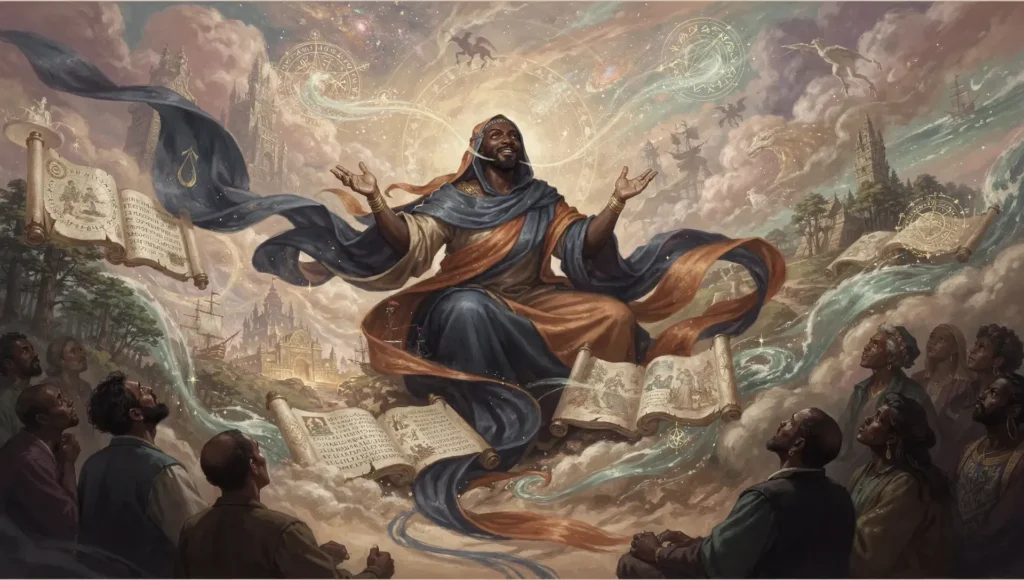
Folklore and mythology often begin where historical records end. When official documents go silent, when witnesses disappear, when ships vanish, or when a death cannot be explained, people reach for story. They create legends to hold the terror, confusion, and unanswered questions that history leaves behind.
That is why old myths still matter. They are not merely decorative tales from a distant past. They are cultural records of fear, warning, memory, and suspicion. A cursed object, a forbidden container, a doomed voyage, or a ship found drifting without survivors may sound impossible at first. Yet these legends survive because they often begin with something real: a disaster, a disappearance, a strange death, or a mystery no one could comfortably explain.
In supernatural historical fiction, folklore becomes more than atmosphere. It becomes evidence. The myth is not just a shadow behind the plot. It becomes a possible clue to something hidden in history.
David M. Dye’s Do Not Open understands that distinction. The novel does not use folklore and mythology as decoration. It treats mythological warning, maritime legend, and historical mystery as parts of the same investigation. The result is a suspenseful story where the past feels unfinished, the supernatural feels disturbingly plausible, and history itself seems to be withholding evidence.
Why Folklore Still Matters in Fiction
Folklore keeps ancient fears alive because it speaks to questions people still ask today. What happens when humans ignore a warning? Why are some objects treated as dangerous? Why do certain places, ships, or relics seem to carry tragedy with them? Why do some stories refuse to disappear?
Readers remain fascinated by myths about forbidden objects, cursed voyages, divine punishment, and lost civilizations because these stories feel both impossible and strangely believable. They operate in the space between reason and dread. A rational mind may reject the curse, but it still recognizes the pattern: someone opens what should remain sealed, sails where they were warned not to go, takes what was never meant to be touched, or asks questions that powerful people would rather bury.
This is why folklore and mythology are so effective in suspense fiction. They do not need to prove themselves immediately. Their power comes from suggestion. A myth can sit quietly beneath a story, shaping every choice the characters make. It can make a historical mystery feel older than the records surrounding it.
For American readers who enjoy intelligent suspense, this kind of fiction offers more than escape. It invites investigation. It asks whether a legend is simply a story, or whether the story survived because someone, somewhere, was trying to preserve a warning.
The Power of Mythology in Historical Suspense
Supernatural historical fiction gains emotional weight when mythology is woven into the structure of the mystery. A conventional mystery often asks, “What happened?” A myth-driven historical mystery asks something deeper: “Why have people feared this for generations?”
That question changes the reading experience. The mystery no longer belongs only to one crime, one victim, or one moment in time. It becomes part of a larger pattern. A myth may stretch across countries, wars, religious traditions, ancient texts, classified programs, and maritime accounts. It may appear in different forms across different cultures, but the warning remains familiar: do not open, do not touch, do not disturb, do not seek knowledge without consequence.
This is where mythology gives supernatural historical fiction its force. It connects personal curiosity with collective memory. The reader is not simply following a clue trail. They are watching characters confront the possibility that past generations were not superstitious fools. They may have understood something modern people have forgotten.
A strong historical suspense novel does not ask readers to abandon logic. It asks them to consider whether logic and legend can coexist. Could a myth preserve a distorted memory of a real event? Could a cursed artifact be tied to a documented tragedy? Could a supernatural warning be a symbolic explanation for something history recorded only in fragments?
Those are the questions that give the genre its lasting appeal.
Ghost Ships and the Fear of the Unknown
Few images capture historical dread as powerfully as a ghost ship. A vessel adrift at sea creates instant tension because it combines isolation, death, silence, and unanswered questions. On land, there may be witnesses. At sea, there is only distance, weather, wreckage, and whatever the survivors were able to say before they vanished.
That is why ghost ship murder mysteries remain so compelling. A ship is a sealed environment. Its passengers and crew are trapped together. Its cargo may be unknown. Its route may be disputed. Its final hours may never be fully reconstructed. When a ghost ship is discovered without a clear explanation, the imagination immediately begins filling the gaps.
What killed the crew? Why was no one able to escape? Why was the vessel still afloat? Was the danger human, natural, military, chemical, or something older and stranger? Every unanswered question increases the pressure.
The sea also magnifies fear because it erases evidence. It swallows bodies, cargo, logs, weapons, and witnesses. In maritime fiction, the ocean is not just a setting. It is an accomplice. It hides what happened and forces investigators to work with fragments: a distress call, a damaged manifest, a survivor’s testimony, a missing log, a rumor repeated in different versions across decades.
For supernatural historical fiction, the ghost ship becomes the perfect meeting point between folklore and evidence. It is real enough to investigate, but strange enough to resist closure.
How Do Not Open Blends Myth, History, and Mystery
David M. Dye’s Do Not Open builds its suspense around the fear of opening what should remain sealed. That idea is ancient. It appears in mythological traditions, religious warnings, and stories of forbidden knowledge. Dye connects that fear to maritime mystery, dangerous history, and the eerie uncertainty of a ghost ship narrative.
The novel draws readers into a world where mythology may not be metaphor. A warning may not be symbolic. A legend may not be a legend at all. The atmosphere is tense, investigative, and historical, but the supernatural pressure is never far away. The ghost ship element gives the story immediate dread: a vessel, unexplained deaths, a terrifying final message, and the possibility that something was released.
What makes Do Not Open especially effective is that it treats mythological warnings as possible historical truth. The novel does not simply place an ancient myth beside a modern mystery. It asks whether the myth could be part of the evidence trail. That approach fits Dye’s broader storytelling identity: fiction grounded in records, disputed incidents, suppressed narratives, and the unexplained edges of official history.
The result is not fantasy wearing historical clothing. It is historical suspense with a supernatural question at its center. What if old warnings survived because they were accurate? What if the past left clues, but modern people dismissed them as folklore? What if curiosity itself is the danger?
Why Readers Love This Blend
Readers are drawn to this blend because it gives them permission to question reality without leaving realism behind. Historical fiction appeals to readers who value research, detail, and context. Thrillers appeal to readers who want momentum, danger, and revelation. Mythology appeals to readers who want wonder, dread, and meaning. Supernatural historical fiction brings all three together.
This kind of story works because it respects the intelligence of the reader. It does not depend on easy scares or empty mystery. Instead, it builds suspense through patterns, documents, legends, motives, and historical uncertainty. The reader becomes an investigator, weighing what is known against what cannot be explained.
For audiences in the United States, where historical thrillers, conspiracy-driven narratives, maritime mysteries, and myth-based suspense all have strong reader appeal, this approach feels especially timely. Readers want stories that are entertaining, but they also want stories with substance. They want fiction that rewards curiosity.
That is what folklore and mythology provide. They give supernatural historical fiction a deeper architecture. They remind readers that every official record has edges, every archive has omissions, and every legend may contain a trace of truth.
Conclusion
Folklore and mythology are not relics of the past. In the right story, they become living forces. They challenge what we think we know about history, evil, curiosity, and human ambition.
A myth can warn. A cursed object can accuse. A ghost ship can become a crime scene. A maritime legend can become a historical mystery waiting to be reopened.
That is the power of supernatural historical fiction. It does not ask readers to choose between evidence and imagination. It asks them to look closer at both.
Readers who enjoy folklore and mythology, supernatural historical fiction, and ghost ship murder mysteries will find David M. Dye’s Do Not Open a haunting and thought-provoking read.