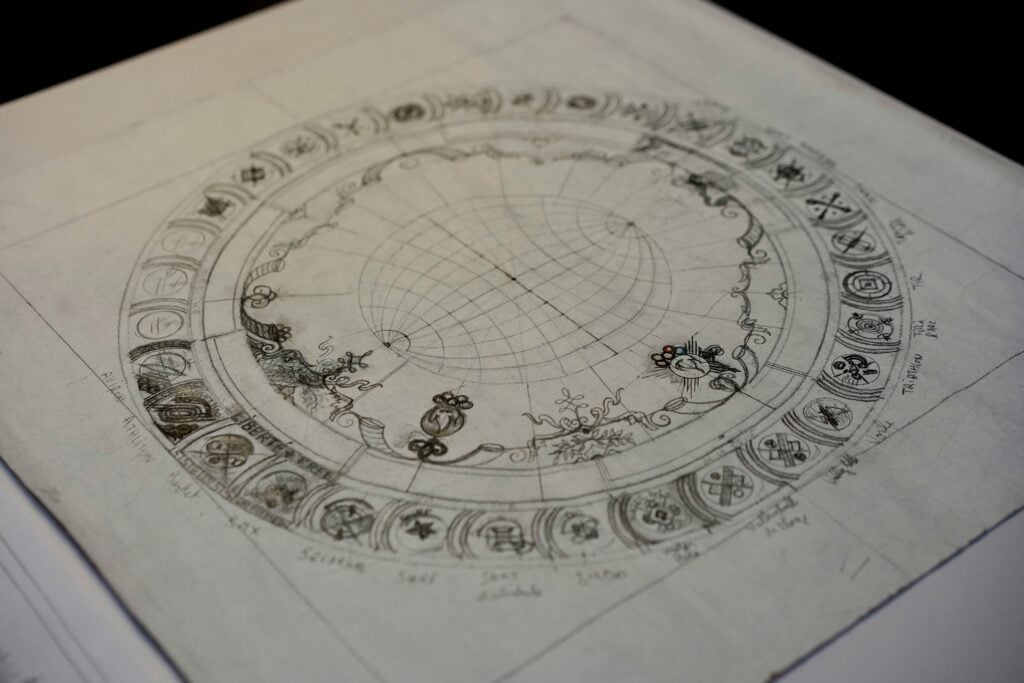
Most people know their star sign. Far fewer know that it represents roughly one twelfth of what a birth chart contains, and that two people born under the same sign can have charts with almost nothing else in common.
A birth chart — also called a natal chart — is a diagram of where the planets sat in the sky at the exact moment and place you were born. It looks intimidating the first time you see one. It is considerably simpler than it appears.
The chart is a snapshot, not a prediction
Start with what is actually being recorded, because this part is straightforward astronomy.
At any given moment, the sun, moon and planets occupy particular positions relative to the Earth. Those positions are calculable with precision for any date in history. A birth chart plots them for one specific moment, from one specific location on the planet’s surface.
What astrology adds is a system of interpretation laid over that map — a tradition, developed over roughly two thousand years, that assigns meaning to each position and the relationships between them. The astronomy is exact. The interpretation is a symbolic language, and it is worth being clear about which is which.
Why the time and place matter so much
This is the detail that surprises newcomers most.
The sun moves through one sign per month, which is why your star sign only requires a birth date. But the Earth completes a full rotation every twenty-four hours, which means the horizon sweeps through the entire zodiac in a single day.
The practical consequence: a chart calculated for 6am and one calculated for 6pm on the same date, in the same city, will differ substantially. Two babies born in the same hospital four hours apart have meaningfully different charts.
Location matters for the same reason. The sky visible from Sydney at a given instant is not the sky visible from Lisbon.
This is why a proper chart asks for your birth time and birthplace, and why any reading based on your date alone is working with a fraction of the picture. If you do not know your birth time, a birth certificate or hospital record usually has it.
The three layers you need to understand
Everything on the chart wheel comes down to three things stacked together.
Planets are the what. Each represents a domain of experience in the astrological tradition. The sun is associated with core identity, the moon with emotional life, Mercury with thinking and communication, Venus with values and attraction, Mars with drive and assertion. The outer planets move slowly and are read as generational rather than personal.
Signs are the how. Each planet falls in one of the twelve zodiac signs, which is taken to colour the way that planet expresses itself. Mercury in a sign associated with precision is interpreted differently from Mercury in a sign associated with improvisation — the domain is the same, the style is not.
Houses are the where. The wheel is divided into twelve sections representing areas of life — work, home, relationships, and so on. A planet’s house placement indicates the arena in which that energy is understood to play out.
Put together, a single placement reads as a sentence: this function, expressed this way, in this part of life. The chart is dozens of those sentences at once, which is why interpretation takes practice.
Aspects: how the pieces talk to each other
The lines crossing the middle of the wheel are aspects — the angular relationships between planets.
Some angles are read as harmonious, suggesting placements that reinforce each other. Others are read as tense, suggesting internal friction. Neither is treated as good or bad in contemporary practice; the tense aspects are frequently described as the more interesting ones, on the grounds that friction produces development.
You do not need to master aspects to get something out of a chart. They are the layer to explore once the basics feel familiar.
Start with three placements
If the full chart feels like too much, almost every astrologer will tell you to begin with the same three.
Your sun sign is the one you already know. Your moon sign is associated with inner emotional life. Your rising sign — the sign on the eastern horizon at your moment of birth — is associated with how you meet the world, and it is the one that depends most sensitively on birth time.
These three are often the point where the chart starts to feel less abstract, because they cover the gap between how you experience yourself and how others experience you.
Running your own is the fastest way to understand any of this. A birth chart calculator will generate the full wheel from your date, time and place in a few seconds, and having your own chart in front of you makes the symbols considerably easier to learn than reading about them in the abstract.
What to expect from it
A birth chart will not tell you what will happen. Contemporary astrology, as most people practise it, has largely moved away from prediction toward reflection — using the chart as a vocabulary for thinking about temperament, tendencies and tensions.
Some people find that vocabulary genuinely useful. Others find it interesting and unconvincing, which is a reasonable position and one plenty of thoughtful people hold.
Either way, the chart is a real object with a real history, and understanding how it is built is worthwhile whether or not you end up believing the interpretation. Start with your own, look up the three placements, and see what you make of it.