For a long time, an LMS had a fairly predictable job. It stored courses, enrolled learners, collected assignments, recorded grades and gave administrators somewhere to manage the whole process.
That is useful, but AI raises the bar considerably.
If an AI-powered LMS can understand what an instructor wants to teach, help structure the course, draft assessments, research topics and prepare the first version of learning material, there is little reason for educators to spend days doing all of that groundwork manually.
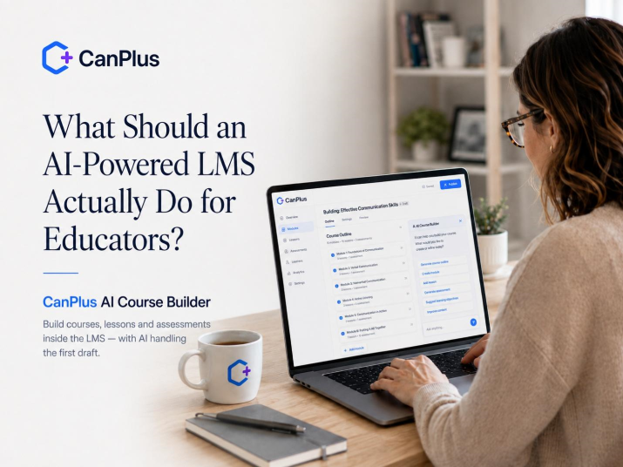
That is the thinking behind the CanPlus AI Course Builder.
An instructor can begin with a subject, an audience and a learning level. A prompt such as Cybersecurity Basics for beginners can become the starting point for a complete course structure. CanPlus can help develop modules, lessons, learning objectives, quizzes, assessments, assignments and grading rubrics, while AI-powered deep research can be used where the subject needs more depth. The material can also be adjusted for beginner, intermediate or advanced learners.
The instructor then works with that structure rather than starting with an empty course shell.
AI should take on more of the first draft
Course creation contains plenty of work that requires academic judgement, but it also contains a lot of repetition. Someone has to create the first module structure. Someone has to draft the quiz. Someone has to prepare the first version of the rubric. Someone has to turn a learning objective into an activity.
AI can take a meaningful share of that first pass.
With CanPlus, an instructor can use AI to help:
- develop the initial course blueprint and module structure;
- turn learning objectives into lessons and activities;
- draft quizzes, assignments and assessment criteria;
- research and expand subjects that need more depth;
- adapt material for different learner levels;
- revisit an existing course when the curriculum or requirements change.
The point is practical. If AI can give an instructor a credible first version in minutes, the instructor can spend their time improving it instead of assembling it piece by piece.
CanPlus builds the course progressively. The educator can review, edit and approve the work before moving to the next stage, and once the course is ready, it can be published within the LMS.
That keeps the important decisions where they belong. An instructor may decide that an assessment is too easy, that a module needs another example, or that the AI has given too much weight to one part of the subject. Those are teaching decisions. The platform gives them something useful to work from.
Why put course creation inside the LMS?
This is where the distinction between a general AI tool and an AI-powered LMS becomes useful.
A standalone tool might generate a syllabus or draft an assignment. The content still has to be copied into the learning platform, organised into modules, formatted, assigned to learners and connected to whatever reporting or assessment workflows the institution uses.
CanPlus keeps course creation and course delivery in the same environment.
The platform combines AI-supported course development with learner management, course delivery and performance tracking. AI also extends into the learner experience through capabilities such as AI Buddy.
For an individual instructor, that removes a lot of unnecessary movement between tools. For a university, training organisation or enterprise managing many courses at once, the operational benefit becomes much more significant.
A modern LMS for higher education or corporate learning should make the entire course lifecycle easier to manage, including the part that happens before a course is ever published.
Courses change. The LMS should make that easier too.
Courses are rarely finished for long.
A new regulation appears. Industry practice changes. A faculty member wants to update examples. Learner feedback shows that one section needs work. A training team needs to turn one programme into separate beginner and advanced versions.
Without the right tools, those changes can reopen a surprisingly large amount of manual work.
AI makes revision much easier. An existing course can become the starting point for a new version instead of forcing the instructor back to a blank page. Content can be expanded, reorganised or adapted while the educator continues to review the decisions being made.
That makes AI useful well beyond initial course creation. It becomes part of how the course stays current.
Give the instructor their time back
The best measure of AI inside an LMS may be quite simple: how much useful time does it return to the educator?
An instructor’s expertise is better spent deciding what learners should understand, finding better ways to explain difficult ideas, improving activities and responding to students. Writing the first version of a rubric or manually building the skeleton of every module can consume hours without necessarily making the teaching itself better.
CanPlus is designed to shift more of that preparatory work to AI while leaving quality, context and approval with the instructor. That approach is central to the way the Course Builder works.
It also changes what it means to start building a course.
Instead of opening an LMS and seeing an empty structure waiting to be filled, an instructor can begin with a much more natural starting point: what do I want to teach, and who am I teaching it to?
CanPlus can help build from there.
We’ll be demonstrating the CanPlus AI Course Builder and some of the wider AI capabilities within the LMS at Bharat Education Summit 2026. If you’re attending and have a course idea in mind, bring it along. Seeing the workflow with a real subject is far more useful than another presentation about what AI might eventually do.a