Perpetual Office 2024 costs less than Microsoft 365 over roughly three years for a single user, but only if you never need the newest features and never move the licence to a second household. That is the whole trade-off, and almost nobody lays out the arithmetic before you are already at a checkout page.
This term the question is unavoidable. Windows 10 stopped receiving security updates on 14 October 2025, so a machine that ran perfectly well last year now needs a licensing decision before it goes back to campus or the office. Below is what each route actually costs and which licence type is right for which situation.
Perpetual License vs Subscription: The Three-Year Comparison
| Microsoft 365 Personal | Office 2024 Home & Business | Office 2024 Professional Plus | |
| Payment model | Annual subscription | One-time purchase | One-time purchase |
| Typical list price | $99.99 | $249.99 | $39.99 |
| Three-year total | 3 × annual fee | Paid once | Paid once |
| Feature updates | Continuous | Security fixes only | Security fixes only |
| Cloud storage included | Yes (1 TB) | No | No |
| Devices covered | Varies by plan | 1 PC or Mac | 1 PC |
| Transferable to a new PC | Account-based | Depends on licence type | Depends on licence type |
| Stops working if you stop paying | Yes | No | No |
The break-even point is the number that matters, and it is simple to work out: divide the perpetual licence price by the annual subscription cost. If the answer is under three, the perpetual licence usually wins for a student who will use the same machine through a degree. If If you need OneDrive storage, Teams, or Office on five family devices, the subscription is not just cheaper. It is a different product.
Why Does a Perpetual License Cost Less Over Time?
Because you are buying a fixed version rather than continuous development. A perpetual Office 2024 license entitles you to that release and its security patches, not to whatever Microsoft ships in 2027. A subscription funds ongoing feature work, cloud storage, and cross-device sync, so it keeps charging.
For coursework, that difference is often academic. Word, Excel, PowerPoint and Outlook have been feature-stable for years at the level most students and small businesses use them. The features that genuinely changed in recent releases Copilot integration, real-time co-authoring at scale, and advanced Excel data types. These are the ones subscription buyers are actually paying for.
The practical test: if you cannot name a feature added in the last two years that you would miss, the perpetual licence is probably the right call.
Which Windows 11 license do you actually need?
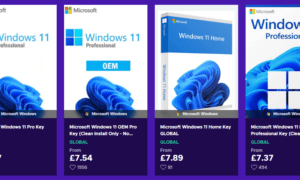
Windows 11 Home covers everything a personal or student laptop does. Windows 11 Pro adds BitLocker drive encryption, Remote Desktop host, Hyper-V, and the ability to join a domain or Azure AD. Windows 11 Education is a Pro-equivalent edition intended for academic use. If you are not encrypting a drive, connecting remotely, or joining a managed network, Home is sufficient.
There is a third option most buyers miss. If you already have Windows 11 Home installed and working, you do not need a full Pro license; an upgrade key unlocks the Pro feature set on the existing installation, keeping your files, applications and settings in place. It is the cheaper path when the hardware is already running.
Retail, OEM, or Volume: The Distinction That Decides Transferability
A Retail license can be moved to a different computer if you replace or rebuild your machine. An OEM license binds permanently to the first device it activates on. A Volume license with MAK and KMS activation is issued under an organisational agreement and is not intended for individual resale. That difference in transferability is most of the reason the prices differ.
The mechanism behind it is worth understanding because it explains the failure mode. When Windows activates, it generates a hardware ID from your machine’s components and registers a digital entitlement against it. Replace the motherboard and the hardware ID changes. A Retail license can be reactivated on the new hardware, usually by signing in with the linked Microsoft account. An OEM license generally cannot be separated because the entitlement was never separable from the original device.
This is also why an unusually cheap key can activate cleanly in September and stop working months later. If a key was issued under a volume agreement and resold outside it, activation may succeed at first and be withdrawn when the underlying agreement is reviewed. The key was never invalid in a technical sense. The authorisation behind it was withdrawn.
Is Buying a Discounted License Key Legitimate?
It depends on where the key came from, and that is a question about sourcing rather than about price. Licenses obtained through authorised distribution and resold in line with the vendor’s terms are ordinarily fine. Licenses pulled out of a volume agreement, a regional programme, or an academic entitlement and sold on generally are not, regardless of what the listing says.
Within the EU and UK, there is a long-established principle that a lawfully sold software license can, under certain conditions, be resold but the conditions matter, and they do not cover every key on every marketplace. Terms also vary by vendor agreement and region. If a specific transaction’s legality matters to you, that is worth checking against the vendor’s current terms rather than a reseller’s summary.
Four checks a buyer can run in under five minutes:
- Look for the license type on the product page: A seller that does not state Retail, OEM or Volume before you pay is the one to be cautious of. The information is not commercially sensitive; omitting it is a choice.
- Check the device count and activation method: “One PC, online activation” and “one PC, phone activation” are different products with different failure modes.
- Find the refund and replacement policy before purchase, not after: Digital keys are commonly non-refundable once delivered, which is defensible. But the policy should be published, not discovered in a support reply.
- Send a pre-sale question. Ask which licence type a specific product is. The speed and specificity of the answer tell you what post-sale support will look like.
What The Price Gap Between Sellers Actually Represents
A license priced well below what it costs to source through authorised channels has to recover that margin somewhere. Usually, it is recovered by not providing anything after the sale: no replacement if the key fails, no reply when activation breaks after a hardware change, and no accountability if the authorisation behind the key is withdrawn.
That does not make every low price illegitimate. Genuine reasons for a discount exist — regional pricing differences, distributor overstock, previous-generation editions being cleared. The distinction is whether the seller can tell you which of those applies.
Disclosure: I work at Msckey, a retailer of digital Microsoft license keys, which is where the operational detail in this piece comes from. Msckey is currently running a Back to School promotion; the licensing principles above apply regardless of where you buy.
FAQ
-
Is Office 2024 cheaper than Microsoft 365?
Over roughly three years, yes, for a single user on a single device. A one-time Office 2024 purchase costs more upfront but stops there, while Microsoft 365 charges annually and stops working when payments stop. Microsoft 365 is usually better value for households needing multiple devices and cloud storage.
-
Can I transfer my Windows licence to a new computer?
It depends on the licence type. A Retail licence can generally be moved to a new machine after deactivating it on the old one, usually by signing in with the linked Microsoft account. An OEM licence is tied to the device it first activated on and is not designed to be transferred, which is why it costs less.
-
Do I need to buy Windows 11 Pro if I already have Home?
No. An upgrade license unlocks the Pro feature set on an existing Windows 11 Home installation without a reinstall, keeping files, applications and settings in place. A full Pro licence is only necessary for a fresh installation or a machine with no existing Windows licence.
-
Why did my cheap Windows key stop working after a few months?
Most often because the authorisation behind the key was withdrawn rather than because the key was faulty. Keys resold outside the agreement under which they were issued can activate successfully and later be deactivated. A hardware change, such as replacing a motherboard, can also break activation on a non-transferable licence.
-
Is it legal to buy a discounted Microsoft license key?
Generally yes, when the key was obtained through authorised distribution and is resold in line with the vendor’s terms. Keys extracted from volume, academic, or regional programmes and resold outside them are a different matter. Terms vary by region and vendor agreement, so verify specifics against current vendor documentation.