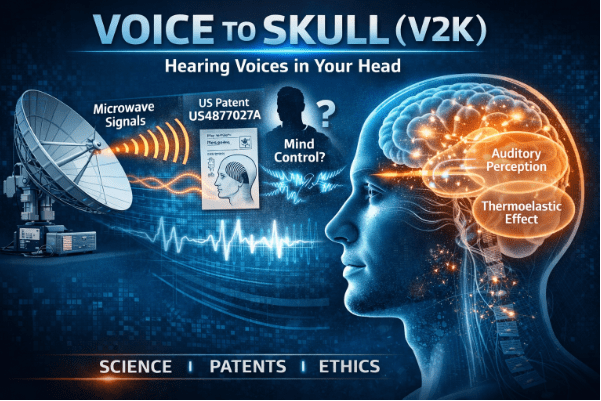
Examining Patents, Science, Remote Neural Monitoring, and Ethical Boundaries
The concept known as voice to skull (V2K) has circulated for decades in online discussions, military speculation, and controversial narratives. However, beyond sensational claims, there are documented patents and scientific experiments that describe how electromagnetic radiation can interact with human auditory perception.
This leads to an important question:
Can hearing voices be made with technology?
To examine voice to skull (V2K) responsibly, we must clearly separate:
- established scientific phenomena
- patented theoretical mechanisms
- speculative interpretations
- ethical and mental health implications
Only by distinguishing these categories can we evaluate what is scientifically documented and what remains unproven.
What Is Voice to Skull (V2K)?
The term voice to skull is not a formal scientific category. It is a popular label for technologies allegedly capable of transmitting sound directly into a person’s head without speakers.
Scientifically, the closest documented mechanism is the microwave auditory effect (also known as the Frey effect), discovered in 1961. It demonstrates that pulsed microwave radiation can induce auditory sensations in humans.
One of the most cited patents related to this phenomenon is:
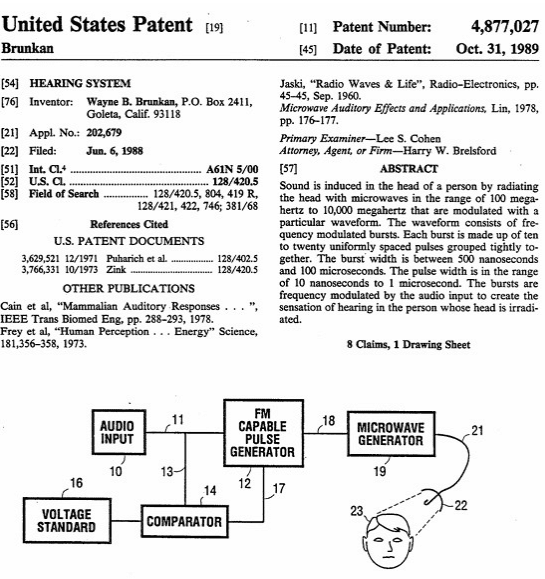
US4877027A – Hearing System (1989)
Inventor: Philip C. Stocklin
Year: 1989
This patent describes a method of using pulsed electromagnetic radiation directed at the head to produce perceived sound through thermoelastic expansion within brain tissue.
Important clarification:
This patent demonstrates a mechanism for induced sound perception — not mind control, not thought insertion, and not verified large-scale deployment.
Hearing Voices in Your Head – Could It Be Technology?
The phrase “hearing voices in your head” is commonly associated with psychiatric conditions such as schizophrenia or severe mood disorders.
There is no scientific evidence that electromagnetic patents like US4877027A are responsible for psychiatric auditory hallucinations.
Medical reality:
- Auditory hallucinations originate from abnormal neural activation patterns.
- They are internally generated cognitive phenomena.
Technological reality:
- The microwave auditory effect requires specific pulsed energy exposure.
- It produces simple sounds (clicks, buzzing, tones), not structured conversational speech under normal experimental conditions.
The leap from laboratory auditory effects to structured remote communication remains scientifically unproven in open literature.
Voice to Skull vs. Hearing Voices in Your Head
The keyword phrase “hearing voices in your head” is most commonly associated with psychiatric conditions.
As the author of this article, I, Marcin Scholke (Marin Szolke), want to state clearly:
- I do not question the importance or necessity of psychiatry.
- I do not claim that psychiatric symptoms are technological in origin.
- My intention is to raise awareness about technological possibilities and the importance of responsible development and use.
- Auditory hallucinations are clinically documented phenomena caused by internal neural processes.
There is no verified scientific evidence that voice to skull technology is responsible for psychiatric auditory hallucinations.
At the same time, the existence of patents related to electromagnetic auditory effects demonstrates that technology can influence sensory perception under certain conditions.
Awareness and denial are two extremes. Responsible inquiry sits in the middle.
Remote Neural Monitoring (RNM): Science or Speculation?
Remote Neural Monitoring (RNM) is a term often used online to describe alleged technologies capable of reading or decoding brain activity at a distance.
Current scientific reality:
- Brain activity monitoring requires physical sensors (EEG, implants).
- Non-invasive decoding of detailed thoughts remotely is not publicly verified.
- Signal degradation and electromagnetic interference present major barriers.
Patent Comparison Table
| Patent | Title | Inventor | Year | Core Focus |
| US4877027A | Hearing System | Philip C. Stocklin | 1989 | Microwave pulses inducing auditory perception |
| US4858612A | Hearing Device | Joseph C. Sharp | 1989 | RF auditory transmission concepts |
| US3951134A | Apparatus for Monitoring and Altering Brain Waves | Robert G. Malech | 1976 | Remote detection and modification of brain waves |
| US6011991A | Communication System Including Brain Wave Analysis | Hendricus G. Loos | 2000 | Brain wave-based communication system |
|
US6587729B2 |
Apparatus for Audibly Communicating Speech Using RF Hearing Effect |
James C. Lin |
2003 |
RF-based speech perception via auditory effect |
Important reminder:
A patent demonstrates that an inventor claimed a mechanism novel enough for registration. It does not confirm successful deployment, scalability, safety, or classified implementation.
Technical Feasibility vs. Narrative Expansion
The existence of a patent serves as evidence that a particular technology has been formally described as physically and technically possible under established principles of physics and engineering. A patent is not speculation – it is a technical document presenting a coherent and feasible mechanism.
Patents related to the microwave auditory effect and electromagnetic interaction systems demonstrate that:
- it is possible to induce auditory perceptions using pulsed microwave radiation (the microwave auditory effect),
- it is possible to design communication systems based on brainwave analysis,
- it is possible to technically model interactions between electromagnetic fields and neural tissue.
For example, patent US4877027A describes a specific mechanism for generating auditory sensations through controlled electromagnetic pulse emission. This demonstrates that the phenomenon is not hypothetical – it has been described in technical terms and recognized as sufficiently coherent to warrant patent protection.
At the same time, it is important to distinguish between three levels:
- Physical possibility – confirmed through the mechanism’s description and consistency with physics.
- Engineering feasibility – requiring precise control of energy, timing, and environmental conditions.
- Operational scale – dependent on technological maturity, safety, and regulatory constraints.
From a physics standpoint:
- electromagnetic fields attenuate with distance,
- precise neural targeting requires careful control of energy parameters,
- interference and biological variability present engineering challenges — but do not negate the principle.
Modern brain-computer interfaces show that the nervous system can be technically monitored and modulated. The development of neurotechnology confirms that interaction between electronic systems and the brain is not abstract —-it is a real and actively explored area of research and engineering.
Therefore:
Patents constitute evidence that specific mechanisms for electromagnetic influence on perception have been technically formulated and recognized as feasible.
This does not automatically imply widespread deployment, but it demonstrates that the technology exists within the boundaries of physics and engineering – and is not mere fantasy.
In this sense, voice to skull is not merely an internet narrative. It refers to real, documented phenomena and technical solutions whose scope and application depend on technological development and ethical oversight.
Expanded Ethical Section: Neurotechnology and Human Autonomy
Emerging neurotechnologies – from cochlear implants to deep brain stimulation — already demonstrate that we can interact with the nervous system in sophisticated ways.
This raises critical ethical questions:
- Consent -Any interaction with neural processes must be voluntary.
- Transparency – Military or intelligence research involving neurotechnology must be subject to oversight.
- Psychological harm – Even the belief that one is being targeted can produce distress.
- Weaponization risks – Technologies influencing perception blur lines between communication and coercion.
The broader issue is not whether V2K is operational – but whether society is prepared for increasingly advanced brain-interface systems.
As AI integrates with neurotechnology, ethical frameworks must evolve accordingly.
Einstein’s warning about technology exceeding humanity resonates here: technological capability without moral clarity creates instability – whether real or perceived.
Final Position: Awareness Without Paranoia
Voice to skull (V2K), hearing voices in your head, and remote neural monitoring are topics often surrounded by misinformation.
Based on documented patents and scientific literature:
✔ The microwave auditory effect is real.
✔ Patents such as US4877027A describe mechanisms for induced sound perception.
✔ Brainwave monitoring exists — but requires physical sensors.
✖There is no verified public evidence of widespread covert V2K deployment.
✖There is no evidence linking psychiatric hallucinations to RF patents.
My position as Marcin Scholke (Marin Szolke) is simple:
We should not dismiss psychiatry.
We should not promote paranoia.
But we also should not ignore the growing capabilities of neurotechnology and electromagnetic systems.
Technological awareness is not denial of medicine.
It is preparation for ethical responsibility.
“It has become appallingly obvious that our technology has exceeded our humanity.”
– Albert Einstein (attributed)
Author: Marcin Scholke (Marcin Szolke)
References:
- Allan H. Frey, -“Auditory System Response to Radio Frequency Energy,” 1961
- US4877027A – Hearing System Paten (Hearing Voices)
- US4858612A – Hearing Device Patent
- US3951134A – Monitoring and Altering Brain Waves
- US6587729B2 – RF-Based Speech Perception