
What Happens in a Ceremonial Ketamine Session

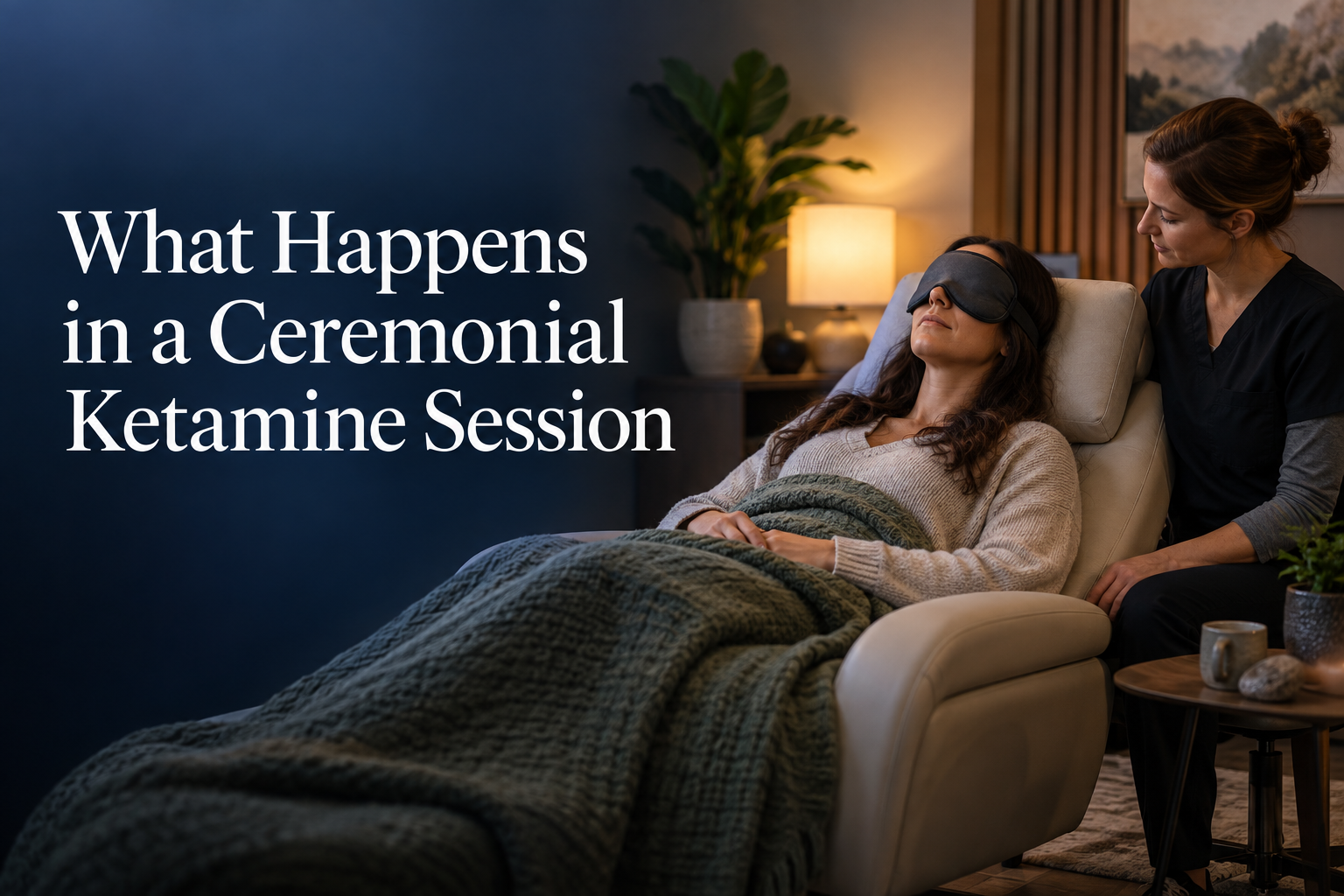
The word ceremonial describes how the session is held rather than what is administered. The substance is the same one used in clinical infusion settings. What differs is the environment: intention setting beforehand, music, low light, eye coverings, an unhurried pace, and a facilitator present throughout rather than a clinical room with a timer.
The reasoning behind that approach is that set and setting influence the experience substantially, which is well supported. The reasoning does not remove the medical requirements, and a session held ceremonially still needs the clinical layer underneath it.
Here is the full sequence.
Screening
Nothing should happen before a thorough assessment, and this is the part a prospective participant should scrutinize most closely.
It should cover psychiatric history and current diagnoses, previous treatment and what resulted, medical history with particular attention to cardiovascular conditions and blood pressure, current medications including anything that interacts, substance use history, family psychiatric history, and pregnancy status.
Ketamine raises blood pressure and heart rate and produces dissociation. Certain conditions make it inappropriate, including uncontrolled hypertension, significant cardiovascular disease, a history of psychosis, active mania, pregnancy, and some substance use histories.
A program that does not screen thoroughly, or that has no licensed prescriber involved in the decision, is not one to proceed with regardless of how the sessions are framed. Legitimate ceremonial ketamine work has a prescriber and a medical screening behind it.
Preparation
Good programs include at least one preparation session before any dosing.
This typically covers what the experience is likely to involve, what to do if it becomes difficult, what you are hoping to address, and practical logistics. Intention setting is common, meaning identifying what you are bringing to the session without scripting an outcome.
Practical instructions usually include fasting for several hours beforehand, arranging transportation since you cannot drive afterward, wearing comfortable clothing, and clearing the remainder of the day. Within Center covers all of this before a first session rather than on the day.
The session
Arrival and baseline. Vital signs are taken. Blood pressure is checked before dosing and monitored during. You settle into a reclining chair or a mat.
Setting. Low lighting, a curated music playlist, an eye mask, blankets. A facilitator remains present throughout. Some programs involve two people, one clinical and one supporting.
Dosing. Route varies. Intramuscular injection and sublingual lozenges are both common in ceremonial settings, and intravenous infusion allows the most precise control. Dose depends on body weight, route, prior experience, and clinical judgment.
Onset. Within minutes for intramuscular administration, somewhat longer for sublingual. Early effects include a sense of heaviness, altered perception of the body, and changes in the sense of time.
The peak. Typically twenty to forty minutes, depending on route and dose. Experiences vary widely and commonly include dissociation, a sense of distance from ordinary identity, vivid visual imagery, emotional release, and a feeling of perspective on things that have felt fixed.
It can also be uncomfortable. Anxiety, nausea, confusion, and distressing imagery occur. This is one of several reasons someone should be present rather than a reason to avoid the treatment.
Return. Effects fade over the following thirty to sixty minutes. Most people are oriented and able to converse within about an hour of the peak, often feeling tired and reflective.
Before leaving. Vitals are checked again, there is usually a short conversation about what came up, and someone else takes you home. No driving, and no important decisions that day.
Integration
This is where the work actually happens, and it is what separates a treatment program from an experience.
Ketamine can produce a temporary state in which established patterns feel less fixed and perspective shifts are available. That state is transient. Whether anything durable comes from it depends on what is done afterward.
Integration sessions typically occur within days and involve making sense of what surfaced, connecting it to current difficulties, and identifying concrete changes. This is ordinary psychotherapy applied to fresh material, and its importance is easy to underestimate when the session itself was so much more dramatic.
Programs that dose without integration are providing an experience. The evidence supports the combination.
Course of treatment
A single session rarely produces lasting change. Protocols commonly involve a series over several weeks, with maintenance sessions afterward at decreasing frequency depending on response.
Response is assessed along the way, and it is reasonable to ask at the outset how progress will be measured and what happens if it is not working.
Side effects
During: elevated blood pressure and heart rate, nausea, dizziness, disorientation, anxiety.
After: fatigue, mild residual dissociation, headache, occasional emotional rawness for a day or two.
With frequent heavy use over long periods: bladder and urinary tract problems are documented. This is associated with heavy recreational patterns rather than supervised therapeutic protocols, and it is a reason supervised dosing schedules exist.
Abuse potential. Ketamine is a controlled substance with real potential for misuse, which is among the reasons take home models without monitoring have drawn regulatory concern.
Questions to ask before booking
- Who is the prescriber, and what are their credentials?
- What does screening involve, and what would rule me out?
- Are vital signs monitored during the session?
- Who is present throughout?
- What preparation and integration are included?
- How many sessions are anticipated, and what does it cost in total?
- What happens if I have a difficult experience?
- Do you coordinate with my existing therapist or psychiatrist?
- How do you assess whether it is working?
Vague answers to any of these are informative.
What it is not
Not a first line treatment for depression or anxiety. Established treatments should generally be tried adequately first.
Not a substitute for ongoing psychotherapy.
Not appropriate during acute crisis, which requires immediate care.
Not a guaranteed outcome. Some people respond substantially, others partially, and some not at all.
Within Center provides ceremonial ketamine sessions within a clinical structure including screening, prescriber involvement, monitoring, and integration.
The ceremonial framing is about how the session is held. The screening, the monitoring, and the work afterward are what determine whether it helps.
If you or someone you know is struggling or in crisis, call or text 988 to reach the Suicide and Crisis Lifeline, available 24/7.






Comment