An AI prototype can look convincing long before a customer team can use it safely. That gap is where an AI FDE has to do real work. The role sits close to product, implementation, and the people who own the day-to-day process. A model response is only one part of the job. Someone still has to ask what the customer is trying to change, what data is available, who will review the result, and what happens when the answer is wrong.
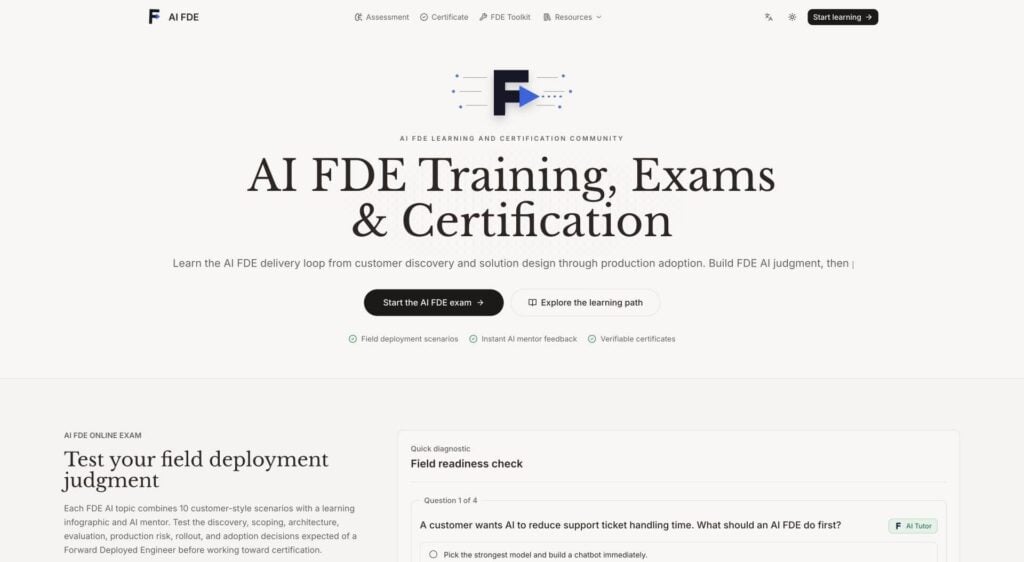
The public AI FDE learning and assessment pages are structured around delivery work rather than a catalogue of model names. They cover discovery, scoping, architecture, prototype work, evaluation, production, rollout, and lessons that can be reused later. That sequence matches the uncomfortable middle of applied AI work, where a pilot either becomes part of a working process or quietly disappears.
Start with the work, not the model
The homepage frames the learning path as a delivery loop. That is a sensible starting point. A field engineer can begin with a model only after the team has made a few earlier decisions: which workflow matters, whose work will change, where the boundary cases live, and what a useful result looks like.
Consider a support team that wants help sorting incoming cases. A fast prototype can label a sample queue and produce tidy summaries. The harder questions arrive next. Does the system need to recommend a reply, route a case, or simply surface missing information? Can it use the ticket history? Who sees sensitive customer details? What should the team do when the confidence is low? Those choices alter the evaluation plan and the deployment design.
This is why a good training path should make room for scoping and handoff work. It should ask learners to explain trade-offs rather than simply produce a working prompt. The public AI FDE materials keep returning to that delivery rhythm. The wording is direct: move from the field problem through a prototype, test the output, then turn a successful approach into something a team can run and improve.
There is also a communication skill hiding inside that sequence. A customer may ask for “an AI agent” when what they need is a smaller, more reliable change to a familiar process. The engineer has to turn a broad request into a decision the team can inspect. A useful scoping note names the input, the expected output, the person who checks it, and the point at which the system should hand the work back. It is less exciting than a demo, but it makes later conversations much easier.
Training should give learners repeated chances to write those notes. They can compare two possible scopes, explain why one has a cleaner evaluation path, and identify what evidence would make them change their mind. That is a habit worth building. It helps a team avoid building a large interface around a question that has not been settled.
There is a limit worth keeping in view. A course can provide practice, vocabulary, and a shared way to talk about decisions. It cannot reproduce the pressure of a customer escalation or the responsibility of owning a production workflow. Learners still need supervised work and feedback from people who know the domain.
Use scenarios to test judgment
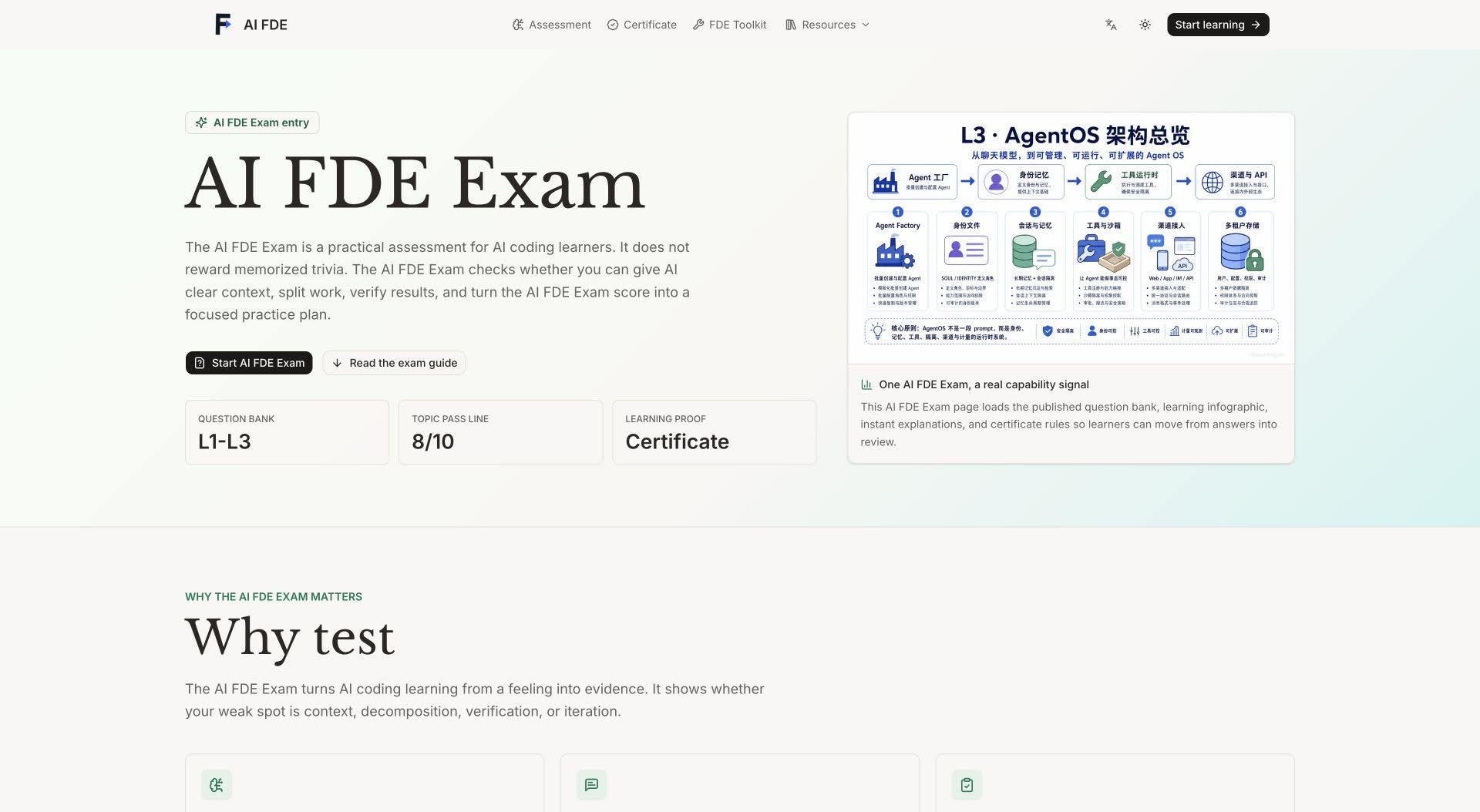
The public exam page shows L1, L2, and L3 scenario assessments, with an 8/10 topic pass line. It also describes an AI mentor that can explain the reasoning behind an answer. That is more useful than a trivia-first format for this subject. A fde engineer often has to choose a next step while the available facts are incomplete.
Scenario questions can expose the difference between knowing a term and using it. In the support example, a learner might have to decide whether to test a classifier on historical cases, how to handle uncertain results, or when to keep a human reviewer in the loop. None of those questions has a magical answer. The quality comes from making assumptions visible and showing how the choice will be checked.
The level structure also gives a learner a way to separate basic understanding from operating-model work. The public page positions the later material around architecture, evaluation, adoption, and reusable practice. That is a better progression than treating every AI project as a prompt-writing exercise. A prototype can be useful, but a prototype with no evaluation plan has not earned trust yet.
The AI mentor is a useful addition if it explains why an answer fits the scenario. It should be treated as a study aid, though. A learner still needs to question the explanation, compare it with the case details, and recognise that a real customer environment may add constraints the question did not include.
One practical way to use this material is to pause before reading the explanation. Write down the decision, the evidence that would support it, and the consequence of being wrong. Then compare that note with the mentor’s explanation. The difference is often more useful than the score. It shows whether the learner missed a constraint, chose an evaluation method that cannot answer the question, or made an assumption without stating it.
That kind of review also teaches a healthy response to model output. An AI mentor can present a tidy explanation, but tidy language is not proof. The learner has to connect the answer back to a workflow and a test. The same discipline carries into customer work, where a plausible prototype can still fail the moment an unusual case enters the queue.
Make completion easy to verify
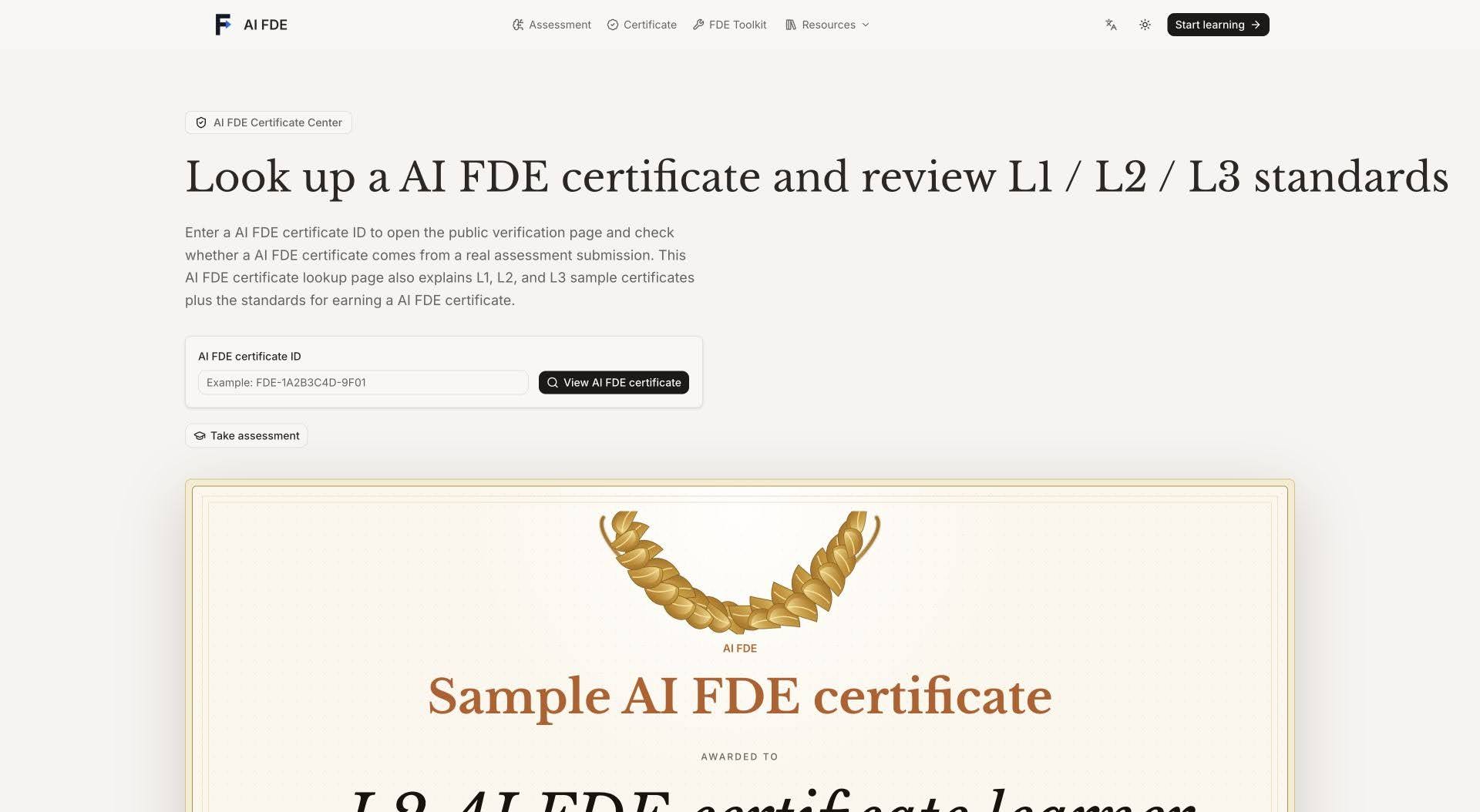
The certificate page adds a public certificate-ID lookup, published L1, L2, and L3 standards, and a sample credential. That is practical for a learning programme. It gives a hiring manager, team lead, or learner a way to check that a record exists without relying on a screenshot of a badge.
Verification does not prove that someone will succeed in every deployment. It does something narrower: it confirms a record and shows the level framework behind it. That distinction matters. The site describes its credential as an independent community credential, rather than an official certification from an AI lab or employer. The boundary is clear on the public pages and should remain clear when the credential is shared.
For people moving into applied AI delivery, the strongest evidence will usually combine several things: scenario work, project outcomes, references from the teams involved, and a record that another person can verify. AI FDE covers the scenario and verification parts of that picture. The rest still comes from the work itself.
That is a reasonable place to set expectations. A learner can use the programme to practise how delivery choices fit together and to earn a record that others can look up. A team evaluating a candidate should still ask for examples of problem framing, evaluation, and communication with the people affected by the change. The combination is more informative than any single score or credential.