In today’s rapidly evolving technological landscape, Nordic companies face mounting pressure to deliver innovative electronic products faster, more cost-effectively, and with exceptional quality. Whether you’re developing advanced industrial automation systems in Sweden, breakthrough medical devices in Denmark, or cutting-edge IoT solutions in Norway, the question inevitably arises: should we manufacture in-house, or partner with a specialized provider? For CEOs and business leaders across Scandinavia, understanding what EMS companies do and how they can transform your product development strategy has never been more critical.
Electronic Manufacturing Services providers have evolved far beyond simple assembly houses. Today’s leading EMS companies serve as strategic partners that can accelerate time-to-market, reduce capital expenditure, mitigate supply chain risks, and enable companies to focus on their core competencies of innovation and market development. For Scandinavian businesses seeking reliable, nearby manufacturing alternatives to Asia, the emergence of sophisticated EMS capabilities in Central Europe, particularly in Poland, presents compelling opportunities that align perfectly with Nordic values of quality, transparency, and long-term partnership.
This comprehensive guide explores what modern EMS companies actually do, the critical services they provide, and why an increasing number of Nordic CEOs are choosing nearshoring partnerships with providers like TSTRONIC for their electronic assembly needs. Whether you’re exploring SMT assembly for the first time or seeking to optimize your existing manufacturing strategy, understanding the full scope of EMS capabilities will empower you to make informed decisions that drive competitive advantage.
Understanding Electronic Manufacturing Services: The Strategic Foundation
At its core, an Electronic Manufacturing Services provider is a specialized company that designs, manufactures, tests, and delivers electronic components and assemblies for original equipment manufacturers. Rather than building and maintaining expensive in-house production facilities, companies outsource the complex, capital-intensive aspects of electronics production to EMS partners who possess dedicated expertise, advanced equipment, and optimized processes.
The EMS model emerged in the 1980s as electronics became increasingly complex and manufacturing technologies more sophisticated. Today, the global EMS market has grown into a massive industry valued at over 647 billion dollars in 2026, with European operations experiencing particularly robust growth driven by nearshoring trends. For Nordic companies, this growth represents not just market expansion but a fundamental shift in how electronic products are brought to market.
Modern EMS companies handle the entire production lifecycle, from initial design support and prototyping through full-scale manufacturing, testing, and logistics. This comprehensive approach allows original equipment manufacturers to leverage world-class manufacturing capabilities without the substantial capital investment required to build equivalent facilities. For a CEO evaluating strategic options, the EMS partnership model offers flexibility, scalability, and access to specialized expertise that would be prohibitively expensive to develop internally.
The value proposition extends beyond cost savings. Leading EMS providers bring decades of accumulated manufacturing knowledge, established relationships with component suppliers, proven quality management systems, and the ability to rapidly scale production up or down based on market demand. They invest continuously in cutting-edge equipment and process improvements, ensuring clients benefit from the latest manufacturing technologies without bearing the full investment burden. This is particularly relevant for Scandinavian companies operating in high-mix, medium-volume environments where flexibility and quality are paramount.
Core EMS Capabilities: From Concept to Delivery
When evaluating what EMS companies do, it’s essential to understand the breadth of services that distinguish sophisticated providers from simple contract assemblers. A comprehensive EMS partner offers capabilities across the entire product lifecycle, each critical to successful electronic product realization.
Design for Manufacturing Support and Engineering Services
The journey begins long before the first component is placed on a circuit board. Leading EMS providers offer extensive design-for-manufacturing support, collaborating with your engineering teams to optimize product designs for efficient, high-quality production. This involves analyzing PCB layouts to identify potential assembly challenges, recommending component selections that balance performance, availability, and cost, and suggesting design modifications that can significantly improve manufacturability and reliability.
For Nordic companies developing innovative products, this early-stage collaboration proves invaluable. An experienced EMS partner can identify issues that might only become apparent during volume production, such as costly problems like components too close together for automated placement, thermal management concerns, or testability limitations. By addressing these issues during design, companies avoid expensive redesigns and accelerate time-to-market. When partnering with providers offering electronic assembly services in Poland, this design support comes with a deep understanding of European component markets and regulatory requirements, ensuring smooth product launches across the Nordic and broader European markets.
Prototype Development and New Product Introduction
Once designs are optimized, the New Product Introduction phase bridges the gap between concept and production. NPI represents one of the most critical services EMS companies provide, yet it’s often underestimated by those new to outsourced manufacturing. This phase involves building initial prototype quantities, validating manufacturing processes, developing test procedures, and progressively scaling toward volume production.
A robust NPI process includes creating detailed manufacturing documentation, programming automated assembly equipment, designing custom test fixtures, and conducting pilot production runs to identify and resolve any remaining issues. For complex electronic assemblies, this iterative process might involve multiple build cycles, each refining processes and validating quality. The investment in thorough NPI pays enormous dividends by ensuring that when full production begins, processes are stable, quality is predictable, and yields are optimized.
Scandinavian companies benefit particularly from working with EMS providers who view NPI as a partnership rather than a transaction. The geographic proximity of Central European manufacturing hubs to Nordic markets facilitates frequent communication, site visits during critical development phases, and rapid iteration cycles that simply aren’t possible when working with distant Asian suppliers. This collaborative approach aligns well with Nordic business culture, where transparency and mutual trust form the foundation of successful long-term relationships.
SMT Assembly and Advanced PCB Population
Surface Mount Technology assembly represents the technological heart of modern electronics manufacturing. SMT assembly involves placing tiny electronic components directly onto circuit board surfaces using sophisticated automated equipment, enabling the high component densities and compact designs that characterize contemporary electronics. When people discuss electronic assembly, they typically mean this highly automated, precision-driven process.
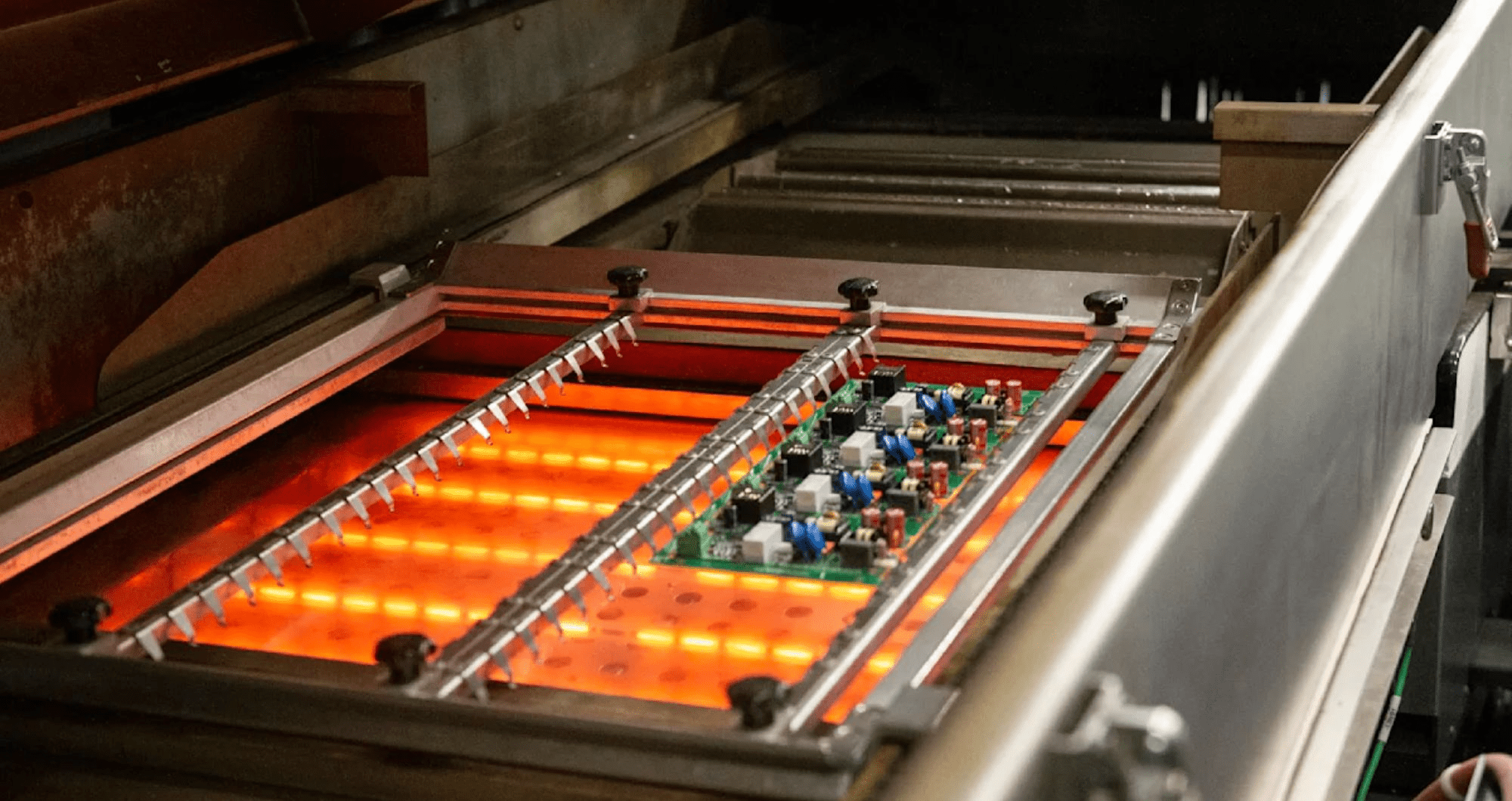
Modern SMT and THT assembly lines represent substantial capital investments, typically millions of euros for a fully equipped production line. These lines integrate multiple technologies: high-speed pick-and-place machines that position components with micrometre accuracy at rates exceeding 100,000 components per hour, automated solder paste printers that apply precise solder deposits to board pads, sophisticated reflow ovens with precisely controlled thermal profiles, and automated optical inspection systems that verify every placement.
For Nordic manufacturers, accessing this level of technology through an EMS partnership eliminates the need for enormous capital expenditure while ensuring products benefit from the latest manufacturing capabilities. Leading providers operate multiple SMT lines with varying capabilities, enabling them to handle everything from complex prototypes to high-volume production efficiently. They maintain expertise in advanced packaging technologies such as ball grid arrays, chip-scale packages, and fine-pitch components, which require specialized handling and process control.
The quality and reliability of SMT assembly directly impact the final product’s performance. Microscopic solder joint defects can lead to intermittent failures that are extraordinarily difficult to diagnose. This is why sophisticated EMS providers implement multiple inspection and verification steps throughout the SMT process to catch potential issues before they become embedded in finished products. This rigorous approach to quality control ensures that Nordic companies receive assemblies meeting the exacting standards their markets demand.
Through-Hole Assembly and Mixed Technology Boards
While SMT dominates modern electronics, Through-Hole Technology assembly remains essential for components requiring robust mechanical connections or high current-carrying capacity. THT involves inserting component leads through holes drilled in circuit boards and soldering them on the opposite side, creating powerful mechanical and electrical bonds.
Many industrial, automotive, and power electronics applications still rely on through-hole components for connectors, transformers, high-power semiconductors, and other parts subject to mechanical stress or thermal cycling. A capable EMS provider offers comprehensive THT capabilities, including wave soldering for efficient batch processing and selective soldering for boards that combine SMT and THT components without damaging surface-mount parts.
The ability to seamlessly integrate both SMT and THT assembly on mixed-technology boards distinguishes sophisticated EMS providers from basic assemblers. This capability is particularly relevant for Nordic industrial and automotive applications, where products must withstand harsh operating environments while maintaining long-term reliability. When evaluating EMS partners, ensure they have both the technologies and the expertise to optimize mixed-technology assembly processes for quality and efficiency.
Comprehensive Testing and Quality Assurance
Manufacturing electronic assemblies is only half the equation; verifying they function correctly is equally critical. Comprehensive EMS providers offer extensive testing capabilities that go far beyond visual inspection, implementing multiple verification stages to ensure every assembly meets specifications before shipment.
In-circuit testing uses sophisticated fixtures with hundreds or thousands of test probes to verify electrical connectivity, component values, and basic circuit functionality. Functional testing goes further, powering up assemblies and running them through operational sequences that mimic real-world usage. For complex products, this might involve custom test software, specialized test equipment, and environmental stress testing in climate chambers to validate performance across temperature and humidity ranges.
Advanced providers also implement automated optical inspection using high-resolution cameras and artificial intelligence to detect solder joint defects, missing components, incorrect parts, and assembly anomalies that human inspectors might miss. X-ray inspection reveals hidden issues in elements such as ball grid arrays, where solder joints are concealed beneath the package. This multi-layered approach to quality assurance ensures exceptionally low defect rates, typically measured in parts per million rather than percentages.
For Scandinavian companies whose reputations depend on product reliability, partnering with an EMS provider that prioritizes comprehensive testing is non-negotiable. When requesting a PCB assembly quotation, explicitly discuss testing requirements and capabilities. The incremental cost of thorough testing is invariably lower than the cost of field failures, warranty claims, and damaged brand reputation.
Box Build, System Integration, and Final Assembly
Many EMS providers extend their services beyond populated circuit boards to complete box build and system integration. This involves installing PCB assemblies into enclosures, connecting cables and harnesses, integrating mechanical components, loading firmware, performing final system testing, and preparing products for shipment.
Box build services transform circuit boards into finished products, eliminating the need for clients to manage multiple suppliers and integration steps. For Nordic companies, this turnkey approach offers substantial advantages: simplified supply chain management, single-point accountability for quality, reduced logistics complexity, and faster time-to-market. Rather than coordinating with a PCB assembler, an enclosure supplier, a cable manufacturer, and a final assembly house, you work with a single integrated partner who manages the entire process.
The sophistication of box build capabilities varies significantly among EMS providers. Leading companies offer climate-controlled clean rooms for sensitive products, automated testing and configuration systems, custom packaging design, and direct-to-customer fulfillment services. For medical devices, industrial controls, and other products requiring system-level validation, these capabilities prove essential.
Supply Chain Management: A Hidden Yet Critical EMS Function
One of the most valuable yet often overlooked services EMS companies provide is comprehensive supply chain management. In today’s volatile component markets, effective supply chain management can mean the difference between on-time product launches and frustrating delays.
Professional EMS providers maintain established relationships with component distributors and manufacturers, giving them access to allocation and priority that smaller buyers cannot achieve independently. They leverage purchasing power across multiple clients to negotiate favourable pricing and secure components during shortages. They also provide material planning expertise, advising clients on long-lead components, obsolescence issues, and cost-optimization opportunities.
For Scandinavian companies, working with a European-based EMS provider offers additional advantages. Central European suppliers have direct access to European component distribution networks, avoiding the complexities of transcontinental logistics. They understand European regulatory requirements like RoHS and REACH, ensuring compliance without extensive client involvement. They also share compatible time zones and business practices, facilitating smooth communication when supply chain issues require immediate attention.
The component shortage challenges of recent years have elevated supply chain management from a background function to a strategic differentiator. When evaluating EMS partners, inquire deeply about their supply chain capabilities, supplier relationships, inventory management systems, and approach to managing component obsolescence. A provider with sophisticated supply chain management can navigate disruptions that would paralyze less-capable partners, thereby protecting your production schedules and market commitments.
Quality Management Systems and Certifications
Quality management represents the foundation upon which all EMS services rest. Leading providers implement comprehensive quality management systems certified to international standards such as ISO 9001, and many hold additional industry-specific certifications for automotive, medical, or aerospace applications.
These quality systems encompass every aspect of operations: incoming material inspection to verify component authenticity and quality; process control procedures ensuring consistent assembly; statistical process control monitoring for early problem detection; corrective action systems addressing the root causes of defects; and continuous improvement programs driving ongoing enhancement.
For Nordic customers, quality certifications assure that EMS partners operate in accordance with globally recognized standards. However, certifications alone don’t guarantee quality—implementation matters more than certificates on the wall. When evaluating providers, look for evidence of quality culture: transparent communication about quality metrics, willingness to share defect data, proactive problem-solving, and continuous investment in quality improvement.
The best EMS providers view quality not as a cost center but as a competitive advantage. They understand that consistently delivering defect-free products builds trust, reduces total cost of ownership, and enables long-term partnerships. This philosophy aligns perfectly with Scandinavian business values, where quality and reliability trump short-term cost savings.
Why Scandinavian Companies Are Choosing Nearshoring to Poland
The question of where to manufacture electronic products has evolved dramatically over the past decade. While Asian manufacturing dominated for years because of labour cost advantages, the calculus has shifted. Supply chain disruptions, rising transportation costs, geopolitical uncertainties, and the need for responsive, flexible manufacturing have prompted Nordic companies to reconsider their strategies.
Poland has emerged as Europe’s leading nearshoring destination for electronics manufacturing, offering a compelling combination of advantages that resonate strongly with Scandinavian requirements. The country provides a skilled technical workforce with strong engineering education, modern manufacturing infrastructure comparable to that of Western Europe, and competitive costs approximately 40-50% lower than Scandinavian labour rates, while maintaining European quality standards.
Geographic proximity delivers tangible benefits that distant manufacturing simply cannot match. Road freight from Poland to Scandinavia takes days rather than the weeks required for sea shipment from Asia. The Baltic Sea provides direct maritime connections between Polish ports such as Gdańsk and major Scandinavian destinations, facilitating efficient logistics for large shipments. Compatible time zones enable real-time communication and rapid problem resolution, while similar business cultures ease collaboration.
For Nordic CEOs, nearshoring to Poland offers strategic advantages beyond cost and logistics. Manufacturing within the European Union ensures regulatory alignment, intellectual property protection under European law, and simplified customs procedures. It also supports sustainability objectives by reducing transportation distances and associated carbon emissions. Perhaps most importantly, geographic proximity enables the kind of close collaboration that drives innovation—site visits during development phases, face-to-face problem solving, and the trust that comes from regular personal interaction.
Poland’s electronics manufacturing sector has matured significantly, now hosting numerous sophisticated EMS providers with world-class capabilities. The country’s investment in infrastructure, technical education, and manufacturing technology has created an ecosystem capable of supporting the most demanding applications. For Scandinavian companies in automotive, medical devices, industrial automation, and telecommunications, Polish EMS providers offer capabilities that rival or exceed those available elsewhere, combined with service levels and responsiveness that distant suppliers cannot match.
Selecting the Right EMS Partner: Key Considerations for Nordic CEOs
Choosing an EMS partner represents a strategic decision with long-term implications for product quality, time-to-market, and competitive position. For Scandinavian business leaders evaluating options, several critical factors deserve careful consideration.
Technical Capabilities and Equipment: Ensure potential partners possess the specific technical capabilities your products require. Do they have experience with your component types, packaging technologies, and assembly complexities? Are their equipment and facilities modern and well-maintained? Can they demonstrate process control and quality metrics that meet your standards? Request facility tours and speak with their engineering teams to assess technical depth.
Industry Experience and References: EMS providers often develop expertise in particular industries through accumulated experience. Seek partners with relevant industry background who understand your regulatory requirements, reliability expectations, and market dynamics. Request customer references from similar applications and speak candidly with those references about their experience.
Quality, Culture, and Certifications: Beyond examining certifications, assess whether quality is genuinely embedded in the organization’s culture. How do they handle quality issues when they arise? What continuous improvement initiatives are active? What defect rates do they typically achieve? A provider’s willingness to discuss qualit —problems and solutions transparently reveals more than perfect marketing presentations.
Communication and Responsiveness: Cultural compatibility and communication effectiveness matter enormously in long-term partnerships. During evaluation, assess responsiveness, clarity of communication, and whether you feel heard and understood. Geographic and cultural proximity to Scandinavia provides natural advantages that facilitate smooth collaboration.
Financial Stability and Scale: Your EMS partner’s financial health and operational scale should align with your requirements. They should be substantial enough to provide the capabilities and capacity you need, yet not so large that your business becomes insignificant to them. Financial stability ensures they’ll be there for the long term, investing in capabilities and supporting your growth.
Flexibility and Scalability: Markets and products evolve, requiring manufacturing partners who can adapt. Evaluate whether potential partners can scale with your growth, accommodate design changes, support new product introductions efficiently, and adjust to demand fluctuations without excessive minimum order quantities or inflexible contracts.
For Nordic companies beginning their EMS partner search, consider starting with a pilot project to evaluate capabilities, communication, and cultural fit before committing your entire product portfolio. This de-risks the relationship while providing concrete evidence of performance.
The Future of EMS: Trends Shaping the Industry
Understanding where the EMS industry is heading helps inform long-term strategic decisions. Several key trends are reshaping how electronic manufacturing services operate and the value they provide.
Industry 4.0 and Smart Manufacturing: Leading EMS providers are implementing Industry 4.0 technologies, including IoT-connected production equipment, real-time data analytics, artificial intelligence for quality prediction, and digital twin simulations. These technologies enable unprecedented visibility into production processes, predictive maintenance to minimize downtime, and continuous optimization that drives improvements in quality and efficiency.
Sustainability and the Circular Economy: Environmental responsibility has moved from a nice-to-have to an essential. Progressive EMS providers implement comprehensive sustainability programs, including renewable energy use, waste-reduction initiatives, responsible electronics recycling, and support for circular-economy principles. For Scandinavian companies with firm sustainability commitments, partner environmental performance increasingly influences supplier selection.
Advanced Manufacturing Technologies: The electronics industry continuously evolves with new component packages, materials, and assembly techniques. Leading EMS providers invest in staying at the technology frontier by implementing advanced capabilities such as miniaturized component handling, flexible circuit assembly, additive manufacturing for electronics, and advanced thermal management solutions.
Supply Chain Resilience: Recent disruptions have permanently elevated supply chain resilience as a strategic priority. Modern EMS providers implement sophisticated supply chain risk management, including multi-sourcing strategies, strategic inventory buffers, component lifecycle management, and supply chain visibility systems that provide early warning of potential disruptions.
For Nordic CEOs planning for the next decade, partnering with EMS providers that invest in these future-focused capabilities ensures access to evolving best practices and technologies that drive competitive advantage.
Making the Strategic Decision: Key Takeaways for Scandinavian Business Leaders
Electronic Manufacturing Services companies do far more than simply assemble circuit boards. They serve as strategic partners who can accelerate innovation, reduce risk, optimize costs, and enable companies to focus on core competencies. For Scandinavian business leaders, understanding the full scope of what modern EMS providers offer is essential for making informed strategic decisions.
The nearshoring trend toward Central European manufacturing, particularly in Poland, reflects fundamental shifts in how companies balance cost, quality, responsiveness, and risk. Geographic proximity to Scandinavia, combined with sophisticated manufacturing capabilities, European regulatory alignment, and compatible business cultures, makes Polish EMS providers increasingly attractive alternatives to distant Asian manufacturing.
When evaluating EMS partnerships, look beyond simple price comparisons to assess the total value of technical capabilities, quality systems, communication effectiveness, supply chain management, and strategic alignment. The right partner becomes an extension of your organization, contributing expertise and capabilities that enhance your competitive position.
Whether you’re developing your first electronic product or optimizing an existing manufacturing strategy, taking the time to understand what EMS companies do thoroughly and carefully selecting the right partner will pay dividends throughout your product’s lifecycle. In an increasingly competitive global market, the strength of your manufacturing partnerships can be as strategically significant as the innovation of your products themselves.
For Nordic companies ready to explore how a sophisticated Central European EMS partnership can enhance their competitive position, engaging in detailed discussions with potential partners represents the essential next step. By understanding capabilities, assessing cultural fit, and starting with pilot projects, you can build manufacturing relationships that support your growth and innovation objectives for years to come.