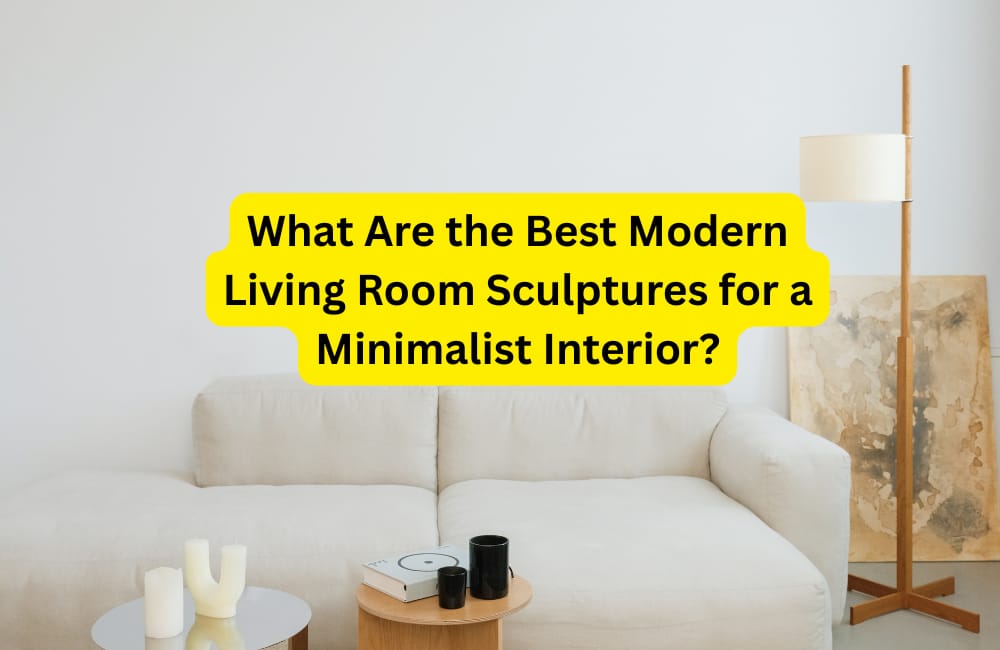
What Are the Best Modern Living Room Sculptures for a Minimalist Interior?
The best modern living room sculptures for a minimalist interior are pieces with clear silhouettes, restrained materials, organic or geometric forms, and enough visual presence to become a focal point without making the room feel crowded. Abstract metal sculptures, sculptural ceramics, natural wood figures, stone forms, and carefully chosen human or organic silhouettes can all work particularly well.
The key is not to add more decoration. It is to choose one sculptural element that earns its space.
Minimalist interiors depend on proportion, negative space, texture, and visual balance. A sculpture can strengthen all four when its scale and material relate naturally to the furniture and architecture around it. The wrong piece, however, can quickly make a restrained room feel cluttered or disconnected.
What makes a sculpture work in a minimalist living room?
Minimalism is often misunderstood as simply using fewer objects. In practice, a minimalist room gives individual objects more visual responsibility because there are fewer competing elements.
That changes how sculpture should be selected.
A successful piece usually has a recognizable overall shape rather than lots of small decorative details. Its silhouette should remain interesting from across the room, while its surface can reward closer viewing.
This is why abstract and contemporary sculpture often works particularly well. A simplified human form, continuous line, geometric volume, or flowing organic shape can create visual interest without introducing the complexity of a heavily ornamented object.
The sculpture also needs breathing room. A contemporary piece placed among several vases, books, framed pictures, and decorative accessories may lose the very quality that made it attractive.
In a minimalist setting, negative space around the sculpture is part of the composition.
The best sculpture styles for minimalist interiors
There is no single “best” sculpture for every minimalist living room. The right choice depends on the room’s architecture, furniture, materials, and the type of atmosphere you want to create.
1. Abstract sculptures
Abstract sculpture is one of the most adaptable choices for a contemporary minimalist interior.
Look for pieces based on:
- Geometric volumes
- Curved or continuous lines
- Interlocking forms
- Simplified human figures
- Asymmetrical compositions
- Open or negative-space structures
Abstract forms are particularly useful when the rest of the room already has strong architectural lines. A curved sculpture can soften a rectangular sofa and coffee table, while a geometric sculpture can reinforce a more structured interior.
The important distinction is between simple form and visually empty form. Minimal does not mean boring. A sculpture should still have enough shape, shadow, or material variation to hold attention.
2. Metal sculptures
Metal is a natural fit for modern interiors because it introduces a crisp, architectural quality.
Black metal works well against pale walls and light furniture. Stainless steel or silver-toned metal can reinforce a cool, contemporary palette, while bronze, brass, or gold finishes can introduce warmth.
Metal is particularly effective when the living room already contains related materials such as glass, steel, chrome, or dark wood.
Best for: contemporary, industrial, monochrome, and minimalist interiors.
Watch out for: highly reflective finishes in rooms with strong direct sunlight. Excessive reflection can make an otherwise calm space visually restless.
3. Organic and flowing sculptures
If your minimalist living room feels too angular, an organic sculpture can provide the missing counterpoint.
Think of:
- Soft curves
- Wave-like forms
- Rounded silhouettes
- Abstract botanical shapes
- Continuous flowing lines
This approach works especially well with Japandi, Scandinavian, warm-minimalist, and natural interiors, where wood, linen, stone, and neutral colors are already present.
The contrast is subtle: the furniture may establish order through straight lines, while the sculpture introduces movement.
4. Wooden sculptures
Wood is one of the easiest materials to use when a minimalist room needs warmth.
Natural wood brings grain, irregularity, and tactile variation into interiors dominated by smooth surfaces. That makes it particularly useful in rooms with white walls, pale upholstery, concrete, or other cool materials.
A vertical wooden sculpture can also add height without requiring a large footprint.
Best for: Scandinavian, Japandi, Wabi-Sabi, warm minimalism, and interiors with natural materials.
5. Sculptural ceramics
Ceramics offer something metal and polished stone often cannot: a combination of form and surface texture.
A matte white ceramic sculpture can almost disappear into a pale minimalist room from one angle and become highly visible from another as light creates shadows across its surface.
Sculptural vessels are especially versatile because they can function somewhere between art and décor. A contemporary ceramic vase with an unusual form can be displayed empty as a sculptural object rather than treated purely as a container.
How large should a living room sculpture be?
Scale is often more important than price or material.
A sculpture that is too small can disappear beside a large sofa or substantial sideboard. A sculpture that is too large can dominate the room and undermine the sense of openness that minimalist design depends on.
Instead of choosing an arbitrary measurement, judge the sculpture in relation to the furniture surrounding it.
For a sideboard or console, a tall, narrow sculpture can create vertical emphasis without consuming much surface area.
For a large empty floor area, a freestanding sculpture can become the room’s principal visual anchor.
For a coffee table, a smaller horizontal or compact sculptural object is generally more appropriate because it must coexist with practical space for everyday use.
For open shelving, several large objects are usually unnecessary. One sculptural piece surrounded by empty shelf space often has greater visual impact than a collection of small ornaments.
A useful test is to photograph the room from the main viewing position. If the sculpture disappears into the furniture, it may be underscaled. If your eye goes immediately to the sculpture and nowhere else, it may be oversized or too visually dominant.
Where should you place a sculpture?
Placement should begin with sightlines and light, not with an empty surface that needs filling.
A sculpture can work particularly well in five locations.
On a minimalist sideboard
This is one of the easiest arrangements. Give the sculpture a defined area rather than surrounding it with multiple decorative objects.
A tall sculpture positioned slightly off-center can create asymmetry while still feeling balanced.
Beside the sofa
A floor sculpture can occupy the vertical space beside a sofa without competing directly with the seating.
This works particularly well with narrow pieces that have a strong silhouette.
In an architectural niche
A niche, alcove, or recessed wall can provide natural framing. Because the architecture already separates the object from the rest of the room, additional decoration is often unnecessary.
Near a window
Natural light can reveal texture and create changing shadows throughout the day. This is particularly effective for carved wood, textured ceramic, stone, and perforated metal.
However, strong direct sunlight can be unsuitable for some finishes and materials, so check the sculpture’s care instructions before placing a valuable piece in prolonged sunlight.
As a freestanding focal point
A substantial sculpture can occupy an otherwise unused area and establish a destination for the eye.
This is where scale matters most. The sculpture should relate to the room’s architecture rather than simply filling floor space.
Should the sculpture match the furniture?
Not exactly.
Trying to make every material and color match can make a minimalist interior look overly coordinated. A better approach is to establish a relationship between the sculpture and the room.
For example:
- A black sculpture can echo black window frames without matching the sofa.
- Natural wood can connect with a wooden floor or coffee table.
- A bronze finish can pick up warm lighting or brass hardware.
- White ceramic can reinforce a pale wall while adding three-dimensional texture.
- A stone sculpture can complement a marble or travertine surface without duplicating it.
Think in terms of echoes rather than copies.
This creates cohesion without making the interior look like a showroom set.
Color: neutral or contrasting?
Minimalist interiors do not require every sculpture to be beige, white, gray, or black.
A neutral sculpture is the safer option when the room already has a strong architectural identity and you want the artwork to integrate quietly.
A contrasting color can be more effective when the room lacks a focal point.
For example, a predominantly neutral room can accommodate a sculpture in deep green, rust, blue, burgundy, or another controlled accent color. The important thing is that the color has somewhere else to relate to—perhaps a cushion, artwork, rug, or small decorative detail.
One strong color relationship is usually more convincing than several unrelated accent colors.
What materials work best?
The material should support the mood of the room as well as the sculpture’s form.
Metal provides a crisp, architectural, contemporary character and suits modern, industrial, monochrome interiors.
Wood brings warmth, tactile variation, and a natural quality that works especially well with Japandi, Scandinavian, Wabi-Sabi, and warm minimalist spaces.
Ceramic introduces subtle texture and soft visual character, making it useful for minimalist, Nordic, and organic interiors.
Stone provides weight and permanence, which can complement luxury minimalist and natural interiors.
Glass offers transparency and visual lightness, making it useful when you want sculpture without adding much visual mass.
Resin allows for a wide variety of contemporary forms and can work well in modern decorative settings.
Material also affects how the sculpture interacts with light. A polished surface reflects its surroundings; a matte surface absorbs more light and emphasizes shape; textured surfaces create shadows that change throughout the day.
That means two sculptures with identical silhouettes can look completely different in the same room.
Common mistakes to avoid
The most common mistake is treating sculpture as filler.
If a shelf looks empty, adding a sculpture simply because something needs to occupy the space is rarely the best solution. Start by asking what the room actually lacks: height, texture, contrast, warmth, movement, or a focal point.
Another mistake is choosing too many statement pieces. If every object demands attention, none of them becomes the visual anchor.
Avoid placing a delicate sculpture directly next to an object that is dramatically larger or visually heavier unless you deliberately want an asymmetrical composition.
Finally, don’t ignore practical considerations. Check the sculpture’s weight, stability, dimensions, cleaning requirements, and suitability for the intended location—especially if it will stand on a narrow console or in an area with frequent foot traffic.
How to choose the right sculpture in five steps
If you are buying a sculpture for a minimalist living room, use this sequence rather than shopping by appearance alone.
- Identify the room’s missing element.
Does it need height, warmth, texture, movement, or contrast? - Choose the form.
Decide whether a geometric, organic, figurative, or abstract silhouette complements the architecture. - Select the material.
Use wood for warmth, metal for structure, ceramic for texture, and stone for visual weight. - Check the scale.
Measure the intended location before buying. Consider both the sculpture’s height and its footprint. - Remove competing objects.
Once the sculpture is installed, step back. If necessary, remove nearby décor rather than adding more objects to “complete” the arrangement.
That final step is particularly important in minimalist interiors.
When a sculpture is not the right choice
A sculpture is not automatically the solution for every empty living-room wall, shelf, or corner.
If the room already contains a large painting, dramatic lighting fixture, patterned rug, and multiple decorative objects, another statement piece may create visual competition.
Likewise, a very small room may benefit more from a compact sculptural object than a large floor piece. And if children or pets frequently use the area, stability and placement may matter more than visual impact.
Minimalism is ultimately about intentional selection. Sometimes the best design decision is to leave an area empty.
The KUNSTPLAZA approach to choosing modern sculpture
For a minimalist living room, the most useful question is not, “Which sculpture is most impressive?”
Ask instead:
“Which sculpture gives this room something it does not already have?”
If the furniture is angular, introduce a flowing form. If the palette is cool, consider wood or another warm material. If the room lacks height, look vertically. If everything is neutral, a controlled color accent can create focus. If the room already has plenty of visual activity, choose a quieter form—or choose nothing.
The strongest minimalist interiors do not contain the most decoration. They contain the objects that have the clearest reason for being there.
For a modern living room, one thoughtfully chosen sculpture—given the right scale, light, position, and negative space—can do more than an entire collection of decorative accessories.