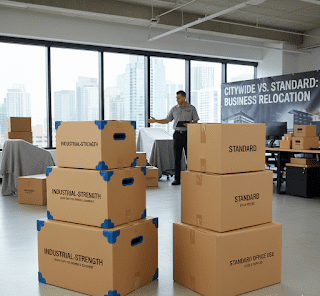
Relocating a business is vastly different from moving a home. When your company needs to transition to a new office space, the stakes are higher expensive equipment, sensitive documents, and minimal downtime requirements demand professional-grade solutions. One of the most critical yet overlooked decisions in commercial moves is choosing the right cardboard moving boxes for your business equipment and supplies.
While cheap moving boxes might seem like a cost effective solution for your office relocation, understanding the difference between standard residential boxes and industrial-strength commercial packing boxes for moving can save your business thousands in damaged equipment, lost productivity, and replacement costs.
Understanding the Difference: Standard vs. Industrial-Strength Boxes
Standard residential cardboard moving boxes are designed for typical household items—clothing, kitchenware, books, and personal belongings. These boxes typically have a single-wall construction with a burst strength of 200 pounds per square inch, adequate for most home goods.
Industrial-strength commercial boxes, however, feature double-wall or triple-wall construction with burst strengths ranging from 275-600 PSI. This enhanced durability is essential when moving heavy office equipment, stacked file boxes, or sensitive electronics that can’t afford damage during transport.
When Standard Cheap Moving Boxes Work for Office Moves
Not every item in your office requires industrial-grade packing boxes for moving. Standard cardboard moving boxes are perfectly suitable for:
Light Office Supplies: Desk accessories, stationery, small office decorations, and personal desk items can safely travel in standard boxes. These cheaper options help control your moving budget while protecting non-critical items.
Soft Goods: Office linens, cushions, promotional materials, and fabric items don’t require heavy-duty protection. Standard packing boxes for moving provide adequate protection at a fraction of the cost.
Non-Essential Documents: General correspondence, old marketing materials, and archived paperwork that isn’t fragile can be packed in regular cheap moving boxes, making them an economical choice for bulk document transport.
For businesses looking to maximize budget efficiency, using standard boxes for appropriate items while investing in industrial-strength options for critical equipment strikes the right balance. Resources like Jordan River Moving’s guide to cheapest moving boxes can help you identify where to source affordable options for non-critical items.
When Industrial-Strength Boxes Are Non-Negotiable
Certain office items demand the superior protection that only commercial-grade cardboard moving boxes can provide:
Computer Equipment and Servers: Desktop computers, servers, monitors, and networking equipment contain sensitive components that can’t withstand the jolts and compressions of standard boxes. Industrial-strength boxes with reinforced corners and double-wall construction protect expensive technology investments, often worth $1,000-$10,000 per unit.
Heavy Files and Documents: Legal firms, medical offices, and financial institutions often need to transport banker’s boxes filled with critical documents. When stacked four or five boxes high, standard cheap moving boxes can collapse under weight, potentially damaging irreplaceable files. Industrial boxes maintain structural integrity even when heavily stacked.
Specialty Office Equipment: Printers, copiers, plotters, and other office machinery require custom-sized industrial packing boxes for moving. The heavier gauge cardboard prevents shifting during transport and protects against impact damage.
Sensitive Electronics: Security systems, telecommunication equipment, and A/V installations need maximum protection. Industrial boxes often include foam inserts or custom fitting options that standard boxes cannot provide.
Cost Analysis: Initial Investment vs. Long-Term Value
At first glance, industrial-strength cardboard moving boxes cost 2-3 times more than standard cheap moving boxes. A standard medium box might cost $2-3, while an industrial equivalent runs $6-10. For a typical office move requiring 100-200 boxes, this difference can seem substantial.
However, consider the cost of replacing damaged equipment:
- One damaged computer: $800-2,000
- Printer repair or replacement: $500-3,000
- Lost or damaged client files: Potentially thousands in recovery costs and liability
- Business downtime from equipment damage: $5,000-10,000 per day
Investing an extra $500-1,000 in proper packing boxes for moving provides insurance against far more expensive consequences. Most businesses find that strategic use of industrial boxes for critical items while using cheaper options for appropriate goods creates the optimal cost-benefit ratio.
Box Specifications That Matter for Commercial Moves
When selecting cardboard moving boxes for your business relocation, pay attention to these specifications:
Burst Strength: Measures how much pressure a box can withstand before breaking. Minimum 275 PSI for office equipment, 350+ PSI for heavy items.
Edge Crush Test (ECT): Indicates stacking strength. Look for 44 ECT minimum for commercial moves where boxes will be stacked in trucks or storage.
Wall Construction: Single-wall for light items, double-wall for most office goods, triple-wall for heavy equipment or long-distance moves.
Size Standardization: Commercial packing boxes for moving should be uniform sizes for efficient stacking and space utilization in moving trucks.
Frequently Asked Questions
What’s the main difference between cheap moving boxes and industrial-strength boxes for offices?
The primary difference lies in construction and durability. Standard cheap moving boxes feature single-wall cardboard with 200 PSI burst strength, suitable for light items. Industrial-strength cardboard moving boxes use double-wall or triple-wall construction with 275-600 PSI ratings, designed to protect heavy office equipment, stacked files, and expensive electronics. While industrial boxes cost 2-3 times more, they prevent equipment damage that could cost thousands in replacements and business downtime.
How many moving boxes does a typical office need?
Box requirements vary by office size and equipment density. A general estimate: small offices (5-10 employees) needs 50-75 boxes, medium offices (20-30 employees) require 150-200 boxes, and large offices (50+ employees) may need 300-500 boxes. Tech-heavy offices require more packing boxes for moving due to equipment protection needs. Professional movers can provide accurate assessments based on your specific inventory.
Can I use residential cardboard moving boxes for my business relocation?
Yes, but strategically. Residential cheap moving boxes work well for office supplies, personal desk items, soft goods, and non-critical documents. However, computers, servers, heavy files, printers, and sensitive equipment require industrial-strength packing boxes for moving to prevent damage. Most successful office moves use a combination—standard boxes for appropriate items and commercial-grade boxes for critical equipment—balancing cost and protection.
Are reusable plastic crates better than cardboard moving boxes for office moves?
Both have advantages. Reusable plastic crates excel for electronics and equipment—they’re waterproof, stackable, and extremely durable. However, cardboard moving boxes are more cost-effective for one-way moves, items going into storage, or mixed-use scenarios. Many businesses rent plastic crates for computers while using cheap moving boxes for documents and supplies. For comprehensive sourcing options, visit Jordan River Moving’s moving boxes guide.
Conclusion
Choosing between standard cheap moving boxes and industrial-strength cardboard moving boxes isn’t an either-or decision for commercial moves. Smart businesses use a strategic combination: industrial-grade packing boxes for moving critical equipment and valuable items, with cost-effective standard boxes for appropriate goods.
This balanced approach protects your most important assets while controlling moving costs. For businesses planning relocations, investing time in proper box selection pays dividends through reduced damage, minimized downtime, and smoother transitions.
Whether you’re moving a small startup or an established enterprise, understanding the role of quality cardboard moving boxes in your relocation strategy is essential. With proper planning and the right packing boxes for moving, your business can transition to its new space efficiently, safely, and within budget.