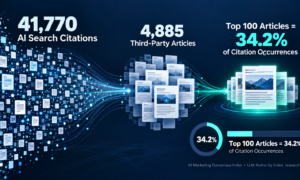
For decades, large corporations built websites around a familiar assumption: people would search for information, click a result and arrive on a company-controlled page. Generative AI is complicating that path. Search engines increasingly provide AI-generated summaries, while standalone AI platforms can answer detailed questions about companies, products and industries without requiring a traditional search-results journey. For Fortune 500 companies, this changes the role of the corporate website without diminishing its importance. The site remains an authoritative source of company information, but its content may now reach audiences indirectly through systems that interpret, summarize and compare information before a user ever visits.
Websites Need Stronger Foundations
AI search creates another reason for corporations to examine the technical and informational foundations of their websites. Generative systems need to interpret what a company does, how its products relate to one another and which information carries authority. A sprawling corporate site filled with outdated pages, duplicate explanations and confusing hierarchies makes that job harder.
Working with a full cycle website design agency can address the website as an interconnected digital product rather than a collection of individual pages. Information architecture, UX, development, CMS structure, accessibility, performance and search considerations all affect how information gets organized and delivered.
For a multinational corporation, these issues multiply. A site may contain thousands of pages covering products, leadership, investor information, careers, regional operations, corporate policies and technical resources. The challenge is no longer simply publishing all of that material. Companies need structures that establish clear relationships among it and make important information easy to identify.
That benefits human visitors, traditional search engines and emerging AI discovery systems alike.
Human Experience Still Matters
The rise of AI search does not mean corporations should start designing websites primarily for machines. People who reach a corporate site still expect it to work exceptionally well, regardless of how they found it.
That makes responsive web design as relevant as ever. Visitors may move from an AI-generated answer to a corporate website on a phone, tablet or desktop computer. They should encounter an experience appropriate for the device rather than a site whose usefulness depends on screen size.
Performance matters for the same reason. A generative tool may help someone identify the right company or product, but a slow or confusing destination can squander that opportunity. Navigation, accessibility and content clarity continue shaping whether visitors trust what they find.
Large companies also have reputational considerations that smaller organizations may encounter at a different scale. A corporate website represents the organization to investors, job candidates, customers, regulators and journalists. AI may change the route people take to reach that information, but it does not eliminate expectations for a credible first-party source.
Authority Becomes More Valuable
Generative search creates an unusual information environment because users may receive answers assembled from several sources. Corporate information can appear alongside journalism, reviews, databases, social platforms and other third-party material.
That makes authoritative first-party information increasingly important. Companies need accurate descriptions of products, services, leadership, policies and other subjects people routinely research. Information scattered across outdated pages can create ambiguity about which version remains current. This does not require corporations to turn every page into an encyclopedia entry written for an algorithm. Clear language and sensible organization remain more useful. Companies should know which facts matter to their audiences and ensure those facts appear in reliable, accessible locations.
Traditional SEO remains relevant here. Search engines still direct enormous numbers of users to websites, and established practices around technical quality, useful content and logical structure continue serving a purpose. Generative Engine Optimization, often called GEO, adds another consideration by examining how content may perform within AI-driven discovery.
Governance Needs Greater Attention
For Fortune 500 companies, adapting to AI search is partly a governance issue. Large organizations frequently have numerous teams publishing digital content across divisions, regions and subsidiaries. Without strong oversight, different parts of the organization can publish conflicting descriptions, outdated statistics or inconsistent terminology.
AI systems can expose those inconsistencies in ways companies cannot fully control. If several public sources describe the same organization differently, a generated answer may not reflect the version corporate leadership would prefer.
Content governance can reduce that risk. Organizations can establish ownership for high-value corporate information, retire obsolete pages and maintain clear sources for facts likely to change. Technical teams can also ensure that redirects, site architecture and structured information support the current organization rather than preserving years of digital clutter. The objective is not total control over AI-generated answers, which companies cannot guarantee. It is providing stronger source material from which digital systems can work.
Corporate Websites Will Endure
AI search may reduce the number of situations in which people need to visit a website for a simple answer. It can also make the corporate website more important as the definitive source behind those answers.
For large companies, the response should not be to chase every change in generative technology. It should be to build and maintain digital properties that communicate accurate information clearly, perform reliably and adapt as discovery changes. The corporate website is not disappearing. Its audience is expanding to include both the people reading its pages and the technologies interpreting what those pages say.