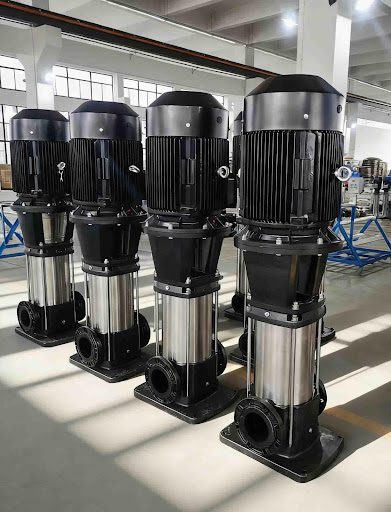
If you’ve ever tried to push water up 20 stories or feed a boiler that needs 300 PSI, you know that regular pumps hit a wall quickly.. That’s where the Vertical Centrifugal Pump with multistage impellers steps in. These aren’t just pumps; they’re pressure-building beasts, engineered to turn a modest motor into a high-head workhorse without hogging your floor space.
What is a vertical centrifugal pump? The Main Idea
First, let’s get the definition of the “Vertical Centrifugal Pump” right. Fluid flows in at the bottom, gets spun by impellers, and flows out at the top of this dynamic pump with a vertical shaft. Unlike horizontal pumps, its upright stance saves serious floor space, which is gold in cities or crowded factories. But the real star here is the multistage impeller design: multiple impellers stacked on a single shaft, each adding pressure incrementally. Think of it like climbing stairs. A single-stage pump lifts you one step; a Vertical Centrifugal Pump with multistage impellers carries you up 10 steps at once. Each impeller is a mini pressure generator, and together, they turn low-pressure input into high-head output (we’re talking 100–1,000+ feet of head). That’s why you’ll hear terms like vertical multistage centrifugal pump—it’s all about stacking stages for serious pressure without the bulk.
The Multistage Toolkit for Vertical Centrifugal Pump Parts
To understand how multistage impellers work, you need to know the vertical centrifugal pump parts that make it happen. Let’s get to the point:
- Multistage Impellers: The Pressure Builders
These are the main parts of the show. They are spinning disks with curved vanes that throw fluid outward (thanks to centrifugal force!) to change motor torque into pressure. In a vertical multistage pump, 2–20+ impellers stack on a single shaft, with fluid passing through each stage one after another.
- Design tricks: Closed impellers (with front/back shrouds) work for clean fluids; open impellers handle solids (think wastewater). For high pressure, engineers lean on “mixed-flow” impellers—they balance flow and head better than pure radial designs.
- Materials matter: Stainless steel (SS304/316) resists rust; superalloys like Hastelloy can handle harsh chemicals. A chemical plant might use PTFE-lined impellers in a vertical multistage centrifugal pump to keep the product from getting dirty.
2. Pump Casing: Directing the Flow
- What it does: It is a shell that is shaped like a cylinder or a volute and holds the impellers and guides the fluid. For easy access, vertical designs often have split casings (top and bottom) so that you don’t have to take the whole pump apart to fix it.
- Inline centrifugal pump casings are small enough to fit in tight spaces. Vertical inline centrifugal pump models combine the motor and pump into one unit (shaft-in-shaft design, super space-savvy).
3. Shaft: The Power Transmitter
- What it does: A high-strength steel rod connecting the motor to the impellers. In multistage pumps, it’s built to handle the torque of multiple impellers without bending.
- Special case: Vertical cantilever pumps skip the bottom bearing—the shaft “cantilevers” from the motor, which cuts wear in sandy or abrasive fluids (think mining slurries).
4. Bearings: Keeping It Smooth
- What they do: Hold up the vertical shaft and cut down on friction. Bronze or ceramic sleeve bearings work for low speeds, while ball or roller bearings work for high speeds.
- Pro tip: Bearings are often sealed in in line vertical pumps to keep fluid out. This is very important in wet or submerged environments.
5. Seals: No-Leak Guarantee
- What they do: Mechanical seals (carbon-graphite vs. silicon carbide) or packing glands stop fluid from leaking along the shaft. For hazardous stuff, double mechanical seals with a buffer fluid are standard.
6. Motor: The Engine
- What it does: Electric motors (5–500+ HP) drive the shaft. Explosion-proof models for chemical plants; IE3/IE4 energy-efficient ones to trim bills. In vertical inline centrifugal pumps, the motor and pump share a shaft—saves space but needs precise alignment.
Every part is important, but the multistage impellers are the best. Imagine a vertical centrifugal pump diagram: a vertical shaft with five impellers stacked on top of each other like coins. The first one gets 50 feet of head from the fluid, then the second one gets 50 feet of head, and so on. By stage 5, you’ve got 250 feet of head—enough to push water to a 25-story building.
How Multistage Impellers Boost Pressure: The Science (Without the Headache)
The Vertical Centrifugal Pump design shines because of staged energy transfer. Here’s the play-by-play:
- Priming: Put fluid in the pump (or let self-priming models pull it in through a vacuum).
- First step: The motor turns the shaft, and the first impeller throws the fluid out. A diffuser (a stationary vane) slows it down by changing kinetic energy into pressure (about 10 to 50 feet of head).
- Next stages: The fluid goes into the next impeller, and the process starts over. Each stage adds about 10 to 50 feet of head, so 10 stages add more than 500 feet.
- Discharge: The pressurized fluid comes out of the top outlet and is ready for its job (boiler, rooftop tank, you name it).
Key insight: Unlike positive displacement pumps (which trap fluid), centrifugal pumps rely on rotation. The multistage design multiplies this—each impeller builds on the last. A vertical multistage pump with 5 stages can deliver the same head as 5 single-stage pumps, but in 1/5 the space. One factory we worked with swapped their single-stage pump for this setup and watched energy bills drop 25% in six months—real savings, no fluff.
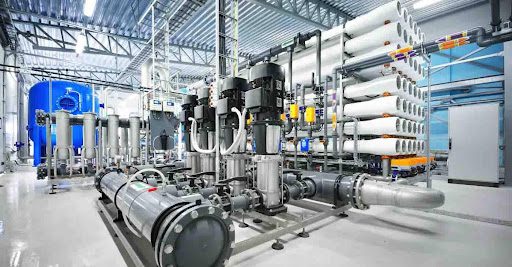
Why Multistage Vertical Centrifugal Pumps Are the Best Choice for High-Pressure Applications
So, why pick a Vertical Centrifugal Pump with more than one stage of impellers? Let’s be honest:
- Unmatched Pressure Efficiency Single-stage pumps can only lift water about 100 feet, while multistage pumps can lift water more than 1,000 feet. To get to 300 PSI (690 feet of head), a vertical multistage centrifugal pump for a boiler feed system might have 8 stages. A single-stage pump would need to be too big and wasteful to do this.
- Vertical design that saves space Vertical pumps take up 50–70% less floor space than horizontal pumps. With a multistage impeller stack, you can make a high-head pump that fits in a closet. In line vertical pumps take this further—motor and pump share a shaft, ditching the baseplate entirely.
- Energy Efficiency Multistage impellers are sized to match the head you need. Instead of forcing a single-stage pump to work overtime (wasting energy), a vertical multistage pump uses just enough stages. We’ve seen factories cut energy use by 25% after making the switch.
- Dependability in Tough Situations The vertical layout reduces vibration (no misaligned shafts), and multistage impellers are better at moving solids than high-speed single-stage pumps. For fluids that are rough, vertical cantilever pumps (a type) don’t have a bottom bearing, which means less wear and a longer life.
Applications: Where These Pumps Really Shine
The Vertical Centrifugal Pump with multistage impellers isn’t just a lab curiosity—it’s a workhorse in industries where pressure matters:
- High-rise water supply: A 30-story building needs ~300 feet of head. A vertical multistage pump with 6–8 stages does this quietly, fitting in a basement mechanical room. Vertical inline centrifugal pumps are popular here—compact and easy to service.
- Boiler feedwater: Power plants and factories need 150–300 PSI to feed boilers (prevents “starvation”). A vertical multistage centrifugal pump with 10–12 stages delivers this reliably, even with hot, corrosive water.
- Chemical transfer: Chemical plants move acids, solvents, or slurries that need high pressure and corrosion resistance. A vertical multistage pump with PTFE-lined impellers and Hastelloy shafts handles this without leaks.
- Ag irrigation: Large farms use these pumps to draw water from deep wells (500+ feet) and push it through center-pivot sprinklers. In line vertical pumps are common here—minimal maintenance, maximum uptime.
Different Types of Design: More Than Just Multistage
Not every Vertical Centrifugal Pump is the same. Here are the main differences, along with the keywords you asked for:
- Vertical Multistage Pump: This pump stacks impellers to reach high heads (over 500 feet). Used in high-rises and boiler feeds.
- Inline Centrifugal Pump: The motor and pump are in a straight line, which makes the pump small. Vertical inline centrifugal pumps are space-savers for HVAC or light industrial use.
- Vertical Cantilever Pumps: No bottom bearing—shaft “hangs” from the motor. Ideal for abrasive fluids (sand, slurry) where bearings wear out fast.
- In Line Vertical Pumps: A subset of inline pumps with vertical orientation. Popular in tight spots like offshore platforms or mobile equipment.
A Designer’s Checklist for Choosing the Right Pump
Follow these tips to get the most out of a Vertical Centrifugal Pump with multistage impellers:
- Match stages to head: Find the total dynamic head (TDH = elevation + friction losses). Six to eight stages (40 to 50 feet per stage) will be enough for 300 feet.
- Choose the material for the impeller: Use stainless steel for water, Hastelloy for acids, and open impellers for solids. Look through our catalog of vertical centrifugal pump parts Find more to see what you have.
- Optimize casing: Volute casings handle high flow; diffuser casings boost head. Peek at a vertical centrifugal pump diagram to see the difference.
- 4. Prioritize bearings: Use sealed bearings (e.g., SKF Explorer) to prevent contamination. Vertical cantilever pumps eliminate this worry entirely.
- Consider inline options: If space is ultra-tight, in line vertical pumps or vertical inline centrifugal pumps integrate motor/pump—fewer parts, easier install.
Maintenance: Keeping Multistage Impellers Happy
A Vertical Centrifugal Pump with multistage impellers is an investment—here’s how to protect it:
- Inspect impellers quarterly: Look for erosion (sand) or corrosion (chemicals). Worn impellers kill head and efficiency.
- Lubricate bearings: Follow the manual—most need grease every 1,000 hours. For vertical cantilever pumps, check the top bearing more often (it’s the only one!).
- Check seals monthly: Leaks often mean impeller wear or misalignment. Replace mechanical seals before they fail.
- Clean strainers: Clogged suction strainers starve the first impeller—leads to cavitation (bubble collapse that dents vanes).
The Future of Vertical Centrifugal Pump Design: More Intelligent and Stronger
The Vertical Centrifugal Pump is not stuck in the past. This is what will happen:
- IoT sensors: Built-in sensors keep an eye on the vibration of the impeller, the temperature of the bearing, and the pressure in real time. Before they happen, guess what will go wrong.
- 3D-printed impellers: Custom designs for fluids that are hard to work with (like high-viscosity oils) with vanes that are optimized for efficiency.
- Hybrid designs: These designs mix multistage impellers with vertical inline centrifugal pump layouts to get the most space and the most head.
- Green materials: Ceramic-coated impellers don’t corrode without using rare alloys, which saves money and helps the environment.
Conclusion: The Multistage Advantage
The Vertical Centrifugal Pump with multistage impellers is a great example of engineering because it turns a simple vertical design into a powerful high-head pump. It solves the old problem of needing pressure without taking up too much space by stacking impellers. This design works whether you’re feeding a boiler, pushing water to a skyscraper, or moving chemicals—click here to learn more about vertical centrifugal pumps.
References
[1] Thomasnet. “An Overview of Vertical Centrifugal Pumps.” Thomasnet-This introduces the definition, working principle, main types, application scenarios, and selection considerations of vertical centrifugal pumps.-Read more
[2] Testbook. “Vertical Turbine Pump: Definition and Diagram.” Testbook-This introduces the definition, working principle, main components, and application scenarios of vertical turbine pumps, and provides relevant diagrammatic explanations.-Read more