Ask any fleet mechanic what keeps them up at night and stopping power comes up fast. A brake caliper that’s slow to release or leaking air pressure doesn’t just cost money, it puts a loaded truck at risk on a downhill grade. That’s why buyers spend real time comparing an air disc brake caliper before committing to a purchase order.
The market’s crowded with names, but not all of them build to the same tolerances. Whether you’re hunting for truck brake calipers manufacturers that understand heavy-duty wheel ends, or trying to sort out which brake calipers manufacturers deserve your business, this guide should save you a few headaches.
What Makes an Air Disc Brake Caliper Different
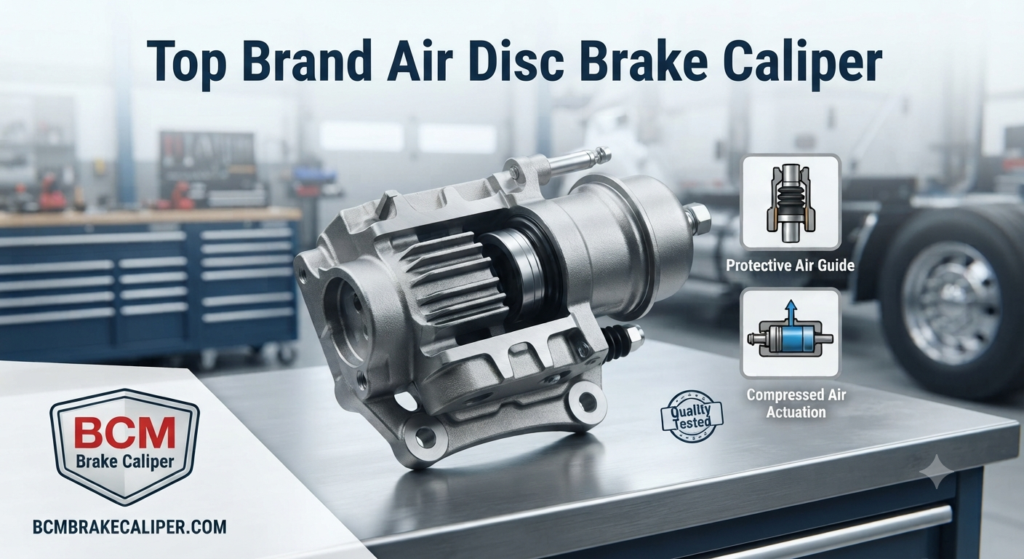
An air disc brake caliper uses compressed air and a pneumatic actuator to clamp the pads against the rotor, instead of the brake fluid and piston setup found in a standard hydraulic caliper. It’s mechanically simpler in some ways, but the forces involved on an 80,000-pound rig are nowhere near what a passenger car caliper ever handles.
That difference matters when you’re sourcing parts. A caliper built for a Class 8 tractor has to survive constant heat cycling, road grime, and thousands of clamp-release cycles without the guide pins seizing or the adjuster drifting out of spec. Fleet operators who’ve dealt with a seized air disc brake know exactly how expensive a roadside failure gets, both in towing costs and lost delivery time.
Why Brand and Cross-Reference Accuracy Matter
Calipers that “look the same” often aren’t interchangeable, and matching the wrong one to your wheel end is the fastest way to end up with a comeback. Mounting bolt patterns, actuator strokes, and adjuster mechanisms vary between brands, and sometimes even within the same brand’s lineup across model years.
Knowing your major air disc platforms by name and model code is what prevents that mismatch. The industry runs on a handful of dominant systems, including KNORR (SN5, SN6, SN7, SB7, SL7, SM7, SK7, ST7), BENDIX (ADB22X, ADB22X-LT), MERITOR (DX195, DX225, ELSA225, ELSA225E, DUCO, EX225H, EX225L, EXLA225, EX225LS), WABCO (PAN17, PAN19, PAN22, MAXX17, MAXX22T, MAXXUS), HALDEX ModulX, and BPW (TSB 3709, 4309, 4312), according to BCM Brake Caliper. Get the exact code off your current unit, and the replacement search gets a lot faster.
What to Look for in Truck Brake Calipers Manufacturers
The strongest truck brake calipers manufacturers share three traits: a long production history, in-house machining, and documented pressure and cycle testing before parts ship. A shop that’s been machining calipers for over a decade has usually already worked through the common failure modes, so you’re not the one discovering them on a customer’s rig.
In-house control over drilling and casting tends to hold tighter tolerances than outsourced housing work, and a caliper that hasn’t been pressure-tested is a gamble you shouldn’t take on a braking system.
Production scale plays into this too. A supplier running at something like a million pieces a year generally holds more consistent quality control than a small operation piecing together batches, and that volume usually translates into better lead times when a truck is sitting idle waiting on a wheel-end part.
Choosing Among Brake Calipers Manufacturers for Mixed Fleets
Fleets rarely run one make of vehicle, which is exactly why sourcing calipers piecemeal from different brake calipers manufacturers turns into a logistics headache. A yard might have European tractors, American pickups for support vehicles, and a scattering of Asian-market SUVs for staff, and juggling separate vendors for each one adds paperwork nobody needs.
A supplier that covers both the car and truck side under one catalog solves this. That means Audi, BMW, Ford, Honda, and Toyota coverage sitting alongside the major air disc platforms for trucks. A supplier profile like BCM’s lists replacement calipers spanning thousands of vehicle models, which for a busy parts counter means fewer vendor relationships and fewer chances of ordering from an unverified source.
It’s also worth checking the repair kit and piston side of the catalog. A caliper piston kit or guide sleeve kit lets a shop rebuild instead of replace when the housing is still sound, saving the customer money while keeping inventory moving.
OEM Versus Aftermarket: The Real Tradeoffs
OEM and aftermarket calipers can perform identically, provided the aftermarket part is cast and machined to the same material spec as the original. Where aftermarket falls short is when a manufacturer cuts corners on alloy grade or skips a heat-treatment step, and that usually shows up within a year as premature guide pin wear or piston corrosion.
The safest move before buying is asking direct questions: what material is the housing cast from, is the piston chrome-plated or coated against corrosion, and does the manufacturer check its output against OEM specifications rather than eyeballing dimensions. A manufacturer confident in its process answers these without hesitation.
Sourcing From China: What Buyers Should Verify
China’s brake caliper sector has become a major supply source for OEM and aftermarket buyers worldwide, mainly because labor and material costs allow competitive pricing without automatically sacrificing quality.
The sector is uneven though, so a bit of due diligence still pays off. Ask for certifications, request samples before committing to a bulk order, and check whether the factory has shipped into markets with strict safety enforcement, like North America or the European Union.
Regularly exporting into those regions means the factory has already cleared import inspections, which is a decent proxy for build quality. It’s worth looking at packaging too, since a well-machined caliper that arrives corroded from moisture exposure in transit is still a returned shipment.
FAQs
Q: What’s the typical lifespan of an air disc brake caliper?
Most last several hundred thousand miles under normal fleet duty. Heat cycling, road salt exposure, and driving conditions can shorten that considerably.
Q: Can I rebuild a caliper instead of replacing the whole unit?
Often, yes. If the housing isn’t cracked or corroded internally, a repair kit with new seals, boots, and pistons brings it back to spec for a fraction of the replacement cost.
Q: Is aftermarket as reliable as OEM for heavy-duty trucks?
It can be, provided the manufacturer uses comparable materials and testing standards. The risk isn’t the aftermarket label itself, it’s inconsistent quality control at some suppliers.
Q: How do I know if a caliper will fit my specific truck model?
Cross-reference the exact model code stamped on your current caliper, like a KNORR SN7 or MERITOR EX225L, rather than relying on vehicle year and make alone. Actuator and mounting variations exist even within one brand’s lineup.
Q: Does manufacturing volume actually affect part quality?
It correlates more with consistency than raw quality. Higher-volume manufacturers tend to catch defects earlier through repeated production runs and usually offer more stable lead times.
Final Thoughts
Picking the right caliper supplier comes down to more than unit price on a spec sheet. It’s about finding a manufacturer whose parts hold up on the road, whose catalog matches what your fleet or shop actually needs, and who answers technical questions honestly.
Whether you’re replacing one unit on a customer’s pickup or restocking a fleet’s wheel-end inventory, the fundamentals stay the same: verified cross-references, proven materials, and a manufacturing track record you can actually check.