Outline: quick tour of leading AI music platforms → what each tool does best → how creators can use them for short video → market context, copyright risks, and commercial potential.
Why short-video music matters now
Short video platforms reward instant hooks. Music that grabs attention in the first two seconds performs best. AI can generate those hooks at scale. That makes AI music creator tools an essential part of the modern creator toolkit.
How I tested these tools (method and constraints)
I approached each platform as a short-form video producer.
Test steps: prepare a 30-second reference (WAV, 16-bit, 44.1 kHz), write a 10–15 word mood prompt, and try each site’s default “generate” flow.
I judged ease of prompting, iteration speed, export formats, stem availability, and licensing clarity.
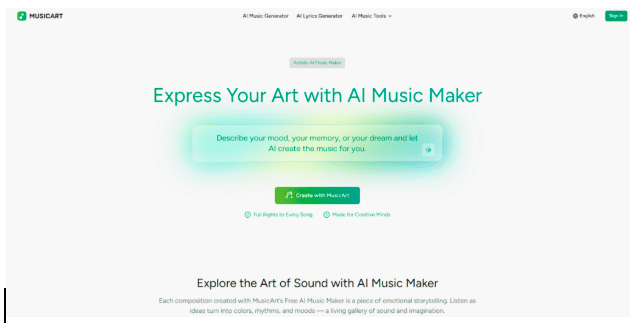
MusicArt — cinematic sketches for creators
Quick view
MusicArt leans into expressive, design-forward outputs. It positions itself as a tool for sound designers and advertisers who need moodful tracks fast.
What stood out
Purpose-built presets for jingle moods. Easy layer remixing. Clear claim of royalty-free ownership and a downloadable “certificate” with releases. That level of rights clarity is helpful for creators planning to monetize content.
How a creator would use it
Pick a mood, nudge instrumentation, export stems, and drop them into your short-video editor. The UI favors iterative tweaks over deep mixing.
Strengths & tradeoffs
Good for brand work and trailers. Less suited to producers who want highly humanized vocal performances.
Freemusic AI — quick tracks with low friction
Short summary
Freemusic AI emphasizes instant generation and royalty-free outputs. It pitches itself as “type a mood, get a track.”
Use case
Good for creators who need background beds for explainer clips, podcasts, or B-roll. The “text→song” flow removes friction for non-musicians.
What I noticed in use
Simple prompts produce usable stems. The mastering loudness tends to be platform-ready, which is convenient for short-form platforms.
MusicAI — brand consistency at scale
Snapshot
MusicAI promotes brand sound identity and scale. It calls out video and campaign uses as primary use cases.
Practical takeaway
If your channel needs a uniform sonic palette across dozens of clips, MusicAI’s templated approach speeds that process. It’s less about a one-off banger and more about a sonic kit you reuse.
Pros & cons
Pros: consistent outputs, templates for social. Cons: might feel formulaic without manual tweaking.
MusicCreator AI — ownership-first approach
Executive view
MusicCreator AI foregrounds rights — everything generated is royalty-free and claimable by the user. That messaging is explicit and consistent across their pages.
Why that matters
With publishers and platforms scrutinizing content rights, clear ownership makes it safer to publish commercially. For creators monetizing their short videos, that reduces friction.
On the creative side
The platform supports libraries and batch generation, which helps when you need multiple variants of a theme for A/B testing.
OpenMusic AI — tools for full production workflows
Short introduction
OpenMusic AI bundles text-to-music, lyric generation, stem separation, and basic mastering. It reads like an all-in-one playground for producers.
How creators benefit
If you want to generate a short loop and then split stems to re-arrange in a DAW, OpenMusic’s stem tools are handy. The site explicitly targets creators who want a one-stop workflow.
Considerations
Powerful for experimentation. Expect to do additional mixing if you need broadcast-grade fidelity.
Udio — community and discovery + generator
Snapshot
Udio blends discovery with generation. It’s positioned as both a creator tool and a place to share music.
Notable feature
Discovery features help creators find what’s trending aurally. That can inform which moods or genres to prompt for short-video hooks.
Mureka — lyric-aware generation
What it is
Mureka emphasizes lyric-to-song capabilities. It tries to turn written words into coherent melodies and phrasing.
Why creators might pick it
If you produce vocal-forward shorts (singing hooks, vocal drops), Mureka’s lyric sensitivity is important. It’s useful for quickly iterating chorus lines and vocal hooks.
Soundful — loop and stem power for creators
Overview
Soundful is marketed as an “AI music studio” producing MIDI, stems, and loop-based assets ready for streaming and short video.
Where it shines
Loop generation and simple stem exports let you build repeating motifs that work well for 15–30 second TikTok or Reel formats.
Market context: growth, adoption, and the legal cloud
The AI music generation market is growing rapidly. Multiple industry reports estimate strong CAGR figures (20–30%+ for generative AI in music), with market values rising from hundreds of millions in 2024 to multi-billion forecasts by the early 2030s. This expansion explains why startups and established platforms are racing to add features for creators and brands.
At the same time, legal risk is real. In 2024 major labels filed suits against music-AI companies alleging unauthorized use of copyrighted recordings in training data. That litigation underscores the need for transparent licensing statements and for creators to confirm rights before monetizing generated music.
How AI music creator tools are commercializing music production
- Lowered entry cost. A social creator can produce dozens of bespoke tracks without hiring a composer. That compresses time-to-publish.
- Scale for brands. Companies can generate cohesive audio libraries for campaigns at a fraction of traditional costs. Platforms explicitly advertise brand identity workflows.
- New revenue vectors. Faster sound design and iteration make micro-licensing and in-platform music use cases more viable. Market research predicts rising revenues in this segment.
A creator’s checklist before you publish generated music
- Confirm the tool’s license and ownership language. Prefer platforms that state explicit royalty-free ownership.
- Export stems if you plan to remix. Platforms that provide stems or MIDI give more flexibility.
- Keep a record of prompts and export metadata. This supports future claims and replicability.
- Monitor legal news: training-data lawsuits could affect downstream rights.
Example scenario: launching a 30-day short-video campaign
Day 1: Use MusicAI to create 5 sonic templates for your series.
Day 7: Use Soundful to generate loop variations and export stems for editing.
Day 14: Use Mureka to craft a short vocal hook for the campaign’s main theme.
Result: quicker iteration, consistent audio signature, and fewer licensing headaches—assuming you validated ownership claims.
Pros, cons, and final thoughts
Pros: Big speed gains for content pipelines. Easier experimentation. Lower cost for bespoke audio. Market growth is accelerating adoption.
Cons: Rights and training-data disputes create legal uncertainty. Outputs can sound synthetic if prompts are shallow. Some creators report wanting more human nuance.
Final thought: An AI music creator is not a replacement for human craft. It is a multiplier for output and a new layer in the production stack. For short-video creators, these tools are most valuable when used as sound design accelerators—paired with human taste, editing, and quality control.
Sources & further reading
Product pages for MusicArt, MusicAI, Freemusic AI, MusicCreator AI, OpenMusic AI, Udio, Mureka, and Soundful (linked in the outline). Industry and legal context from Reuters (label lawsuits), Grand View Research / Market analyses, and sector studies referenced above.