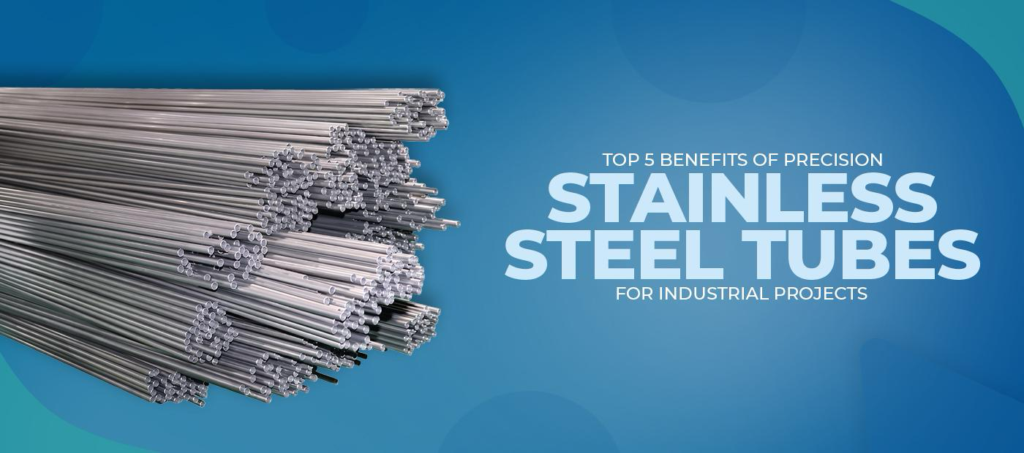
Every industrial project depends on the reliability of its components. From chemical processing lines to hydraulic systems in heavy machinery, precision stainless steel tubes for industrial applications form the backbone of performance. When tubing fails, the cost goes far beyond replacement. It includes downtime, maintenance, lost production, and potential safety risks.
This is why engineers and procurement teams consistently choose high-precision stainless steel tubing solutions. Below are five key benefits that make them a smart investment for long-term industrial performance.
1. Superior Corrosion Resistance for Harsh Environments
Corrosion is one of the most expensive and unpredictable challenges in industrial systems. It weakens materials over time and often becomes visible only after damage has progressed.
Corrosion-resistant stainless steel tubes for chemical and marine environments perform exceptionally well because of their chromium content. This element forms a passive oxide layer on the surface that protects against rust, oxidation, and chemical exposure. Even if the surface is scratched, the layer regenerates naturally without external coatings.
Different grades serve specific environments:
- 304 and 304L stainless steel tubes for general engineering, water systems, and food processing
- 316 and 316L stainless steel tubes for marine and chemical applications
- 321 SS tubing for high temperature industrial systems
- 310S SS tubes for furnace and heat exchanger applications
With proper grade selection, stainless steel tubing can last decades, making it a reliable choice for industries that demand durability and minimal maintenance.
2. High-Dimensional Accuracy for Precision Applications
In industries where performance depends on exact tolerances, standard tubing is often not sufficient. Applications such as instrumentation, hydraulics, and heat exchangers require precision stainless steel tubes with tight tolerances.
Cold-drawn stainless steel tubes are manufactured through a process that refines the grain structure and improves dimensional accuracy. This results in:
- Consistent wall thickness and diameter
- Better concentricity
- Smooth internal surfaces for efficient flow
Cold-drawn stainless steel tubes for hydraulic and instrumentation systems ensure reliable performance by reducing pressure loss and improving flow consistency.
For advanced applications such as analytical instruments and medical devices, capillary stainless steel tubes with ultra-precise sizes are essential. Even slight variations can impact performance, which is why precision manufacturing plays a critical role.
3. Strength and Reliability Under Extreme Conditions
Industrial environments involve fluctuating pressures, high temperatures, and constant mechanical stress. Tubing must maintain structural integrity under these demanding conditions.
High-strength SS tubes for high-pressure and temperature applications offer excellent tensile strength and fatigue resistance. They perform reliably across a wide temperature range and resist both corrosion and thermal degradation.
Specialised grades enhance performance:
- 321 and 347 stainless steel tubes for high temperature stability
- Seamless tubes for pressure-critical systems
- Welded tubes for cost-effective structural and fluid applications
High-quality welded tubes are produced using controlled fabrication processes, including proper inert gas purging with purge dam , post-weld annealing, and inspection. These practices help preserve corrosion resistance inside the weld and ensure the weld zone matches the strength and durability of the base material.
Choosing the right type of tubing ensures long-term reliability even in demanding industrial environments.
4. Hygienic Surface Finish for Sensitive Industries
In industries such as food processing, pharmaceuticals, and biotechnology, surface finish directly affects safety and compliance.
Hygienic stainless steel tubes for food and pharmaceutical industries provide smooth internal surfaces that prevent contamination and support effective cleaning. Rough surfaces can trap bacteria and reduce cleaning efficiency.
Cold-drawn tubes naturally have a refined finish. For stricter requirements, processes such as electropolishing further improve surface quality and reduce surface roughness.
Key advantages include:
- Easy cleaning and maintenance
- Resistance to contamination
- Compliance with GMP standards
Electropolished SS tubes for cleanroom and bioprocessing applications are widely used where hygiene standards are critical.
Capillary tubes used in medical and analytical systems require even higher levels of precision and surface quality, ensuring accurate flow and reliable performance.
5. Long-Term Cost Efficiency and Value
While stainless steel tubing may have a higher initial cost, it offers significant savings over time.
Long-lasting stainless steel tubes for industrial projects reduce:
- Maintenance requirements
- Replacement frequency
- System downtime
The self-healing oxide layer eliminates the need for coatings. Dimensional stability reduces the risk of leaks and failures over time.
Industries worldwide are increasingly adopting stainless steel due to its durability and lifecycle value. Demand continues to grow as companies prioritise materials that deliver long-term performance.
When sourcing tubing, it is important to choose ISO certified stainless steel tube manufacturers with full material traceability. Compliance with ASTM or EN standards ensures consistent quality and performance.
Choosing the Right Stainless Steel Tubing Solution
Selecting the right tubing is not just about material. It involves matching the grade, manufacturing process, and supplier capability to your application.
- Use welded stainless steel tubes for structural and general fluid applications
- Choose seamless or precision-drawn tubes for pressure-critical systems
- Opt for capillary tubes for analytical and medical use
Working with experienced manufacturers ensures quality control, documentation, and reliability across the supply chain.
Conclusion
Precision stainless steel tubes offer a combination of durability, accuracy, strength, and long-term value that few materials can match.
Whether you need precision SS tubes for hydraulic systems, corrosion-resistant tubing for chemical plants, or hygienic SS tubes for food processing, the benefits remain consistent.
By selecting the right grade and working with trusted manufacturers, you ensure that your tubing performs reliably for years. In most cases, it becomes the most dependable part of your entire system.