The artificial intelligence boom looks like software, but it runs on concrete, copper, and electricity. Every chatbot answer and every model trained sits on top of a physical machine in a building that has to be powered, cooled, and watched around the clock. That physical footprint is growing at a startling rate. Global electricity use by data centers is on track to double to about 945 terawatt-hours by 2030, roughly the amount of power the entire country of Japan uses today. Behind every leap in what AI can do is a far less visible race to build and run the data centers that make it possible.
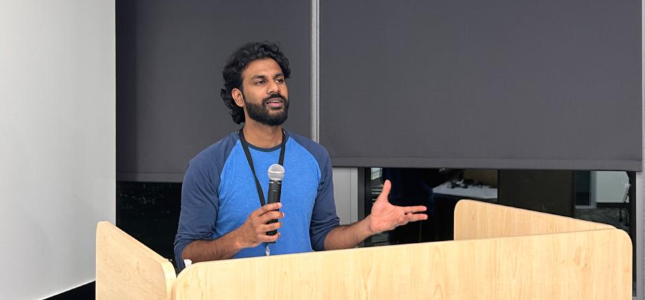
Anish Reddy Yennapusa works at the physical layer of that race. As a software development engineer, he designed and built a global telemetry and monitoring platform for a worldwide fleet of data centers, unifying how the facilities are measured and optimizing how they use power. He authored a paper at the 19th IEEE International Conference on Machine Learning and Applications (ICMLA). His work sits at the point where lines of code meet megawatts, keeping the machines that run modern AI both visible and efficient.
The AI Boom Is a Building Boom
For a decade, data centers grew more efficient roughly as fast as they grew busier, so their total power use stayed relatively flat. That era is over. Data center electricity demand is now climbing about 15% a year, more than 4 times faster than electricity demand from everything else combined, driven by the enormous compute appetite of AI. Each new generation of models needs more chips, and more chips need more power, more cooling, and more physical space. The result is a construction wave of data centers on a scale the industry has never attempted.
Yennapusa builds the systems that keep that expansion from outpacing the systems that manage it. As the lead developer on a global monitoring platform, he created the infrastructure that ingests telemetry from data centers spread across the world, each with its own hardware, layout, and quirks, and turns it into a single, coherent picture. The platform did not replace an older tool so much as create a capability that had not existed before: one unified view across a fleet that had grown too large and too varied to watch site by site.
“You cannot grow what you cannot see, and at this scale, seeing everything is the hard part,” Anish Reddy Yennapusa says. “Every data center is a little different. Monitoring one of them is easy. Building something that understands all of them at once, in real time, without drowning in noise, is the actual job.”
You Cannot Manage What You Cannot See
The scale of what is being watched is hard to overstate. In the United States alone, data centers are projected to consume more electricity than all of the country’s heavy manufacturing combined by 2030, including aluminum, steel, cement, and chemicals. A fleet drawing that much power throws off an immense stream of signals: temperatures, power draw, hardware health, network status, security events, thousands of readings a second from every site. Left unwatched, a small anomaly in that stream, an overheating rack or a failing power supply, can cascade into an outage that takes real capacity offline.
This is the problem Yennapusa’s platform was built to solve. He developed microservices that ingest telemetry for availability, security, power, and vendor systems and standardize it so that data from very different sites can be compared and acted on. He engineered the big-data pipelines that carry this flood of measurements at a global scale and deliver real-time, actionable alerts to data center technicians. The point is to catch the small problem at 2 a.m. before it becomes the large one by morning.
“Raw telemetry is just noise until you give it structure,” Yennapusa explains. “A number on its own means nothing. That same number, compared against what normal looks like for that exact machine in that exact location, becomes an early warning. Most of the engineering is turning a firehose of readings into a short list of things a human should actually look at right now.”
Every Watt Counts
Watching the fleet is only half the mission. The other half is making it use less. Data centers accounted for roughly 1.5% of the world’s electricity in 2024, and that share is expected to reach about 3% by 2030, which turns even small efficiency gains into large absolute savings in both cost and carbon. When a fleet consumes as much power as a mid-sized country, shaving a few percent off its energy use is the difference between needing a new power plant and not needing one.
Yennapusa built the optimization side of the platform directly into it. He developed algorithms that adapt to the different configurations and power profiles across the fleet, optimizing hardware utilization so that infrastructure capacity is utilized more efficiently while reducing unnecessary energy consumption. Some of this reached down to the physical layer, incorporating hardware design work so that monitoring and optimization extended all the way to the machines themselves. The goal was a fleet that runs leaner without running any less reliably.
“In this world, efficiency translates directly into capacity,” Yennapusa notes. “Every watt you save is a watt you can use to run something else, or a watt you do not have to go build new power for. When you are operating at global scale, an optimization that sounds tiny on paper turns into an enormous number once you multiply it across every site.”
Where Global Scale Gets Hard
None of this is theoretical, and none of it is easy. The United States already accounts for close to half of the world’s data center electricity use, and data centers are on track to drive nearly half of all the growth in the country’s power demand through 2030. That concentration means the systems watching over these fleets operate under intense pressure, where a blind spot becomes a risk to critical infrastructure that people and businesses depend on.
The hardest part of Yennapusa’s work is that no two data centers are quite alike. Sites built in different years, in different countries, by different vendors, do not report their status the same way, and a monitoring system has to make sense of all of them without a human hand-tuning each one. He drove development of the platform largely as its sole developer while collaborating with cross-functional teams on specialized components, designing solutions general enough to work across every variation in the fleet while staying precise enough to catch a real fault. Building for that kind of diversity, at that kind of scale, is where most monitoring efforts quietly break.
“The trap is building something that works beautifully for the data center in front of you and falls apart on the next one,” Yennapusa observes. “Real scale is about variety as much as volume: more kinds of things at once, each behaving a little differently. You have to design for the site you have not seen yet, because at a global fleet there is always another one that surprises you.”
Building for What’s Coming
The pressure is only going to intensify. Electricity demand from AI-optimized data centers is projected to more than quadruple by 2030, as the buildout racing to keep up with AI shows no sign of slowing. Every one of those new sites will need to be monitored, measured, and optimized from the day it opens, and the fleets are growing far faster than anyone could ever staff to monitor by hand. The systems that do this work automatically are quietly becoming as essential as the data centers themselves.
That is the future Yennapusa is building for. The story of AI tends to be told through models and benchmarks, but the ceiling on what AI can do is increasingly set by physical limits: how much power can be delivered, how efficiently it can be used, and how reliably the machines can be kept running. The engineers working on that layer rarely get the headlines. Their work is what determines whether the next wave of AI has somewhere to actually run. A platform that keeps a global fleet visible and efficient is part of that foundation, not a footnote to it.
“People picture AI as something that lives in the cloud, somewhere abstract,” Yennapusa reflects. “It lives in buildings full of hot metal that someone has to keep cool, powered, and healthy. As the demand climbs, the invisible work of watching and tuning those buildings stops being a background task. It becomes one of the things that decide how far all of this can go. That is the part I want to keep getting right.”