
The phone-free school movement has reached a tipping point. For the first time, early results are validating what many educators have long suspected: removing phones from the learning environment isn’t punitive. It’s transformative.
Educators across the country are grappling with the same reality. Classrooms that should foster focus, creativity and connection are increasingly shaped by unchecked digital distraction. Teachers aren’t just competing with phones for attention; they’re up against an entire ecosystem of alerts, social pressure and dopamine-driven design engineered to pull students away from learning.
For years, schools tried to address the issue with rules alone. “Phones off during class.” “Phones in backpacks.” “Phones on the teacher’s desk.” These approaches often fall short because they rely on constant enforcement. The burden lands on teachers, creating friction with students and families while pulling valuable time away from instruction.
What’s changing now isn’t just policy. It’s how schools think about implementation.
One Size Does Not Fit All
A growing body of research makes one thing clear: how phone-free policies are implemented matters as much as whether they exist at all.
Schools differ by grade level, campus layout, culture, and instructional needs. A policy that works in an elementary school may fail in a high school. A loose “off and away” model might sound sufficient on paper but often collapses in practice when enforcement becomes inconsistent.
Generation Faraday is designed with this reality in mind. Rather than prescribing a single approach, it supports multiple implementation models, allowing schools to adapt phone-free environments to their specific context—whether phones are secured at classroom entry, during instructional blocks or throughout the entire school day. The goal is consistency without rigidity, structure without disruption.
Why Signal-Level Solutions Matter
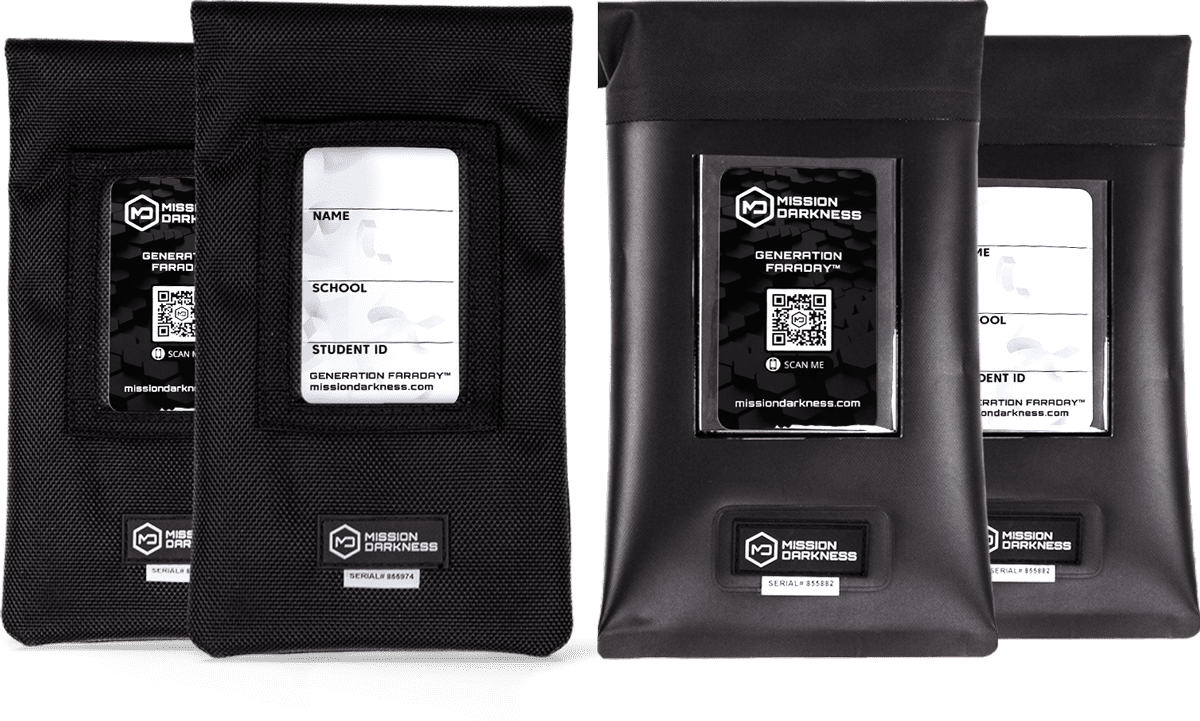
Phone-free classrooms only work when enforcement is removed from individual educators. When compliance depends on trust or constant monitoring, phones inevitably reappear—buzzing in pockets, lighting up backpacks, pulling attention away even when students aren’t actively using them.
This is where Generation Faraday plays a distinct role. And not as a classroom accessory, but as signal-blocking infrastructure designed specifically for schools.
Unlike storage solutions or traditional locking pouches that merely contain phones, Generation Faraday operates at the signal level. Its proprietary shielding materials isolate devices from cellular, Wi-Fi, Bluetooth, GPS and RFID signals. Once a phone is placed inside a Generation Faraday bag, it is no longer connected to the digital world.
No notifications.
No background connectivity.
No constant temptation.
That distinction is critical. Research consistently shows that even the presence of a connected phone reduces cognitive capacity. By fully blocking signals, Generation Faraday removes the neurological burden of resisting distraction, allowing students to focus more deeply on learning.
What the Research Is Telling Us Now
Recent attention from leading researchers has sharpened the conversation around phone-free schools, particularly around where phones are kept and how policies are enforced.
Angela Duckworth, Professor at the University of Pennsylvania and author of Grit: The Power of Passion and Perseverance, has been driving national attention to this issue through her Phones in Focus research. (Watch her October 2025 presentation to the National Governors Association here). Her work emphasizes a core principle of behavioral science known as situation modification, which is the idea that changing the environment can be far more effective than relying on willpower alone.
As Dr. Duckworth explains, “The farther a temptation is from you physically, the weaker its psychological pull on you is. Physical distance creates psychological distance.”
Her findings underscore a critical insight: academic outcomes improve not simply when phones are turned “off,” but when they are physically and functionally inaccessible during the school day. Duckworth has extrapolated that the farther a phone is from a student, the higher the GPA—challenging the loose “off and away” models used in many schools, where phones remain nearby and connected.
Importantly, Dr. Duckworth also highlights that implementation matters. When teachers are not given clear, practical guidance on how to enforce phone-free classrooms, adherence drops. In many schools, valuable instructional time is lost collecting, monitoring and redistributing devices, which is an issue that structured, signal-level solutions are designed to eliminate.
Shifting the Burden from Teachers to Systems
It’s easy to frame phone restrictions as punishment. But that framing misses the deeper reality.
Phone-free classrooms aren’t about control; they’re about restoring calm, focus and connection. Phones have become a defining feature of adolescent life, but inside schools they often function as a daily obstacle for both students and educators.
Teachers are asked to deliver rigorous instruction while simultaneously acting as digital referees—confiscating phones, managing conflicts that originate online and competing with social media for students’ attention. When phones are removed consistently and systemically, classrooms are allowed to function as learning environments again.
From a systems perspective, Generation Faraday transforms phone policies from a behavioral challenge into an environmental solution. Teachers no longer compete with technology; the classroom itself becomes distraction-free by design.
Students Feel the Difference Too
Perhaps the most overlooked voice in this conversation is the students’ own.
According to Common Sense Media, more than half of teens say they feel relief—not stress—when separated from their phones during the school day. Many recognize that constant connectivity is overwhelming and are quietly craving boundaries that allow them to focus and interact face-to-face.
Phones undeniably have value as tools for communication, creativity and learning. But during the school day, their unchecked presence often interferes with what students need most: sustained attention, emotional stability and space to think.
Reclaiming that space isn’t an overreach. It’s an act of care (even if not all the students immediately recognize this).
Building Phone-Free Schools That Actually Work
Effective phone-free programs are not about zero tolerance or punishment. They engage students and families early, communicate expectations clearly and emphasize shared goals: focus, well-being and meaningful learning.
Summer offers a critical window for schools to plan thoughtfully. With students out of the building, districts can collaborate, align policies, and choose implementation models that fit their communities, which ensures consistency without sacrificing flexibility.
Generation Faraday brings proven signal-blocking technology, trusted in security, law enforcement and high-stakes environments, into education—where focus and mental well-being are just as critical.
By addressing distraction at the source, Generation Faraday helps schools move beyond rules and into systems that support both students and educators.
Phone-free classrooms are not a punishment. They are a reprieve.
And as schools rethink the role of technology in education, solutions that remove distraction by design may prove to be the most human-centered innovation of all.