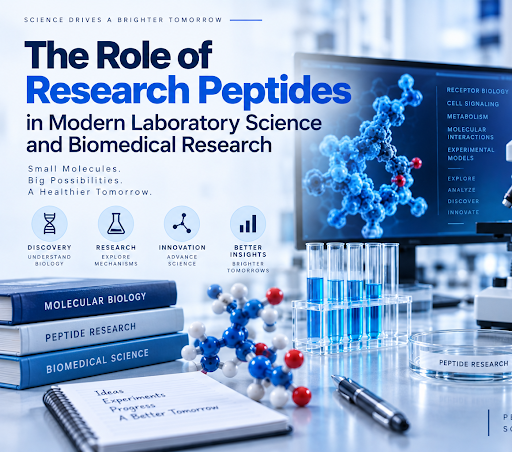
Peptides play an important role in modern laboratory science because they help researchers investigate how biological systems communicate, respond, and regulate complex processes. These small chains of amino acids can interact with receptors, enzymes, and other molecules, making them useful subjects for studying molecular mechanisms.
From receptor biology to metabolism and experimental model systems, peptide research supports a wide range of scientific investigations. However, understanding their role requires more than knowing what a peptide is. Researchers must also consider how peptides are studied, how experimental results are interpreted, and why laboratory findings should not be confused with established medical evidence.
This article explores the scientific importance of research peptides, their applications in biomedical research, and the principles that help make peptide-related experiments meaningful and reproducible.
What Are Peptides and Why Do They Matter?
Peptides are short chains of amino acids connected by peptide bonds. Amino acids are the building blocks of proteins, but peptides are generally smaller and may have distinct biological roles. Some occur naturally in living organisms, where they participate in communication, regulation, and other cellular processes.
A peptide’s function depends on its amino acid sequence, molecular structure, and interactions with other molecules. Even small changes in sequence or chemical modification can influence how a peptide behaves.
This structural diversity makes peptides useful in research. Scientists can study naturally occurring peptides, compare related sequences, or investigate how specific molecular features affect biological activity. These studies help explain how biological systems work at a level that is often difficult to observe directly.
Peptides as Signaling Molecules
Many biological processes depend on chemical signals that allow cells and tissues to communicate. Peptides can act as signaling molecules by interacting with receptors or other molecular targets. These interactions may influence pathways involved in cellular regulation, communication, and response.
The significance of peptide signaling lies in its specificity. A peptide’s structure can determine whether it recognizes a particular receptor or interacts with another biological component. Researchers can use this relationship to investigate how signals are transmitted and how molecular changes affect cellular behavior.
Studying peptide signaling does not mean every peptide has the same function. Each molecule must be evaluated according to its structure, target, and experimental context. This is one reason peptide research remains an important part of molecular and biomedical science.
Research Areas Where Peptides Are Used
Peptides are studied across several fields, each offering a different perspective on biological function.
Receptor Biology
Receptor biology examines how cells recognize and respond to molecular signals. Researchers may study peptide–receptor interactions, binding behavior, and downstream signaling pathways to understand how communication occurs at the cellular level.
Cell Signaling
Cell signaling research focuses on the processes through which cells transmit information. Peptides can help scientists investigate pathway activation, molecular recognition, and changes in cellular responses under controlled conditions.
Metabolism
Metabolic research explores the chemical processes that support life and cellular function. Peptide-related signals may be studied to understand how biological pathways are regulated and how different molecular systems interact.
Molecular Interactions
Peptides are also useful for examining interactions between molecules. Researchers may investigate binding, structure–function relationships, or how chemical modifications influence molecular behavior.
Experimental Model Systems
Laboratory models allow scientists to study biological questions in controlled settings. Peptides may be incorporated into biochemical assays, cell-based experiments, or other research systems designed to examine specific mechanisms.
These applications demonstrate the breadth of peptide science while highlighting the importance of matching each material to an appropriate research question.
How Scientists Study Peptide Structure and Activity
Researchers use a range of analytical and experimental approaches to understand peptide behavior. Structural studies may examine amino acid sequences, molecular mass, folding patterns, or chemical modifications. These details help scientists determine how a peptide’s physical characteristics relate to its function.
Receptor activity may be investigated through binding studies or other assays designed to measure interactions with a target. Researchers may also examine how a peptide behaves under different experimental conditions, including changes that could affect stability or biological activity.
The interpretation of these results requires care. A peptide’s observed behavior in one assay may not predict how it behaves in another system. Experimental conditions, target selection, and measurement methods all influence the meaning of the findings.
Experimental Design and Reproducibility
Reliable peptide research depends on thoughtful experimental design. Researchers must define the question they want to answer, select appropriate materials, and establish methods that allow results to be interpreted clearly.
Controls are especially important. A well-designed experiment may include comparison groups or reference conditions that help researchers distinguish a peptide-related observation from background effects or unrelated variables.
Reproducibility also matters. When experiments are repeated, researchers should document relevant details such as material identity, analytical information, experimental conditions, and measurement methods. Consistent documentation makes it easier to compare results and identify sources of variation.
A strong experiment does not simply produce a result. It provides enough context to explain what was measured, how it was measured, and what conclusions the evidence can reasonably support.
Why Stability and Material Characterization Matter
Peptide research depends on knowing the characteristics of the material being studied. Identity, purity, stability, and biological activity each provide different information about a research peptide.
Identity helps establish that the material matches the intended molecule. Purity concerns the presence of the intended peptide relative to other substances. Stability relates to how the material maintains its expected characteristics over time and under relevant conditions.
These factors can influence experimental consistency. If a peptide degrades, contains unexpected impurities, or has an uncertain identity, researchers may find it more difficult to interpret results or reproduce an experiment.
Analytical documentation, including relevant certificates of analysis, can help researchers understand what has been evaluated. However, documentation should be read in context, and no single quality metric guarantees that a material is suitable for every research purpose.
Interpreting Laboratory Findings Responsibly
Laboratory research produces different types of evidence, and understanding their limitations is essential.
- Laboratory observations: Findings from controlled experiments that describe a measurable interaction or response.
- Preclinical findings: Results from research models used to investigate biological questions before potential clinical evaluation.
- Human clinical evidence: Findings from studies involving people that are designed to assess specific outcomes under defined conditions.
These categories should not be treated as interchangeable. A laboratory observation may help generate a hypothesis, while preclinical research may provide additional information about biological mechanisms. Neither automatically establishes that a compound is safe or effective for people.
Responsible scientific communication avoids presenting early findings as proven medical outcomes. It also recognizes that research results may depend on the model, methods, and conditions used.
Research Peptides and Approved Medicines Are Not the Same
Research peptides are intended for scientific investigation and are not automatically approved medicines. Their use in a laboratory does not establish that they are safe, effective, or authorized for human or veterinary use.
Laboratory findings should not be presented as medical advice. Researchers and readers should distinguish between experimental evidence and the regulatory standards that apply to approved pharmaceutical products.
Responsible research also involves following applicable laboratory safety procedures, institutional requirements, and relevant laws or regulations. Clear communication about intended use helps prevent misunderstandings and supports ethical scientific practice.
Frequently Asked Questions About Peptide Research
Why are peptides useful in biomedical research?
Peptides can interact with receptors, enzymes, and other biological molecules, making them useful for studying signaling, molecular recognition, metabolism, and cellular processes. Their structure can also be investigated to understand how molecular changes influence function.
How do researchers measure peptide activity?
Researchers may use controlled assays to examine properties such as receptor binding, molecular interactions, or cellular responses. The method depends on the research question, and results must be interpreted within the conditions of the specific experiment.
Can laboratory peptide findings be considered medical advice?
No. Laboratory findings are scientific observations, not medical advice. Research peptides are not automatically approved medicines, and experimental results do not by themselves establish safety, effectiveness, or suitability for human or veterinary use.
Conclusion
Research peptides are valuable tools for studying biological signaling, receptor activity, metabolism, molecular interactions, and experimental systems. Their importance comes from the ability to investigate biological mechanisms through carefully controlled scientific work.
Meaningful results depend on appropriate experimental design, reliable material characterization, suitable controls, and responsible interpretation. By understanding the difference between laboratory observations, preclinical findings, and clinical evidence, readers can appreciate the role of peptide research without confusing scientific investigation with established medical use.