Consumer technology coverage gravitates toward phones, wearables, and home automation platforms. Baby care equipment rarely enters the conversation, which is a notable oversight given that it is one of the more instructive categories for studying practical product engineering right now.
The reason is usage frequency. Parents interact with feeding and sleep equipment dozens of times a day, every day, for months at a stretch. In categories with that kind of usage intensity, small design improvements produce measurable, compounding returns in time and effort saved. That is exactly the condition under which automation adoption accelerates.
One product category illustrates the shift particularly well: combined bottle washer, sterilizer, and dryer units, which have moved from niche convenience purchase toward standard equipment in a growing share of households.
The Underlying Problem
The problem these devices address is simple to state and tedious to solve. A bottle-fed infant, whether on formula or pumped milk, requires bottles cleaned and sanitized multiple times a day. Each bottle involves four or five separate components, several with narrow internal channels that hand tools cannot physically reach.
Performed manually, this is a repetitive, multi-step task with genuine hygiene risk when steps are missed, executed by someone operating under significant sleep deprivation. From a product design standpoint, that combination of high frequency, low complexity, and high error cost is close to an ideal automation target.
Automation adoption tends to follow a consistent pattern: high task frequency, low task complexity, meaningful failure cost, and a fatigued operator. Bottle sanitizing scores highly on all four.
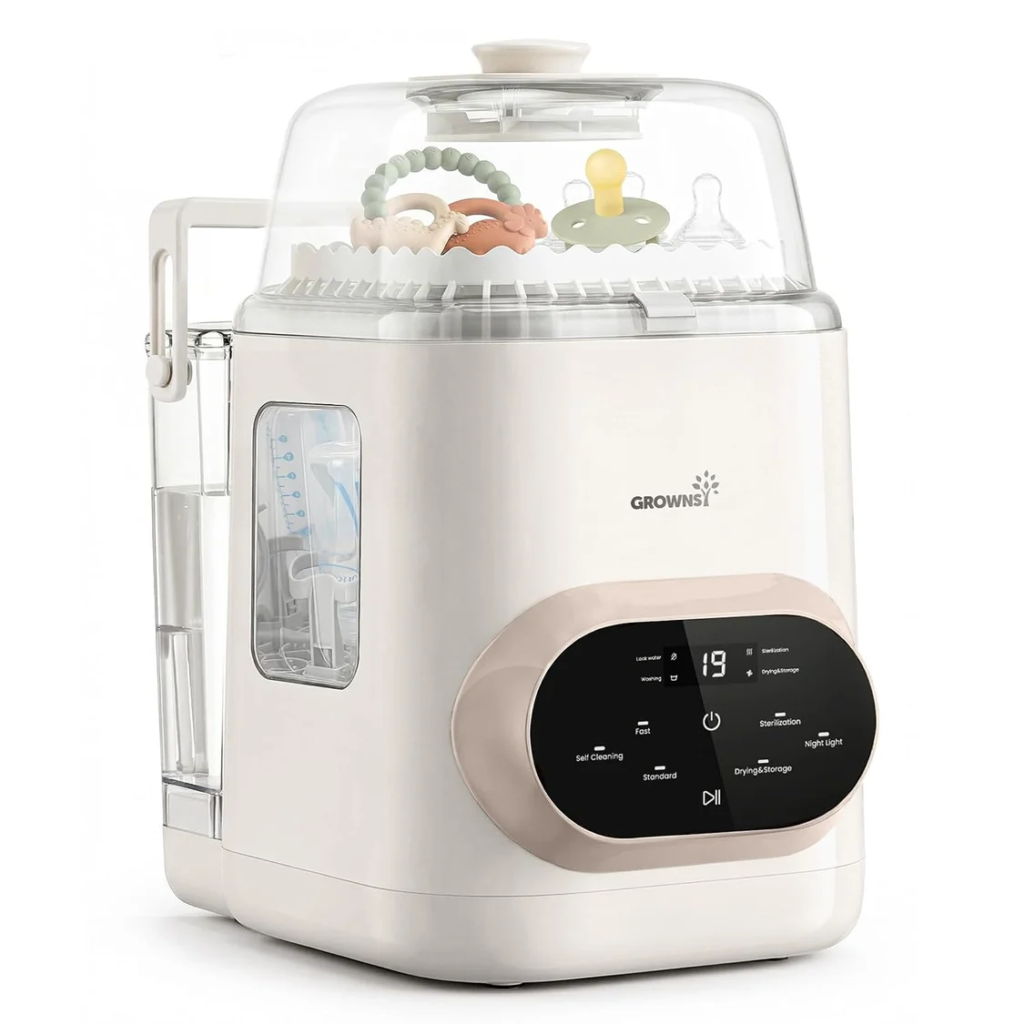
A bottle washer sterilizer and dryer consolidates the entire sequence into one automated cycle, applying high-temperature steam or UV-C exposure to eliminate bacteria, followed by an integrated drying stage. The value proposition is straightforward: replace inconsistent manual execution with consistent machine execution, and remove the hygiene risk introduced by human error.
The Market Signal Worth Tracking
What makes this category interesting is not any individual product. It is the demand pattern underneath it, which mirrors trends already established in adjacent household categories.
| Category | Manual predecessor | Automation driver |
| Robot vacuums | Manual vacuuming | Daily repetition, low complexity |
| Sanitizing dishwashers | Hand washing dishes | Hygiene assurance plus time saved |
| Smart laundry systems | Manual cycle management | Scheduling and consistency |
| Bottle washer and sterilizer units | Sink washing and boiling | High frequency, hygiene risk, fatigued operator |
Each of these categories followed a similar adoption curve. Early products were expensive, slow, and treated as luxury items. Iteration reduced cycle times and prices, at which point the value proposition became obvious to mainstream buyers and adoption accelerated. Baby care equipment is one of the last major household categories to enter that curve.
Demand signals in this space point specifically toward integrated units. Product reviews and parenting community discussion consistently favor machines that combine sanitizing and drying in a single cycle over those requiring a separate air-drying rack, which had been the default configuration for years. Based on user-reported cycle times, that integration cuts total cleanup time roughly in half compared with older sterilizing methods.
Where Products Differentiate
As more brands enter the category, differentiation is consolidating around a small set of factors:
- Cycle speed: newer units complete full sanitize and dry cycles in under ten minutes, against twenty or more in earlier designs. In a category with daily use, this is the most visible competitive axis.
- Capacity: households that pump in addition to bottle feeding need units handling more components per load, or the time advantage disappears across multiple cycles.
- Component durability: these units run high-heat cycles daily for a year or longer. Heating element and seal quality determine whether a product survives that duty cycle, and it is where cheaper entrants fail first.
- Sanitizing method: steam and UV-C have different performance characteristics, and units combining both target buyers prioritizing hygiene assurance over cost.
- Noise output: relevant given that many units run near sleeping infants, and increasingly cited in reviews.
For buyers comparing options, evaluating a broader infant bottle washer range is worthwhile rather than defaulting to the highest-ranked search result, since cycle time, capacity, and build quality vary meaningfully across price tiers within this category.
Who Is Actually Buying
The buyer profile in this category is narrower and more motivated than general baby gear, which shapes how these products get positioned.
The strongest demand comes from households combining pumping with bottle feeding, since pump components multiply the daily cleaning load substantially and make the time saving impossible to ignore. Second is households where both parents work, where time compression makes any daily task reduction valuable. Third is parents of premature infants or babies with medical conditions, where sanitizing guidance is stricter and extends longer, making hygiene assurance the primary purchase driver rather than convenience.
This matters commercially because these three segments respond to different messaging. Convenience framing works for the first two. Hygiene assurance and clinical credibility work for the third. Products attempting to address all three with generic positioning tend to compete purely on price, which is a difficult position in a category where build quality determines whether a unit survives its duty cycle.
Gift purchasing is also a meaningful channel here, since baby registries concentrate high-value purchases into a narrow window before birth. That timing pushes brands toward pre-birth marketing, which is unusual for a product whose value only becomes apparent through daily use afterward.
The Constraints Limiting Faster Adoption
Several factors are slowing growth, and they are worth naming honestly:
- Counter footprint. Kitchen space is finite, and these units compete directly with appliances households already own.
- Limited product lifespan relevance. Unlike a dishwasher, the use case ends when the child stops using bottles, which compresses the value window to roughly one to two years.
- Price sensitivity in a category where families are already absorbing significant new expenses.
- Fragmented bottle standards, since rack designs must accommodate widely varying bottle geometries across brands.
The second constraint is the most structural. Products with a defined end-of-use date face resale and hand-down dynamics that suppress new unit sales, similar to car seats and strollers. Brands addressing this through resale programs or extended-use designs have a meaningful positioning advantage.
Where the Category Heads Next
The likely direction mirrors what already happened in smart kitchen appliances. Expect app connectivity for cycle logging, useful for households where multiple caregivers share night shifts. Expect water quality sensors that adjust cycles and flag descaling needs. Expect quieter motor and pump designs suited to nursery proximity. Expect broader rack compatibility as a competitive feature.
None of these are individually groundbreaking. Collectively, they represent the same incremental refinement that transformed robot vacuums from a curiosity into a default household purchase over roughly a decade.
The Broader Point
For an industry that receives little mainstream technology coverage, baby care equipment is following a familiar and well-documented innovation pattern. Identify a repetitive, high-frequency household task. Apply automation and better engineering. Reduce cycle time and price through iteration. Watch adoption accelerate as the value becomes self-evident to time-constrained consumers.
Bottle sanitizing appears to be the current category making that transition. It is not a headline-grabbing technology story, but it is a clean example of how automation reaches overlooked corners of daily life, and how quickly a product moves from optional to expected once the economics work.