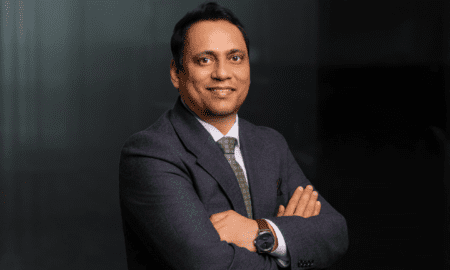
In this interview, we speak with Dzmitry Shaido, a Principal Product Designer working at the intersection of fintech, product strategy, and UX architecture. Having contributed to the growth of multiple fintech startups, he shares his perspective on designing high-trust financial products, navigating complexity in regulated environments, and why developing design thinking is becoming a critical skill for the next generation of designers.
It is often believed that designers usually come to fintech after gaining substantial experience in other industries — the cost of mistakes is too high and the cognitive demands are much more complex. You, however, started building your career in fintech almost immediately. How did that happen?
On the one hand, it was a coincidence. My very first interview, I don’t think it went particularly well. But the product owner who hired me said that they liked the structure of my thinking.
That is something I have carried throughout my entire career and what I now teach others — product and architectural thinking. I believe this is the only way to create products that can bring value to a large number of people at once. And that is probably what attracted me to fintech from the very beginning, it’s the opportunity to create value within an ecosystem with a very broad impact.
Speaking of large audiences: one of the first fintech startups you joined, Paxful, a global peer-to-peer payments fintech, reached 6 million users within a year of your work as a Lead Product Designer and announced a projected growth of 20%. In your opinion, how much does design influence metrics such as conversion and user base growth?
In 2020, crypto was still far from mass adoption and generated a lot of distrust. My task was to find product and design mechanisms that would demonstrate the platform’s accessibility and simplicity. Building trust was critical, because in crypto people are always afraid of scams — users needed to feel that everything on the platform was fast, clear, and secure.
Conversion into trades directly depended on the simplicity of the design, the quality of information delivery, and the clarity of user flows. I deliberately broke processes down into logical steps, worked carefully with texts and copy to explain crypto terminology in simple language, built a friendly visual language, and strengthened social trust signals.
As a result, design plays a huge role in increasing conversion in fintech, because it is design that turns a complex and intimidating system into a clear and trustworthy product.
You joined Blocktrade in summer 2022, and by early 2023 the company had attracted significant investment and established itself as one of the first fully gamified crypto exchanges.
What role did product and design decisions play in this, and how did you achieve such results in a relatively short time?
Unique product solutions do not appear overnight. At Blocktrade, everything started with rebuilding the application architecture, updating the design, and optimizing onboarding — the most challenging stage due to long verification processes. The product was designed for users who were not highly technical, so conducting research and understanding how they perceive financial products was essential.
In-depth interviews showed that the core audience consisted of established individuals who were used to thinking in terms of traditional finance. This led to adapting crypto language into familiar concepts, simple step-by-step flows, and a visual logic close to fiat financial products.
The next stage was full platform gamification based on launching a native token. I designed and implemented a 50-level reward system as part of the product strategy: every action earned XP, increased the user’s level, and unlocked tangible rewards. This significantly increased engagement, DAU and MAU growth, and helped attract both users’ and investors’ attention.
Alongside your core work in fintech, you have been running a course at DesignWorkout, an educational program for product designers, for quite some time. How do you define your mission there?
Yes, I have been actively involved with DesignWorkout since 2023, and during this time we have launched not just one course, but a whole series of educational projects. In short, my mission at DesignWorkout is to help designers build a solid foundation of thinking that stays with them long-term and works independently of tools, trends, or technologies.
I have participated in launching DW Lab craft intensives, workshops, and educational programs as a mentor and editor, but the most unusual project is the thinking development course. It is a continuous format with daily tasks delivered via Telegram, which thousands of designers and creative professionals from different countries have already tried or completed. Despite having no traditional beginning or end, the course retains engagement through regular practice and deep feedback.
My role there is that of a mentor and methodologist: I help structure the process so that participants develop the habit of thinking, observing, and asking questions — allowing them to grow further in product, fintech, research, or art.
You recently joined Monite, and for the company this is a year of active scaling. What key challenges do you face in your role as Principal Product Designer?
The main challenge is continuously rebuilding the product as it grows. At Monite, this means bringing order to the architecture, copy, and UX without slowing down scaling. To optimize the design, I need to establish a clear product architecture. I use Object-Oriented Design for this. It’s also necessary to eliminate inconsistencies and create documentation that connects the API architecture with design decisions. As a result, the interface becomes cohesive and unified. In B2B2B there are no proven recipes, so some solutions have to be invented along the way, in the best sense of the word.
What advice would you give to product designers who are considering a move into fintech in general, and into a fintech startup in particular?
First of all, you need to be ready to work more and at a higher intensity than in a typical company. Fintech, especially at the startup stage, is an aggressive, fast-paced environment where you have to keep learning constantly and be able to dive quickly into complex requirements.
Second, you need to think systemically. You should understand how your design decisions fit into the technical architecture, how data flows through the system, and how the product will scale tomorrow. Design can’t be treated as a set of screens — you have to see it as an interconnected system of logic and rules. It’s this shift in mindset that separates a simply good designer from someone who truly impacts the business.