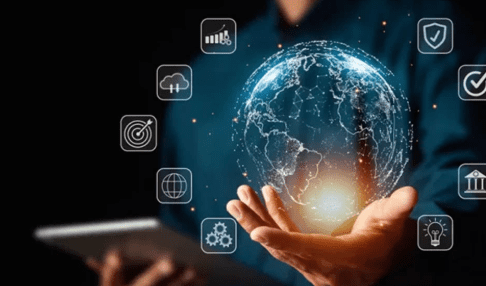
As we cross into the second quarter of 2026, the global marketplace has shifted from “Digital First” to “AI-Native.” For any modern Business, the integration of advanced Technology is no longer a strategic option but the core operating system of the enterprise. We have entered the era of the Autonomous Enterprise, where Artificial Intelligence acts as the primary orchestrator of strategy, management, and Digital Marketing.
1. The Rise of Agentic AI in Business Management
The most significant shift in 2026 is the transition from generative tools to “Agentic AI.” Unlike previous iterations that simply answered questions, these systems can now reason, plan, and execute complex business processes autonomously.
-
Autonomous Project Orchestration: Management in 2026 relies on AI agents that can negotiate with suppliers, manage internal resource allocation, and adjust project timelines in real-time. This has flattened traditional hierarchies, moving organizations toward a “Pod-based” structure where human leaders focus on high-level intent and ethical oversight.
-
Predictive Operational Excellence: Artificial Intelligence now acts as a “Digital Twin” for the entire company. Managers use these simulations to stress-test decisions before they are implemented, predicting market shifts and supply chain disruptions with over 90% accuracy.
-
The New Talent Strategy: In the 2026 Business environment, the “Reskilling War” has replaced the “Hiring War.” Management now prioritizes employees who excel in “Human-AI Collaboration”—professionals who can direct and audit autonomous systems rather than performing manual data tasks.
2. Digital Marketing and the “Generative Engine”
Digital Marketing has undergone its most radical transformation since the invention of the search engine. We have moved beyond keyword bidding into “Generative Engine Optimization” (GEO).
-
The Search-to-Conversation Pivot: Traditional search bars are being replaced by conversational canvases. Marketing strategies now focus on providing high-quality, authoritative “Brand Signals” that AI models use to synthesize answers for consumers. If your brand isn’t part of the AI’s training data or current context, it effectively doesn’t exist.
-
Hyper-Personalized Content at Scale: In 2026, Digital Marketing campaigns are “N=1.” Using Artificial Intelligence, brands generate unique video ads, personalized landing pages, and custom email sequences for every individual customer in real-time. This level of personalization has become a baseline expectation for consumers who now ignore generic “mass market” messaging.
-
The Return of Authenticity: As AI-generated content saturates the internet, “Human-Verified” content has become a premium asset. Successful businesses are balancing their high-tech automation with “Human-Centric” storytelling—using micro-influencers and user-generated content to build the social trust that algorithms alone cannot provide.
3. Technology as a Strategic Infrastructure
By 2026, the distinction between “IT” and “Strategy” has completely disappeared. Technology is now the strategic infrastructure upon which every Business goal is built.
-
Edge Intelligence and Data Sovereignty: To address privacy concerns and latency, businesses are moving their Artificial Intelligence processing to “The Edge”—running models directly on local hardware or user devices. This ensures that sensitive customer data never leaves the ecosystem, turning data privacy into a major competitive advantage.
-
Real-Time Marketing Attribution: AI now connects fragmented data points across the entire customer journey, from a voice search in a car to a purchase in a VR storefront. This allows for perfect attribution, showing exactly which digital touchpoints contributed to a sale and eliminating wasted marketing spend.
-
Sustainability Through Optimization: Advanced Technology is now the primary tool for achieving ESG (Environmental, Social, and Governance) goals. AI-driven logistics and energy management systems allow companies to scale their revenue while simultaneously reducing their carbon footprint, aligning profit with planetary health.
Summary: The 2026 Competitive Matrix
Conclusion: The Mandate for 2026
The defining characteristic of successful Business in 2026 is Intellectual Velocity. The winners are not just those with the best Artificial Intelligence, but those who can most quickly integrate that Technology into a human-centric culture. As Digital Marketing becomes more automated and management becomes more data-driven, the true differentiator will be a company’s “Intent”—the clarity of its mission and the ethics of its execution.
In this new era, the machine handles the efficiency, but the human provides the soul. The path to growth lies in mastering the intersection of both.