Modern security teams have more telemetry than ever, yet one question often remains unanswered during an incident: What did the application actually do? A web application firewall may identify a suspicious request, while endpoint detection and response may flag a new process or connection. Between those events lies the application runtime, where inputs become function calls, libraries execute, authorization decisions are made, and data is accessed. This is the gap that application detection and response is designed to address.
Closing that gap does not mean replacing WAF or EDR. Each control observes a different layer: a WAF typically inspects HTTP traffic before it reaches code, while EDR watches operating-system activity. Neither necessarily understands the complete chain of events inside a running application. Runtime visibility adds that context.
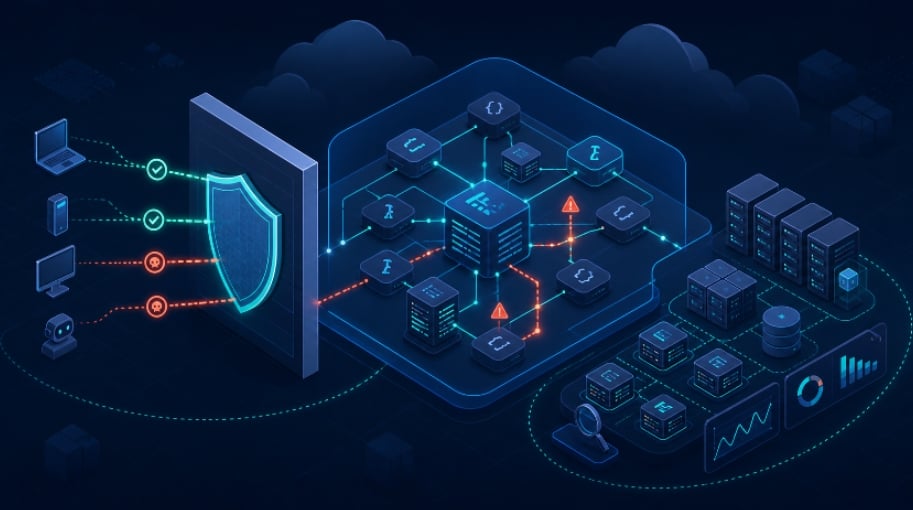
What WAF and EDR Tools Are Built to See
A WAF and an EDR platform solve different problems, and neither was designed to explain application logic.
WAF: inspecting traffic at the edge
A WAF analyzes HTTP conversations and applies rules or models to identify malicious requests. It can block common payloads, enforce request constraints, and rate-limit clients, making it a valuable first line of defense.
However, a request can be syntactically valid and still produce a dangerous result. An authenticated user might exploit a flawed workflow, manipulate an object identifier, abuse a permitted feature at scale, or combine ordinary actions in an unexpected sequence. Because the traffic looks legitimate in isolation, an edge control may lack the business and execution context needed to distinguish abuse from normal use.
EDR: watching the operating system
EDR focuses on endpoint or workload behavior. Depending on the environment, it may detect suspicious process creation, file changes, persistence mechanisms, credential access, or network connections. That visibility is essential when an attack reaches the operating-system layer.
But many application attacks do not produce an obviously malicious system event. A vulnerable function may query records the user should not see, or a trusted library may process attacker-controlled data. To an endpoint tool, the same process is still running; the security significance exists inside its execution path.
Why Modern Application Attacks Create a Blind Spot
Applications combine frameworks, open-source packages, APIs, managed services, databases, and short-lived cloud workloads. One user action may cross several services before completing.
This complexity creates room for attacks that evade controls focused on requests or hosts alone. Common examples include:
– Business-logic abuse that uses valid features for an unauthorized purpose
– Injection payloads that are encoded, fragmented, or transformed before execution
– Exploitation of a vulnerable dependency through an otherwise normal request
– Authorization failures that expose another user’s data without launching malware
The challenge is connecting the initiating request to the affected service, code path, dependency, data operation, and downstream effect. Without that chain, responders must correlate edge logs, application logs, cloud events, and endpoint alerts by hand.
What Runtime Application Visibility Adds
Runtime security observes behavior while code executes, capturing context that external controls cannot reliably provide.
Execution context instead of isolated events
A useful runtime signal explains how an event occurred. It can associate an incoming request with the functions or components that handled it, the identity involved, the data resource accessed, and the resulting action. That context helps distinguish a harmless validation error from a successful exploit.
An outbound connection is not automatically malicious. If runtime evidence shows it followed unexpected deserialization, execution of a rarely used library, and access to a sensitive credential, the event becomes more urgent. Known application behavior may also help analysts close a noisy alert faster.
Faster investigation and response
Runtime telemetry can reduce time spent reconstructing an incident. Responders can determine whether vulnerable code executed, what it touched, and whether the behavior continued across services.
That evidence improves response decisions. A team may block a request pattern, revoke a token, isolate a workload, disable a feature, or roll back a deployment. The right action depends on understanding what happened.
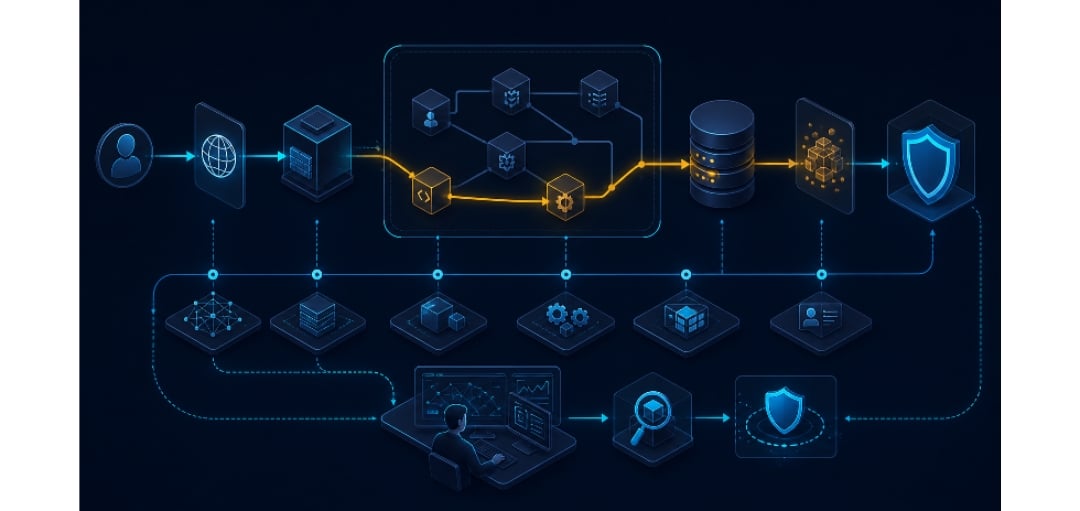
Building a Layered Application Defense
Runtime monitoring is most effective as part of a broader application security program. No single control can cover every stage of an attack.
Keep preventive controls in place
Secure design, code review, dependency management, testing, patching, identity controls, and least privilege reduce the number of exploitable paths. A WAF can stop known or recognizable malicious traffic before it consumes application resources. EDR and cloud workload protections can detect activity that crosses into the host, container, or operating system.
Runtime visibility complements these measures by showing how the application behaves when preventive controls are bypassed or when abuse does not resemble a conventional payload.
Connect telemetry to a response process
Collecting more data is not the objective; producing actionable evidence is. Teams should define which runtime events matter, how they are correlated with request, identity, deployment, and endpoint data, and who owns the response.
Useful practices include assigning a consistent interaction or trace identifier, recording security-relevant successes and failures, protecting logs from tampering, and routing high-confidence findings into existing incident workflows. Application and security teams should also rehearse response scenarios so that an alert can lead quickly to containment and remediation.
Evaluate runtime capabilities carefully
Before adopting any runtime security approach, validate it against the organization’s architecture and operating model. Key questions include:
– Which languages, frameworks, services, and deployment models are supported?
– Can signals be tied to requests, identities, code paths, releases, and data access?
– How does the approach handle ephemeral containers and distributed services?
– What performance overhead and operational maintenance does it introduce?
– Can sensitive application data be minimized, masked, and retained appropriately?
– Does it integrate with existing SIEM, SOAR, ticketing, and response controls?
– Can the team test detections safely and measure false positives?
A proof of concept should use representative workloads and realistic attack scenarios, including business-logic misuse—not only familiar injection tests.
See the Application as Part of the Security Boundary
WAF and EDR technologies remain valuable because they monitor important control points. Their limitations arise when organizations expect either tool to explain activity occurring at a different layer.
The application is not a black box between the network and the operating system. It is an active security boundary where identity, code, dependencies, and data interact. Adding runtime context gives defenders a clearer account of that interaction, improves the quality of investigations, and helps existing controls respond with greater precision. The strongest strategy is not a contest between tools; it is coordinated visibility across the edge, the application, and the workload.