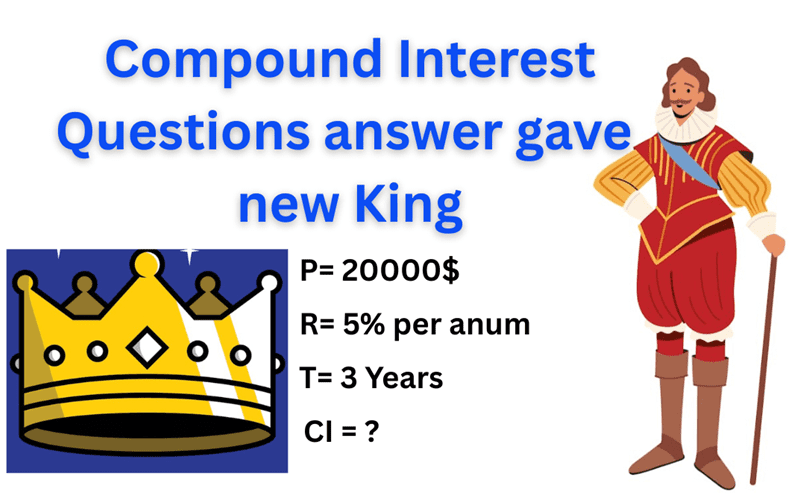
Long before ledgers were digital and calculations could be done in seconds, the prosperous kingdom of Varanvale thrived on discipline, trade, and carefully guarded wealth. Its gold reserves were legendary, its merchants respected across borders—but behind the marble walls of the royal palace, uncertainty quietly grew.
King Rudrayan, ruler of Varanvale for three decades, lay ill.
His physicians whispered among themselves. His strength faded day by day. And the greatest fear was not death itself—but what would follow. The King had no heir.
“A kingdom does not collapse when a king dies,” Rudrayan once said, “it collapses when the wrong man rules.”
So he decided on an unusual test.
Rather than choosing a successor by blood or battlefield glory, he would choose a ruler by intelligence, especially in finance and mathematics, the backbone of any lasting empire.
Two servants were summoned to the court.
The first was Rajan, confident and eloquent, known for his sharp tongue and faster answers. The second was Nirav, calm and observant, a man who spoke little but listened deeply. Both had served the King faithfully for years.
The royal hall fell silent as the King raised his hand.
“I will ask one question,” Rudrayan said, his voice weak but firm. “Your answers will tell me whether you understand wealth… or merely count coins.”
He paused.
“Suppose $20,000 is invested at a 5% rate of interest per annum for two years. Tell me—how much money will there be at the end of two years?”
Rajan stepped forward instantly.
“Your Majesty,” he declared, “five percent of twenty thousand is one thousand dollars per year. Over two years, the interest becomes two thousand dollars. Therefore, the total amount is $22,000.”
Several ministers nodded. The answer was quick, clean, and familiar.
Rajan smiled.
Then Nirav stepped forward.
“Your Majesty,” he said quietly, “that answer assumes simple interest. But investments often grow through compound interest, where interest earns interest.”
A murmur rippled through the hall.
Nirav continued, “Using compound interest, the amount after two years becomes $22,050.”
Rajan scoffed. “Fifty dollars? That difference is meaningless.”
The King did not smile.
“Small mistakes,” he said, “sink great kingdoms.”
Unsure whom to believe, the King ordered the arrival of Acharya Vedanand, the royal mathematician—an old scholar whose calculations were trusted even more than swords.
When the Acharya arrived, the King explained the problem.
The scholar nodded and turned to the court.
“Let us understand this properly,” he said. “Because a ruler who does not understand why will always be ruled by chance.”
He began with simple interest.
“Simple interest is calculated only on the original amount.”
He wrote:
Simple Interest = P × R × T
“Here:
P = 20,000
R = 0.05
T = 2
So:
20,000 × 0.05 × 2 = 2,000
Add this to the principal, and the total becomes $22,000.”
Rajan straightened proudly.
Then the Acharya raised a finger.
“But compound interest,” he said, “is different. It allows money to grow on itself.”
He continued slowly, ensuring everyone understood.
“In the first year, the calculation is:
20,000 × 1.05 = 21,000
In the second year, interest is calculated on 21,000, not the original amount:
21,000 × 1.05 = 22,050.”
He underlined the final number.
“In ancient times,” the Acharya added, “there were no tools or devices to instantly verify such calculations. No tables beyond parchment. No machines. A single mathematical misunderstanding could cost a kingdom dearly. Today, people are fortunate—because they can cross-check such results instantly using a reliable Compound Interest Calculator instead of relying purely on mental arithmetic.”
The court listened carefully.
The Acharya turned toward the King.
“Both answers are mathematically correct,” he said. “But they answer different questions. Rajan solved for simple interest. Nirav understood compound interest—the form most relevant to long-term growth.”
Rajan protested. “But the difference is only fifty dollars!”
The Acharya replied calmly, “In two years, yes. Ten years? On twenty? On a kingdom’s treasury? That difference becomes the line between prosperity and ruin.”
The King closed his eyes for a moment.
“Tell me, Acharya,” he said, “what matters more in a ruler—confidence or correctness?”
“Correctness,” the scholar answered. “Confidence without understanding is the most expensive mistake.”
The King looked at Nirav.
“You did not rush,” Rudrayan said. “You did not boast. You understood how money grows—not just how it is counted.”
He turned to the ministers.
“Write this into our history: Varanvale will be ruled by a mind that understands growth, patience, and precision.”
Rajan lowered his head.
Nirav bowed deeply.
That day, the kingdom learned a lesson far greater than numbers.
Simple interest is what fools count.
Compound interest is what wise rulers understand.
And long after King Rudrayan was gone, the treasury of Varanvale remained strong—not because of gold alone, but because its rulers understood the mathematics behind wealth.