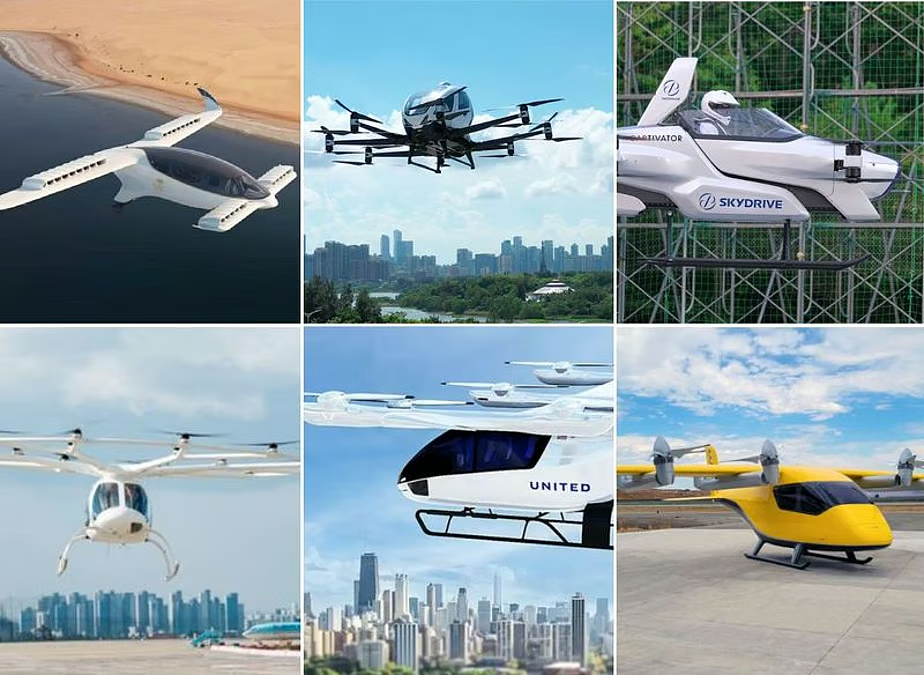
In 2026, the automotive industry has crossed an irreversible inflection point. We are no longer buying “Cars”; we are subscribing to Software-Defined Vehicles (SDVs)—high-performance computers on wheels that happen to transport passengers. The global SDV market is valued at $470 billion this year, dwarfing the traditional mechanical engineering sector. Meanwhile, the “Third Dimension” of travel has opened: the first commercial eVTOL (electric Vertical Take-Off and Landing) networks are launching in Miami and London this month. For a modern Business, profit now comes from “Feature-on-Demand” subscriptions rather than one-time sales. Digital Marketing has likewise evolved, shifting from “Horsepower and Chrome” to “In-Cabin Experience and Algorithmic Safety.”
The Technological Architecture: The SDV & The Sky-Link
By 2026, the vehicle is a “Living Platform,” constantly evolving via the cloud.
-
Zonal Architecture & Centralized Compute: 2026 vehicles have moved away from hundreds of individual tiny computers to a “Zonal” system—a few massive, AI-powered “Brains” that control everything from braking to the infotainment. This Technology has reduced vehicle wiring weight by 60kg, significantly boosting the range of EVs.
-
The eVTOL “Vertiport” Mesh: Urban Air Mobility is no longer sci-fi. 2026 marks the opening of the first Vertiports—compact, solar-powered hubs on top of parking garages and train stations. These hubs use Digital Twin orchestration to manage “De-confliction,” ensuring thousands of quiet, electric sky-taxis can fly over cities without noise pollution or safety risks.
-
V2X (Vehicle-to-Everything) Communication: Using 5G-Advanced and satellite links, 2026 vehicles “talk” to stoplights, pedestrians’ phones, and other cars. This creates a “Collective Intelligence” where a car three miles ahead can warn your vehicle about a patch of ice or a sudden traffic surge.
Artificial Intelligence: The “Eyes-Off” Co-Pilot
In 2026, Artificial Intelligence has transitioned from “Assisting” the driver to “Orchestrating” the journey.
1. Level 3+ “Conditional” Autonomy
Major manufacturers like Mercedes, Honda, and Waymo have scaled Level 3 and Level 4 autonomy in urban corridors. Using Transformer-based Deep Learning, these AI pilots can handle “Edge Cases”—like a cyclist swerving or a dog running into the road—with 45% better accuracy than 2024 models.
2. Agentic In-Cabin Personalization
The 2026 car knows who you are. Agentic AI in the cabin uses biometrics and voice recognition to adjust the seating, climate, and “Visual Mood” (via AR windows) to your heart rate and schedule. If your AI detects you are late for a meeting, it automatically coordinates with the city’s Traffic Orchestrator to find the fastest “Green Light” path.
3. AI Digital Chassis & Predictive Safety
AI now manages the “Physics” of the drive. The AI-Driven Digital Chassis adjusts suspension and torque in milliseconds, reacting to road imperfections before you feel them. Predictive safety systems now use AI to “see” around corners by synthesizing data from the city’s CCTV mesh.
Digital Marketing: The Shift to “The 25th Hour”
Digital Marketing in 2026 is no longer about the “Joy of Driving,” but the “Freedom of Doing.”
-
Marketing “The 25th Hour”: As cars become autonomous, marketers are selling the “Recovered Time.” Campaigns for new SDVs focus on the vehicle as a “Mobile Office,” a “Private Cinema,” or a “Meditation Pod.” The value proposition is: “We give you your commute back.”
-
AEO (Answer Engine Optimization) for Mobility: As commuters ask their AI, “What is the fastest, lowest-carbon way to get to the airport?”, Mobility-as-a-Service (MaaS) providers are optimizing their real-time “Resilience Scores” to ensure their eVTOL or Robo-shuttle is the top recommendation.
-
Hyper-Contextual Transit Ads: In 2026, the vehicle’s interior windows are AR-enabled displays. Marketers serve ads based on the car’s geographic location and the passenger’s intent. Passing a local café might trigger a holographic “Morning Special” coupon on the window, visible only when the AI detects the passenger hasn’t had breakfast.
Business Transformation: From “Owners” to “Users”
The internal Business model of transport has moved to a “Recurring Revenue” framework.
-
Mobility-as-a-Service (MaaS): By 2026, 37% of Gen Z urbanites have opted out of car ownership entirely. They use unified apps that bundle e-scooters, autonomous shuttles, and eVTOL flights into a single monthly Mobility Subscription.
-
Feature-on-Demand (FoD): The hardware you buy is just the base. In 2026, you can “Unlock” features like “Snow Mode” for a weekend ski trip or “Advanced Autonomy” for a long highway drive via an Over-the-Air (OTA) update. This has turned cars into “App Stores on Wheels.”
-
Data Monetization & Fleet Management: Automotive OEMs (Manufacturers) are transforming into Data Companies. They monetize the petabytes of “Street-Level Data” their sensors collect—selling insights on road wear to cities or foot-traffic patterns to retailers.
Challenges: The “Noise” Problem and Regulatory Fragmentation
The 2026 mobility revolution faces two major “Speed Bumps.”
-
Public Acceptance & Noise: NASA research in February 2026 shows that urban residents are highly sensitive to the “unfamiliar whine” of eVTOLs. The professional challenge is designing “Acoustic signatures” that blend into city backgrounds to gain community approval.
-
The “Zonal” Regulatory War: Transport laws are fragmented. A vehicle might be “Level 4 Autonomous” in one city but require a “Hands-on-Wheel” in the next. 2026 is a year of intense lobbying for Harmonized Autonomous Standards to allow borderless travel.
Looking Forward: Toward “Frictionless Earth”
As we look toward 2030, the “Transport Sector” is moving toward “Infinite Connectivity.” We are approaching a world where the act of “traveling” becomes as seamless as streaming a movie—a background service that manages itself while you focus on the destination.