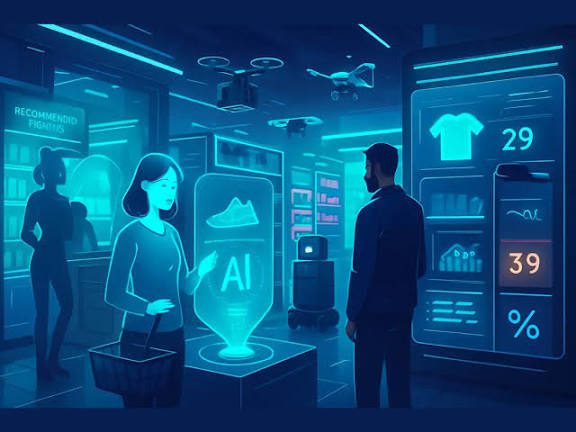
The retail sector has long been the frontline of consumer-facing innovation, but 2026 marks a total departure from the traditional “catalog-and-cart” model. We have entered the era of the “Intelligent Storefront,” where the boundary between a physical shop and a digital app has effectively dissolved. This revolution is powered by the convergence of advanced Technology and Artificial Intelligence, creating a retail environment that is predictive rather than reactive. For any modern Business, the challenge is no longer just about selling products; it is about orchestrating a seamless, high-value experience across every touchpoint. In this landscape, Digital Marketing has transformed into a real-time concierge service, guiding shoppers through a personalized journey that feels less like an advertisement and more like a tailored consultation.
The Technology of the Unified Retail Ecosystem
In 2026, the technological backbone of retail is the “Unified Commerce Engine.” This is a cloud-native architecture that treats every sales channel—be it a flagship store, a mobile app, or a social media shop—as a single, interconnected node.
-
Computer Vision and Autonomous Checkout: Physical retail locations have matured into high-tech environments. Using sophisticated computer vision and sensor fusion, “Just Walk Out” technology has moved from a pilot phase to a global standard. This removes the friction of the checkout line, allowing the human staff to focus on high-value roles like brand storytelling and technical product advice.
-
5G-Enabled “Phygital” Interactivity: High-speed connectivity allows for real-time data exchange between a shopper’s device and the store’s infrastructure. For instance, as a customer approaches a shelf, their smartphone can display an AR (Augmented Reality) overlay showing personalized discounts, compatibility with previous purchases, or a “Carbon Footprint” score for the product.
-
Edge Computing for Privacy: To maintain professional standards of data security, much of the AI processing in retail now happens at “The Edge.” This means customer movements and preferences are analyzed locally within the store or on the device, rather than being sent to a central server, ensuring high-speed responsiveness while protecting user privacy.
Artificial Intelligence: The New Retail Architect
Within the Business of retail, Artificial Intelligence is now responsible for the “Heavy Lifting” of decision-making, from the warehouse to the web-front.
1. Agentic Shopping Assistants
The “Chatbot” of the early 2020s has been replaced by the “Shopping Agent.” These are sophisticated AI entities that possess a deep understanding of the brand’s entire catalog, as well as the individual customer’s history. These agents don’t just answer questions; they proactively suggest “Complete the Set” bundles, manage returns through conversational voice chat, and even negotiate limited-time loyalty rewards to close a sale.
2. Predictive Inventory and “Demand Sensing”
Stockouts and overstocking are being eliminated by AI-driven “Demand Sensing.” By analyzing thousands of variables—including local weather patterns, social media trends, and geopolitical shifts—AI can predict a surge in demand before it happens. This allows a Business to move inventory to where it is needed most, reducing waste and ensuring that the “Digital Marketing” promise of “In Stock” is always fulfilled.
3. Hyper-Personalized Dynamic Pricing
In 2026, pricing is no longer a static number. AI algorithms now perform “Elasticity Modeling” in real-time. A professional retailer can offer a “Loyalty Price” to a returning customer or a “Bundle Discount” that is generated on the fly based on the items in a shopper’s digital cart. This ensures maximum value for the customer while optimizing the profit margins for the business.
[Image showing an AI-powered retail dashboard with real-time foot traffic and heat-map analytics]
Digital Marketing: From Interruption to Integration
The role of Digital Marketing in the 2026 retail landscape has evolved into “Search Everywhere Optimization” (SEO 2.0). Brands are no longer just competing for a spot on a search engine; they are competing for a spot in the AI’s “Synthesized Answer.”
-
Generative Engine Optimization (GEO): Marketers now focus on structuring their product data so it can be easily read and recommended by AI assistants like ChatGPT, Gemini, and specialized retail agents. Professionalism in this space means providing high-quality, authoritative content that an AI can use to explain the benefits of a product to a user.
-
Livestream and Social Commerce: The “Social Storefront” is the new shopping mall. Using AI to manage the logistics, brands are hosting interactive livestreams where viewers can purchase products with a single click or even a voice command. The AI acts as a “Moderator-Marketer,” answering questions in the chat and highlighting products that match the current sentiment of the audience.
-
Predictive Lifecycle Marketing: Instead of “Batch-and-Blast” emails, Digital Marketing now uses AI to trigger messages based on “Predicted Need.” If a customer’s purchase history suggests they are about to run out of a consumable product—like skincare or coffee—the system sends a personalized “Refill” reminder exactly 48 hours before the predicted depletion.
The Professional Shift: The Human-in-the-Loop
As Technology handles the logistics, the professional workforce in retail is moving toward “Creative and Strategic Oversight.”
The modern retail manager is an “AI Orchestrator.” Their job is to monitor the AI’s performance, ensuring that the dynamic pricing stays within ethical guardrails and that the personalized marketing remains brand-aligned. Trust is the most scarce resource in 2026; therefore, a professional Business must ensure its AI is transparent and its data collection is consensual. This “Human-AI Synergy” is what separates leading global brands from generic competitors.
Challenges and the Ethics of Influence
The power of AI to influence consumer behavior brings significant ethical responsibilities.
-
Algorithmic Bias: Retailers must ensure that their AI-driven recommendations and credit offers do not discriminate based on demographic data.
-
The “Privacy Paradox”: While consumers want personalization, they also want total control over their data. Professional retailers are adopting “Zero-Knowledge” marketing techniques, where the AI can provide a personalized experience without the company ever needing to store the user’s raw personal data.
Looking Ahead: The “Direct-to-Avatar” Economy
As we look toward the end of the decade, retail is moving toward the “Meta-Retail” space. We are seeing the rise of the “Direct-to-Avatar” (D2A) model, where businesses sell digital goods and experiences that are as valuable as physical products. AI will be the primary designer in this space, creating infinitely customizable digital assets that reflect the user’s unique identity.
Conclusion
The integration of Technology, Business innovation, Digital Marketing, and Artificial Intelligence has transformed retail from a simple transaction into a sophisticated relationship. The “Intelligent Storefront” is not just about automation; it is about using data to become more helpful, more relevant, and more human. By embracing these tools, professional retailers can build resilient brands that thrive in a world where the only constant is change.