The retail industry has officially moved past the “Omnichannel” era into the age of Unified Commerce. In 2026, the boundary between the physical store and the digital screen has completely evaporated. This transformation is driven by the convergence of advanced Technology—specifically Augmented Reality (AR) and Computer Vision—and Artificial Intelligence, creating a “Spatial Commerce” ecosystem where every environment is shoppable. For a modern Business, the objective has shifted from transactional efficiency to “Relationship Continuity.” Meanwhile, Digital Marketing has evolved into a hyper-personalized recommendation engine that doesn’t just respond to consumer demand but anticipates it through predictive behavioral modeling.
The Technological Foundations: The Rise of Spatial Commerce
In 2026, the “store” is no longer a destination; it is a layer of the physical world.
-
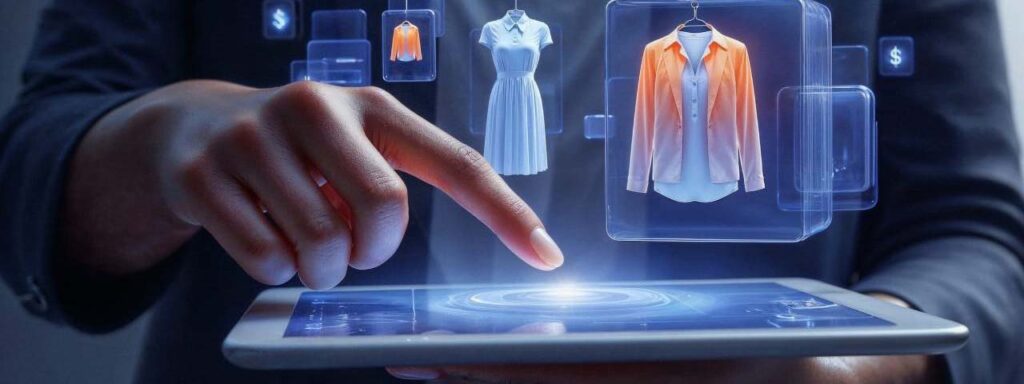
Augmented Reality (AR) Glass Integration: With the mass adoption of lightweight AR glasses, consumers now see a “Digital Overlay” on physical products. Looking at a pair of shoes in a window display instantly surfaces size availability, customer reviews, and a “Virtual Try-On” feature that projects the shoes onto the user’s feet in real-time.
-
Computer Vision and “Just-Walk-Out” 2.0: The Technology that powered early automated convenience stores has scaled to large-format retail. AI-driven camera arrays track item selection with 99.9% accuracy, allowing for a frictionless “Grab-and-Go” experience across apparel, electronics, and groceries.
-
The Smart Fitting Room: Fitting rooms have become data hubs. Smart mirrors suggest coordinating accessories based on the item brought in, allow users to change the ambient lighting to see how an outfit looks at “Sunset” or “Office,” and enable instant checkout via voice or gesture.
Artificial Intelligence: The Brain of the “Predictive Retailer”
In 2026, Artificial Intelligence acts as the central nervous system for retail operations, moving from inventory management to “Intuitive Merchandising.”
1. Agentic Personal Shoppers
Every consumer now has a persistent AI “Style Agent.” This agent understands the user’s current wardrobe, budget, and upcoming calendar events. When a user has a wedding in three weeks, the AI agent “scouts” global inventory, negotiates the best price, and presents the user with a curated selection of outfits that are guaranteed to fit based on the user’s 3D body scan.
2. Dynamic Micro-Fulfillment
For a Business, AI has solved the “Last-Mile” problem. Using predictive analytics, retailers now move inventory to “Micro-Fulfillment Centers” in residential neighborhoods before the orders are even placed. This allows for “Sub-30-Minute Delivery,” fulfilling the consumer’s demand for instant gratification while minimizing the carbon footprint of logistics.
3. Generative Visual Merchandising
Retailers are using Generative AI to create “Infinite Storefronts.” A website or AR display will look different for every user; a minimalist will see a clean, sparse layout, while a maximalist will see a vibrant, accessory-heavy environment. This “Visual Personalization” has increased conversion rates by over 40% compared to static designs.
Digital Marketing: From “Interruption” to “Intention”
Digital Marketing in 2026 is no longer about “chasing” the customer; it is about being present at the moment of intent.
-
The “Zero-Click” Journey: Marketers are optimizing for “Autonomous Purchases.” If a household’s smart fridge detects they are low on milk, the AI agent handles the purchase based on the brand loyalty parameters set by the consumer. Marketing success is now measured by “Agentic Preference”—ensuring your brand is the “Default Choice” for the AI.
-
Contextual “Vibe” Targeting: Traditional demographic targeting (age/location) is dead. AI-driven marketing now targets “Vibes” and “Contexts.” A brand might serve an ad for high-end headphones specifically when a user’s biometric data suggests they are in a high-stress environment and looking for “Auditory Sanctuary.”
-
Community-Led Social Commerce: The “Influencer” has evolved into the “Community Curator.” Brands provide their top advocates with AI tools to create their own “Digital Boutiques,” where the advocate’s followers can shop a curated, AI-fitted collection. This turns marketing into a decentralized peer-to-peer network.
Business Transformation: The “Experience-as-a-Service” Model
The internal structure of a professional retail Business has shifted from “Product Sales” to “Experience Orchestration.”
-
The Death of the “Cashier,” the Rise of the “Concierge”: With checkout automated by Technology, the role of the retail employee has been elevated. Staff are now “Brand Ambassadors” and “Expert Consultants,” focused on building deep human connections and providing specialized product knowledge that an AI cannot yet replicate.
-
Sustainability Transparency: In 2026, every product has a “Digital Passport.” Through a quick scan, consumers can see the entire lifecycle of an item—from the ethical sourcing of raw materials to the carbon cost of its delivery. This “Radical Traceability” is a core requirement for brand loyalty in a professional marketplace.
-
Circular Economy Integration: Leading retailers are building “Resale and Repair” directly into their business models. AI tracks the condition of a product throughout its life, prompting the user when it’s time for a repair or offering a “Trade-In” value when the user is ready for something new.
Challenges: Data Privacy and the “Filter Bubble”
The move to an AI-driven retail landscape brings significant ethical hurdles.
-
The Privacy Paradox: To provide “Predictive Commerce,” brands need access to deep personal data. The “Professional Standard” of 2026 is “Privacy-by-Design,” where data is processed locally on the user’s device rather than in a centralized cloud.
-
The Discovery Gap: There is a risk that AI “Filter Bubbles” prevent consumers from discovering new, unexpected brands. Marketers must build “Serendipity Algorithms” that occasionally introduce users to items outside their established patterns to keep the brand experience fresh.
Looking Forward: The “Invisible Retail” Future
As we look toward the end of the decade, we are moving toward “Invisible Retail”—where the friction of buying is so low that the act of “shopping” disappears into the act of “living.” We will see the rise of “Biometric Payments” (paying with a glance) and “Tele-Presence Shopping,” where users can virtually join a friend in a physical store across the world.
Conclusion
The convergence of Technology, Business, Digital Marketing, and Artificial Intelligence has turned retail into a high-tech, high-touch industry. In 2026, the most successful brands are those that treat the consumer not as a target, but as a partner in a continuous, intelligent dialogue. By embracing Spatial Commerce and predictive intelligence, the retail professionals of 2026 are building a world where the things we need—and the things we love—are always just one “thought” away.