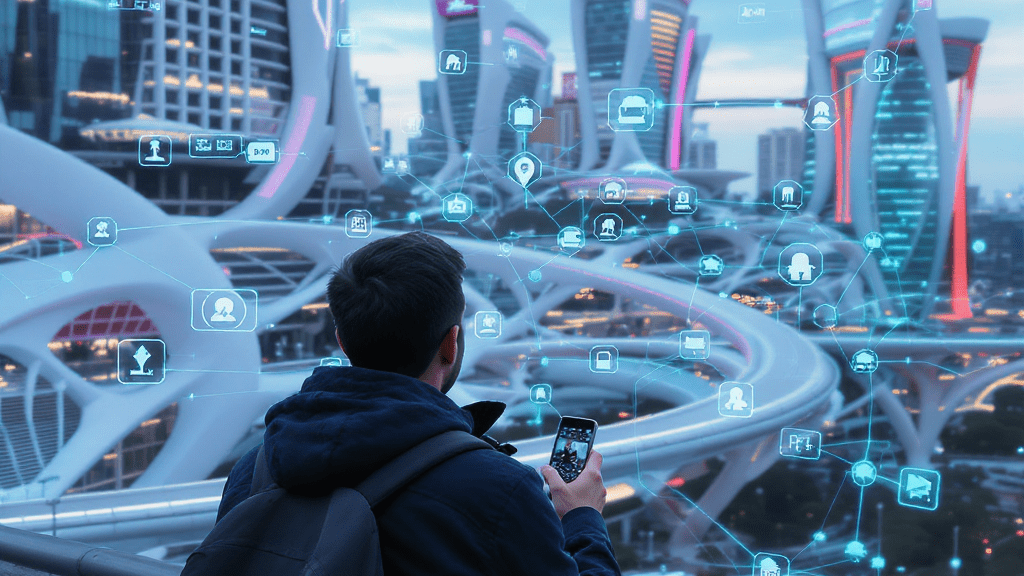
The global travel and hospitality industry has moved far beyond the “recovery” phase of the early 2020s. In 2026, we have entered the era of the “Intelligent Journey”—a paradigm where Technology and Artificial Intelligence work in the background to remove every friction point from the traveler’s experience. For the modern Business, corporate travel is no longer a logistical headache but a strategic tool for relationship building, optimized by AI to ensure maximum ROI and minimum environmental impact. As the definition of “service” evolves, Digital Marketing in the hospitality sector has shifted from selling rooms to selling “Contextual Experiences,” using deep data to predict a traveler’s needs before they even check into their flight.
The Technological Architecture of 2026 Travel
The infrastructure of 2026 travel is built on “Seamless Connectivity” and “Biometric Fluidity.” The goal is a “Zero-Touch” journey from the front door to the hotel room.
-
Universal Biometric Identity: Technology has matured to the point where a traveler’s face or palm print is their passport, boarding pass, and hotel key. This “Single Token” identity, secured by decentralized blockchain protocols, has eliminated airport queues and front-desk check-ins, allowing professional travelers to move through international hubs with unprecedented speed.
-
The “Connected Cabin” and Smart Rooms: 5G-enabled IoT sensors are now standard in both aircraft and hotel rooms. These sensors adjust lighting, temperature, and even air quality based on the traveler’s circadian rhythm and historical preferences. For the Business traveler, this means landing in a new time zone with significantly reduced jet lag and higher cognitive performance.
-
Sustainable Aviation Technology: The 2026 travel sector is defined by the “Green Transition.” From Sustainable Aviation Fuel (SAF) to electric short-haul “Air Taxis” (eVTOLs), technology is finally decoupling the growth of global travel from its carbon footprint.
Artificial Intelligence: The Virtual Travel Concierge
In 2026, Artificial Intelligence has evolved into a “Proactive Travel Agent” that manages the complexity of global movement in real-time.
1. Agentic Itinerary Management
Modern travel platforms utilize “Agentic AI” that doesn’t just book a flight but manages the entire trip ecosystem. If a meeting in New York runs late, the AI agent autonomously rebooks the flight, updates the hotel reservation, notifies the ride-sharing service, and sends a revised itinerary to the traveler’s professional calendar—all without the user needing to open an app.
2. Predictive Pricing and “Fair-Value” Algorithms
For a Business, travel expenses are now managed by AI-driven procurement tools. These systems use predictive analytics to identify the “Value Sweet Spot”—booking travel at the exact moment when the combination of price, route efficiency, and sustainability targets is optimal. This has turned corporate travel into a data-driven science rather than an administrative burden.
3. Real-Time Translation and Cultural Intelligence
Language barriers have effectively been dissolved by AI-powered “Earbuds” and mobile interfaces that provide near-instant, high-fidelity translation. Furthermore, these systems provide “Cultural Nudges,” informing the professional traveler of local business etiquette and social norms in real-time, ensuring that global Business interactions are respectful and effective.
Digital Marketing: From Room Sales to “Contextual Curation”
Digital Marketing in the hospitality sector has moved away from broad discounts toward “Micro-Moment Personalization.”
-
Intent-Based Experience Design: Through Artificial Intelligence, hotels can now identify the reason for a trip. If the data suggests a traveler is visiting for a high-stakes negotiation, the marketing materials sent to them will focus on quiet workspaces and “executive focus” amenities. If the trip is for a team-building retreat, the content shifts to social spaces and group activities.
-
The Rise of “Search-by-Vibe”: Traditional SEO has been replaced by “Contextual Discovery.” Travelers now ask their AI assistants, “Find me a hotel in Tokyo that is quiet, has high-speed fiber for video calls, and is within walking distance of the financial district.” Marketers must ensure their digital assets are structured to answer these complex, multi-variable queries.
-
VR-First Marketing: Before booking a multi-million dollar corporate event, planners now use AI-generated VR simulations to “walk through” the venue. They can see exactly how the branding will look on the screens, test the flow of the buffet, and even simulate the acoustics of the keynote hall.
Business Transformation: The “Experience-First” Model
The internal operations of the hospitality Business are being redefined by the need for “Operational Agility.”
-
Dynamic Staffing and Robotics: Hotels use AI to predict occupancy levels with 99% accuracy, allowing for “Dynamic Staffing.” In the background, autonomous robots handle the “heavy lifting” of laundry, room service delivery, and luggage transport, allowing human staff to focus on high-touch guest relations.
-
The “Work-from-Anywhere” Infrastructure: Professional hospitality brands have pivoted to support the “Digital Nomad” and “Bleisure” (Business + Leisure) trends. Rooms are now designed as high-tech studios, equipped with professional-grade video conferencing and ergonomic setups, turning the hotel into a distributed office network.
-
Real-Time Sustainability Reporting: In 2026, a hotel’s “Sustainability Score” is as important as its star rating. AI-driven energy management systems provide guests with a real-time “Carbon Receipt,” showing exactly how their stay impacted the environment and what the hotel is doing to offset it.
Professional Challenges: The “Authenticity Gap” and Data Trust
As travel becomes more automated, the challenge for the industry is maintaining “Human Warmth.”
-
The Privacy Imperative: With the rise of biometric travel, the “Social Contract” between the traveler and the Business depends on absolute data security. Professional organizations must be transparent about how data is used and provide “Opt-Out” options for those who prefer traditional methods.
-
Guarding Against “AI Generic-ism”: There is a risk that AI-curated experiences become too predictable. The most successful luxury brands are those that use Technology to handle the logistics but empower their human staff to provide the “Unexpected Delights”—the unique, non-algorithmic moments that define true hospitality.
Looking Forward: The Era of “Space Tourism” and Hyper-Speed Rail
As we look toward the late 2020s, the frontier of travel is expanding. We are seeing the first commercial “Space Hotels” and the expansion of AI-managed Hyper-speed rail networks that can compete with regional aviation. In this future, the synergy between Technology, Business, Digital Marketing, and Artificial Intelligence will continue to shrink the world, making global collaboration faster, greener, and more intelligent.
Conclusion
The convergence of Technology, Business, Digital Marketing, and Artificial Intelligence has turned travel from a logistical chore into an intelligent extension of professional life. In 2026, the strongest travel brands are those that use data to become “Invisible Partners” in the journey. By embracing the power of intelligence, the hospitality sector is proving that even in a digital world, the value of the “Human Encounter” remains the ultimate goal—now supported by a global infrastructure that is as smart as the travelers it serves.