In 2026, the agricultural sector is undergoing its most significant shift since the Green Revolution. We have entered the era of “Precision Sovereignty,” where Technology and Artificial Intelligence are no longer just tools for efficiency but the foundation of global food security. The traditional Business of farming has evolved into a high-tech data enterprise, where every seed, drop of water, and gram of fertilizer is optimized by predictive algorithms. As the climate becomes more volatile, the ability to build “Resilient Supply Chains” has become the primary metric of success. Simultaneously, Digital Marketing in the AgTech space has shifted from selling equipment to selling “Verified Sustainability,” using blockchain and AI to provide consumers with absolute transparency from farm to fork.
The Technological Architecture: The Rise of the Smart Farm Ecosystem
By 2026, the “Smart Farm” has moved from a collection of isolated gadgets to a unified, autonomous ecosystem.
-
The IoT Nervous System: Modern fields are embedded with millions of optical, acoustic, and electromagnetic sensors. These sensors provide a real-time “Health Map” of the soil, monitoring everything from microbial diversity to moisture levels at a granular, meter-by-meter level.
-
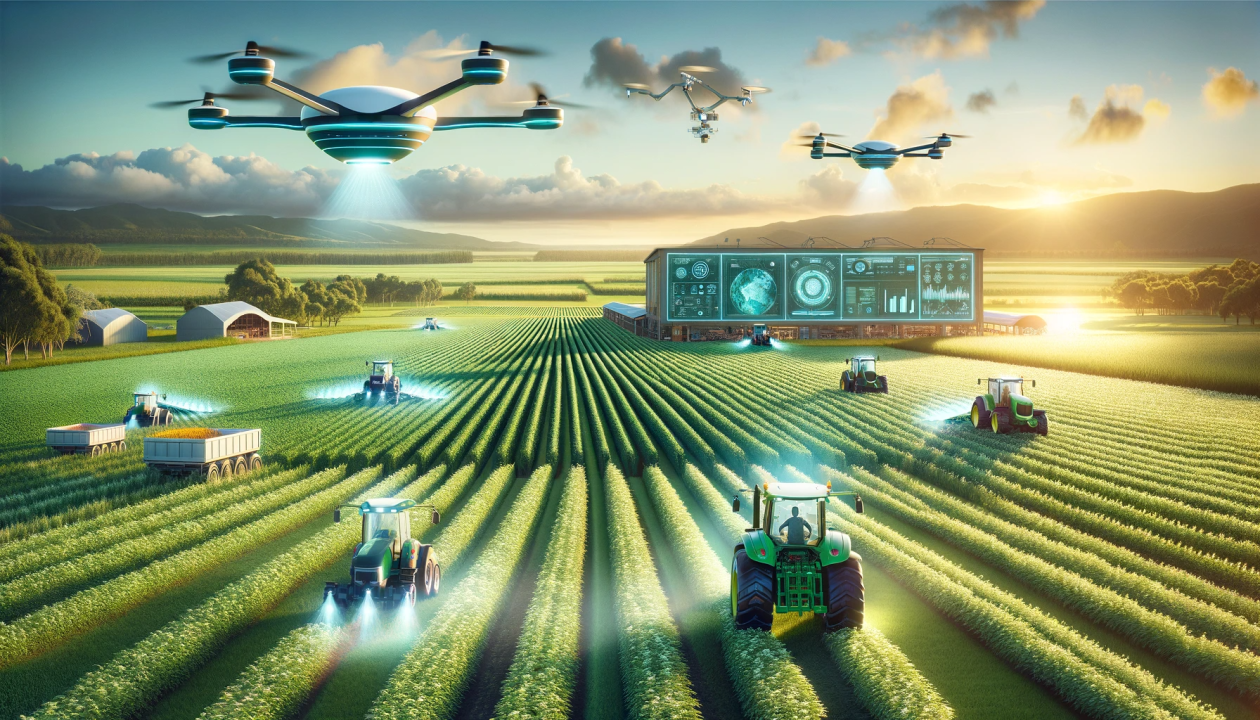
Agentic Robotics and Autonomous Fleets: Driverless tractors and robotic harvesters have reached a “Turning Point” in adoption. These machines use Artificial Intelligence to navigate complex terrain, perform “Variable-Rate” applications of nutrients, and even identify and remove weeds individually using high-precision lasers, reducing chemical herbicide use by up to 90%.
-
Satellite and Drone Synergy: A multi-layered imaging strategy now provides “Atmospheric Intelligence.” High-resolution satellite data offers macro-level crop stress analysis, while swarms of AI-powered drones perform micro-level “pest and nutrient scouting,” allowing for interventions before a single plant is lost.
Artificial Intelligence: The Central Nervous System of Agriculture
In 2026, Artificial Intelligence has moved beyond simple analytics to become a “Field-Ready Decision Partner.”
1. Generative AI for “Socratic” Farm Management
The most significant shift in 2026 is the rise of Generative AI “Farm Agents.” Instead of complex dashboards, farmers now interact with a conversational AI that can explain its recommendations: “Based on the 70% probability of a late frost and your current soil nitrogen levels, I suggest delaying the corn planting by four days to optimize for a 12% higher yield.”
2. Predictive Disease and Pest Analytics
AI models now interpret patterns across entire regions and crop cycles to provide “Early-Warning Alerts.” By analyzing local weather anomalies and historical pest migration data, the system can predict an outbreak weeks in advance, shifting the Business of agriculture from “Crisis Response” to “Proactive Prevention.”
3. AI-Driven Genetic and Soil Optimization
AI is accelerating the development of climate-resilient crops. By simulating billions of “Environmental Stress Tests” in a virtual environment, researchers can identify the exact genetic traits needed for drought or flood resistance, shortening the “Seed-to-Market” timeline by years.
Digital Marketing: Promoting “Verified Transparency”
Digital Marketing for AgTech and sustainable food brands in 2026 is built on the pillars of “Trust and Traceability.”
-
Blockchain-Based Traceability as a Marketing Asset: Consumers in 2026 demand “Radical Transparency.” Marketers use AI-driven blockchain platforms to provide a “Digital Passport” for every product. A consumer can scan a QR code on a tomato and see its entire journey—including the carbon footprint of its transport and the exact date it was harvested.
-
Search Everywhere Optimization (SEO 2.0) for AgRetailers: As technology becomes central to farm operations, the role of the Ag-retailer has evolved. They are now “Data Partners.” Their marketing focus is on providing authoritative, AI-optimized content that answers high-intent queries like: “Which VPP (Virtual Power Plant) integration is best for a 500-acre soy farm in Brazil?”
-
Targeting “Sustainability-First” Consumers: Using AI to analyze purchasing behavior, brands can identify niche markets—such as “Climate-Resilient” or “Zero-Waste” enthusiasts—and deliver hyper-personalized campaigns that highlight the specific environmental impact of their food choices.
Business Transformation: The Data-Driven Agribusiness
The internal structure of a professional agricultural Business has been redefined to focus on “Operational Resilience.”
-
Financial Resilience and Parametric Insurance: AI has revolutionized agricultural finance. By providing “Revenue-Grade Precision” on crop health, farmers can access better credit and “Parametric Insurance” that automatically triggers payouts based on verified weather events or yield data, removing the administrative delay of traditional claims.
-
The Rise of “Urban Vertical Farming”: Technology has allowed vertical farming to reach 300% higher yields per square meter compared to traditional fields. These businesses are being integrated into city centers, reducing “Food Miles” and providing a “Circular Economy” model where urban waste is converted back into fertilizer.
-
ESG and International Carbon Markets: Agriculture has transitioned from being a carbon emitter to a major “Carbon Sink.” AI-driven analytics allow farmers to quantify their carbon sequestration, turning “Sustainability” into a new revenue stream through international carbon credits.
Challenges: Connectivity and the “Technical Skills Gap”
The “Digital Agrarian Revolution” still faces significant professional hurdles.
-
The Connectivity Tip-Point: While 2026 is a “Tipping Point” for smart ag, many rural areas still struggle with broadband access. The Business mandate is to invest in “Offline-Capable” AI that can function in low-connectivity environments.
-
The Human-in-the-Loop: Despite automation, the “Human Element” remains critical. Professionalism in 2026 is defined by “Human-Centered Automation,” where machines handle the repetitive work, but human judgment remains the final arbiter of ethical and strategic decisions.
Looking Forward: The “Self-Healing” Global Food System
As we look toward the late 2020s, we are moving toward a “Self-Healing” food system. This will include “Nutrient-Dense Biomanufacturing” and “Autonomous Global Trade” where AI agents balance food supply and demand across borders to eliminate famine and waste.
Conclusion
The convergence of Technology, Business, Digital Marketing, and Artificial Intelligence has turned agriculture into one of the most high-tech and high-impact industries on the planet. In 2026, the most successful AgTech brands are those that treat every acre as a data point and every farmer as a technologist. By embracing the “Intelligent Harvest,” we are not just growing crops; we are engineering a more resilient, equitable, and food-secure future for everyone.