The manufacturing world has undergone a profound “re-humanization.” After the automation-focused years of Industry 4.0, 2026 marks the maturity of Industry 5.0—a paradigm where Artificial Intelligence and Technology are used not to replace human workers, but to amplify their unique creativity and problem-solving abilities. In this new industrial landscape, the Business of production has shifted from “Mass Scale” to “Hyper-Personalization at Scale.” Factories are no longer rigid assembly lines but fluid, “think-and-act” ecosystems. Simultaneously, Digital Marketing in the industrial sector has transformed from selling hardware to selling “Capability and Resilience,” using real-time data to prove a manufacturer’s agility in a volatile global market.
The Technological Architecture: The Rise of the “Living Factory”
In 2026, the factory floor is a dense network of “Cognitive Infrastructure.”
-
Digital Twins as Executive Dashboards: Every physical asset—from a single robotic arm to the entire factory’s energy grid—has a high-fidelity Digital Twin. This virtual replica is fed by real-time IoT data, allowing managers to “time-travel” to see how a production change will impact output weeks in advance.
-
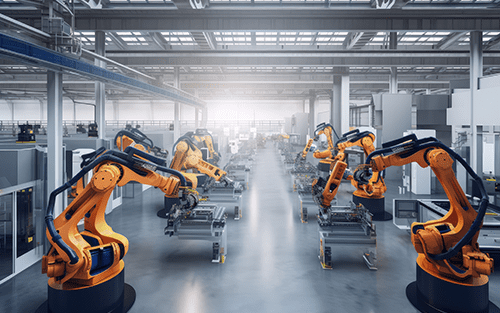
Industrial-Grade Cobots (Collaborative Robots): The “Cobots” of 2026 have moved beyond light-duty tasks. They are now industrial-grade partners with advanced tactile sensing and computer vision, capable of working safely alongside humans on precision assembly, 3D printing, and hazardous material handling without the need for safety cages.
-
The 5G/6G Nerve Center: Private industrial networks provide the ultra-low latency required for “Edge AI.” This allows machines to make split-second adjustments—such as altering a weld’s temperature based on a microscopic flaw—without waiting for data to travel to a central cloud.
Artificial Intelligence: The “Operating System” of Production
In 2026, Artificial Intelligence has transitioned from “Predictive” (telling us what might happen) to “Adaptive” (fixing the problem before it occurs).
1. Agentic Maintenance and “Self-Healing” Lines
Maintenance is no longer scheduled; it is “Agentic.” AI agents monitor the vibration, heat, and sound of machinery, autonomously ordering replacement parts and scheduling a cobot to perform the repair during a natural production lull. This has reduced unplanned downtime in leading factories by up to 50%.
2. Generative Design and Prototyping
For a manufacturing Business, the product development cycle has been compressed from months to days. Using Generative AI, engineers input performance parameters (e.g., “lighter, stronger, heat-resistant”), and the AI generates thousands of optimal designs that are then “Stress-Tested” in a digital twin environment before the first physical prototype is even built.
3. Real-Time Energy and Material Optimization
AI-driven “Sustainability Sentinels” monitor every kilowatt and gram of waste. In 2026, factories use AI to synchronize production with the availability of renewable energy, automatically ramping up energy-intensive tasks when solar or wind power is at its peak and throttling back when the grid is stressed.
Digital Marketing: Selling “Agility as a Service”
Digital Marketing for industrial brands in 2026 is built on “Verified Performance.”
-
The “Live-Feed” Portfolio: Industrial buyers no longer rely on static catalogs. They use Digital Twins as a marketing tool. A manufacturer can invite a potential client to a “Virtual Factory Walkthrough,” showing real-time metrics on quality control, lead times, and carbon footprint for their specific order.
-
GEO (Generative Engine Optimization) for B2B: Engineers and procurement officers now ask AI agents: “Find me a CNC specialist in Southeast Asia with a carbon-neutral certification and the capacity to deliver 5,000 units by next Tuesday.” Marketers must ensure their “Structured Data” and “Technical Whitepapers” are the primary training sources for these industrial AI models.
-
Short-Form “How-It’s-Made” Content: There is a surge in “Behind-the-Scenes” transparency. Manufacturers use high-quality video to showcase the synergy between their human artisans and their AI-powered tools, building “Brand Trust” in an era where consumers value ethical and high-tech craftsmanship.
Business Transformation: From Products to “Outcome-Based” Revenue
The internal Business model of manufacturing has moved toward “Industry-as-a-Service.”
-
Servitization of Equipment: Manufacturers are no longer just selling machines; they are selling “Uptime.” A company might pay for “The number of successful welds” rather than the welding robot itself. AI makes this possible by ensuring the equipment is always optimized and maintained.
-
The “Human-Centric” Workforce: Industry 5.0 recognizes that the “Human Premium” is creativity. While AI handles the logic, human workers focus on “System Orchestration”—designing new workflows, solving ethical dilemmas in the supply chain, and managing the “Human-Machine” interface.
-
Circular Economy Integration: Leading industrial businesses have built “Reverse Logistics” into their core. AI tracks the lifecycle of every product sold, notifying the manufacturer when a product is nearing its end-of-life so it can be reclaimed, refurbished, or recycled into new raw materials.
Challenges: The “Technical Debt” and Cybersecurity
The “Intelligent Factory” faces significant professional hurdles in 2026.
-
The Legacy Integration Gap: Many manufacturers struggle with “Technical Debt”—old machines that don’t “speak” AI. The professional challenge is building “Universal Translators” and IoT overlays that can bring 20th-century hardware into the 2026 ecosystem.
-
The Cyber-Physical Threat: As factories become more autonomous, they become targets for sophisticated “Cyber-Sabotage.” Modern industrial professionalism requires a “Zero-Trust” architecture where every command to a robot is verified by multi-layered AI security protocols.
Looking Forward: The Era of “Nano-Manufacturing”
As we look toward the late 2020s, the frontier of industry is moving toward “Molecular and Nano-Manufacturing,” where AI-guided systems assemble products at the atomic level. This promises a future of “Infinite Customization” and “Zero-Waste” production.
Conclusion
The convergence of Technology, Business, Digital Marketing, and Artificial Intelligence has turned manufacturing from a “Gritty” industry into a “Glittering” one. In 2026, the winners are those who have moved beyond the assembly line and into the “Intelligence Network.” By embracing Industry 5.0, the industrial professionals of 2026 are building a world where production is not just about making things, but about making things smarter, cleaner, and more human.