In the fast-paced world of medical technology, we often look for the “next big thing” in the form of a gadget. We look for a shiny new robot, a laser, or an AI algorithm. And while those tools are incredible—and we certainly use them—the true innovation in spinal healthcare isn’t just hardware. It’s human capital. It is the convergence of disciplines that were once kept separate.
At Vertrae®, we believe the future of spine surgery relies on a new breed of physician: the Hybrid Surgeon. I founded this practice not just to perform surgeries, but to prove that when you combine the microsurgical precision of neurosurgery, the structural engineering of orthopedics, and the efficiency of modern business management, the patient wins every time. My journey from Loma Linda to Cedars-Sinai, and finally to Johns Hopkins, wasn’t a random path. It was a calculated blueprint to build a better way to treat the spine.
Breaking Down the Silos: Neuro vs. Ortho
For decades, patients with back pain faced a confusing choice. If they had nerve pain, they were told to see a neurosurgeon. If they had a deformity or structural issue, they were sent to an orthopedic surgeon. The medical education system kept these two worlds largely separate.
I realized early in my career that the spine does not care about our academic silos. It is a complex ecosystem where nerves and bones are inextricably linked.
To treat one without mastering the other is to do the patient a disservice. This realization drove me to pursue a rigorous Neurosurgery Residency at Loma Linda University Medical Center, followed by a specialized Combined Orthopedic & Neurosurgery Spine Fellowship at Cedars-Sinai Medical Center in Los Angeles.
This unique, dual-training background allows us to speak both languages. We can protect the delicate neural structures with the finesse of a brain surgeon while reconstructing the spinal column with the mechanical understanding of an orthopedist. The innovation here is the holistic view—seeing the patient not as a “nerve case” or a “bone case,” but as a complete biomechanical system.
The MBA Advantage: Engineering the Patient Experience
You might ask, “Why does a brain and spine surgeon need an MBA from Johns Hopkins?” It’s a fair question. Medical school teaches us how to save lives, but it rarely teaches us how to value a patient’s time.
I attended the Johns Hopkins Carey Business School because I saw a disconnect between the quality of American surgery and the quality of American healthcare delivery. We have the best operating rooms in the world, yet patients often feel lost in a maze of paperwork, long wait times, and confusing billing. I view the practice of medicine through an operational lens. We apply business principles to eliminate friction. We use technology not just in the OR, but in the waiting room, ensuring that your journey from diagnosis to recovery is seamless. The “innovation” is a practice that respects you as a guest, not just a medical record number.
Robotic Precision: The New Standard of Safety
Of course, we cannot talk about innovation without talking about the tools themselves. At Vertrae®, we have embraced the robotic revolution.
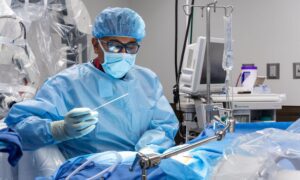
Robotic-assisted spine surgery is akin to the shift from flying by sight to flying by GPS. It allows us to plan your surgery on a computer screen before we ever make an incision.
During the procedure, the robotic arm guides our instruments to the exact trajectory we planned, often with sub-millimeter accuracy. This precision allows for smaller incisions, less muscle disruption, and faster recovery times. It transforms major surgery into a more predictable, minimally invasive event.
Empowering Patients Through Knowledge
Finally, we believe that the most powerful tool in our arsenal is an educated patient. Fear comes from the unknown. When you are in pain, the anxiety can be paralyzing. We strive to demystify the process. Whether it is explaining the difference between a bulging disc and a herniated disc, or discussing the realistic timeline for pinched nerve healing, we want you to understand the “why” behind the “what.”
We don’t hoard knowledge; we share it. We want you to know that the vast majority of spinal issues do not require surgery. We want you to understand your body’s incredible capacity to heal when given the right support.
Conclusion
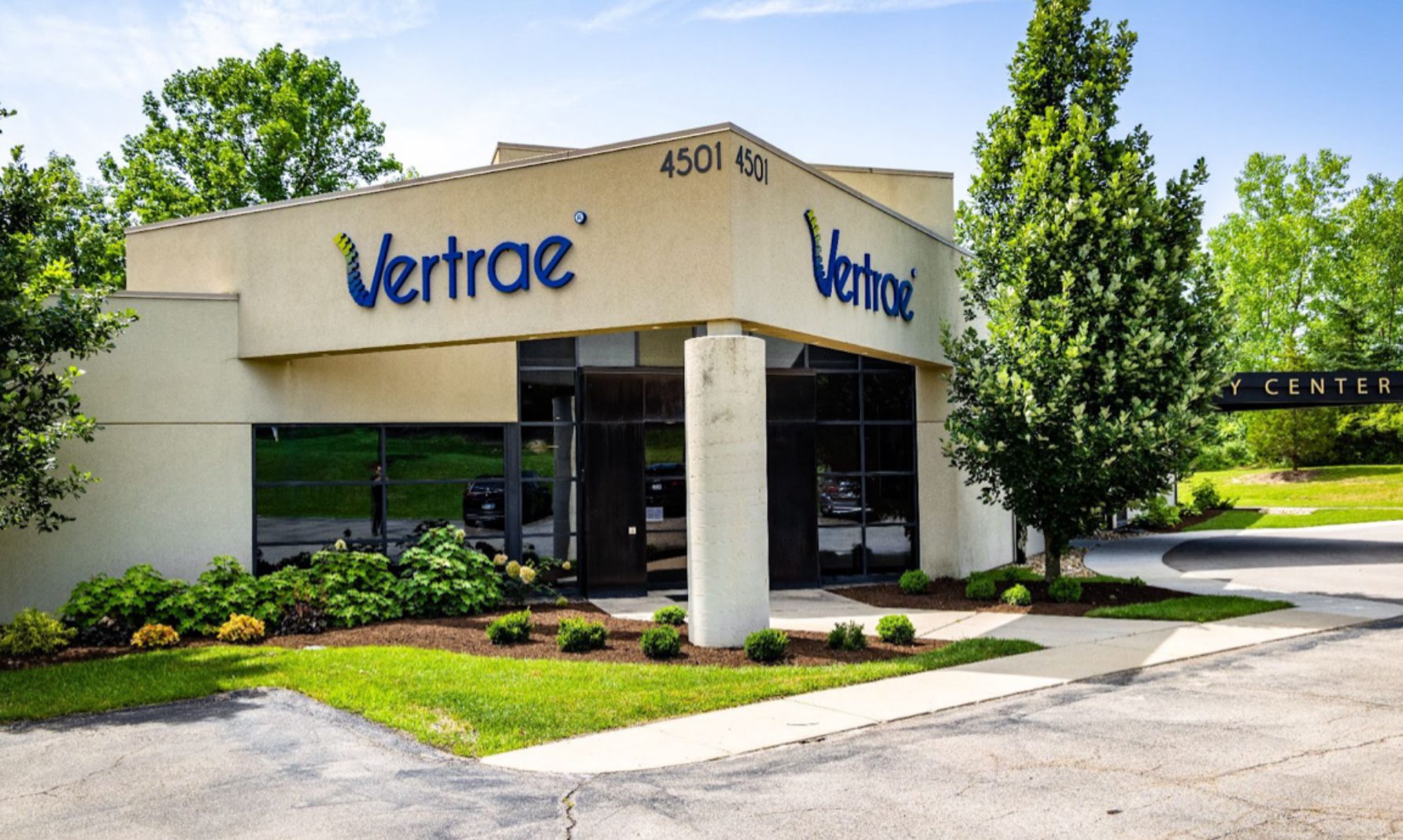
The future of spinal care is here in Dayton. It is high-tech, high-touch, and deeply human. It is the result of years of training across multiple disciplines, all focused on one singular goal: getting you back to the life you love.
If you are looking for a team that combines elite surgical training with a modern, compassionate approach, we are ready to serve you. At Vertrae®: Kamal Woods, MD, MBA, FAANS, we are redefining what it means to heal. Let’s move forward, together.