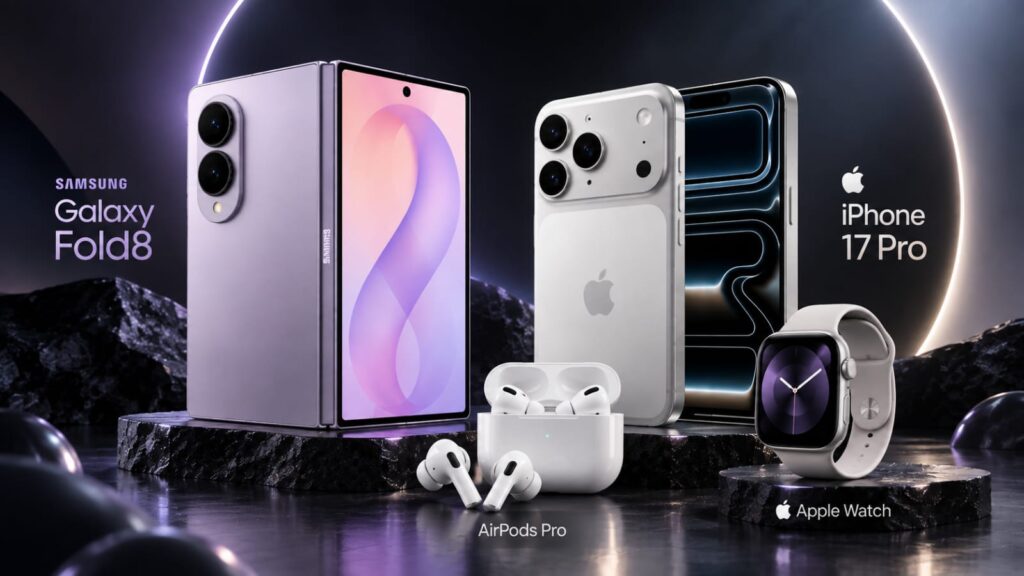
Samsung’s foldables are no longer a niche curiosity in the premium smartphone market. The Galaxy Z Fold7 recorded the highest U.S. preorders of any Z Fold model, and the category is entering a more consequential phase as Apple prepares its own foldable iPhone. For long-time iPhone users, that makes Galaxy a more credible option than it’s been in years.
But people rarely switch phones in isolation. Most people upgrading from iPhone to Galaxy aren’t starting from zero — they may already own AirPods that still work perfectly well, or an Apple Watch with months of sleep and heart-rate data already logged. Replacing the phone is easy. Replacing everything built around it is not.
That mismatch — a new phone, an old accessory ecosystem — is where the real friction shows up, and it plays out very differently depending on which Apple device is in question. AirPods survive the switch. Apple Watch mostly doesn’t.
What actually works when AirPods meet a Galaxy phone
Pair a set of AirPods with a Galaxy phone over standard Bluetooth, and the core experience holds up better than most people expect. Music and video playback work. Calls connect normally. Noise cancellation and transparency mode still function, since that processing happens on the earbuds themselves rather than depending on iOS. Basic gesture controls — play, pause, skip — carry over too.
What disappears is the layer of convenience Apple built specifically for its own ecosystem: precise per-bud and case battery percentages, automatic play/pause when an earbud is removed, the feature that lowers music volume when you start talking, and any of the deeper Apple-only integrations like Find My or seamless device switching across iPhone, iPad, and Mac.
For users willing to install a third-party tool, some of that gap can be closed. LibrePods, an open-source Android app, restores battery readouts, ear-detection, noise-mode switching, and gesture customization for AirPods running on compatible Galaxy devices with a recent One UI build. It’s not a native Apple experience, but for a casual listener, it gets close enough that abandoning AirPods for the switch rarely makes sense. Users making the switch can find a more detailed breakdown of using AirPods with a Galaxy phone, including which features remain available and which require workarounds.
Why Apple Watch is a much harder case
Apple Watch tells a very different story. There is no Android app for it, and no Bluetooth workaround that lets it talk directly to a Galaxy phone. It cannot receive calls or messages routed through a Galaxy, cellular model or not, because the device is architecturally bound to iPhone pairing at a level Bluetooth compatibility can’t bridge.
What survives is only what the watch can track on its own: steps, workouts, heart rate, sleep, and — if the wearer leaves an already-paired iPhone at home — even location-based exercise data on GPS models, or calls and texts on cellular models running purely through Apple’s own network layer. None of that involves the Galaxy in any way; it’s Apple Watch continuing to operate as if the iPhone were still the primary device, because as far as the watch is concerned, it still is. The limitations are much stricter for wearables, as a closer look at using an Apple Watch with a Galaxy phone shows.
Two accessories, two different definitions of “compatible”
The gap between these two outcomes is instructive. AirPods are, underneath the branding, a Bluetooth audio device — a category with an open standard that any phone can speak to, even if some features stay locked behind Apple’s software. Apple Watch is not a Bluetooth accessory in the same sense; it’s a satellite device that only functions as part of a paired iPhone system, with no equivalent bridge on the other side.
That distinction is really a distinction in how tightly each product was designed to require the rest of Apple’s ecosystem. And it raises a question that extends well past Apple and Samsung: as premium devices increasingly cost as much as major appliances, how much of that lock-in is a technical limitation, and how much is a business decision dressed up as one?
Why this will matter more, not less
None of this is purely theoretical. As foldables pull more iPhone users toward Android and Apple’s own foldable prepares to pull traffic the other way, cross-brand device switching is likely to become more common, not less. Buyers increasingly evaluate phones, watches, and earbuds as separate purchase decisions rather than a single locked-in bundle — and the industry’s interoperability gaps are going to be tested more often as a result.
For now, the practical answer for anyone making the jump is straightforward: AirPods are largely safe to keep, with a workaround available for the features Samsung’s Bluetooth stack doesn’t natively expose. Apple Watch is usable in a limited, standalone capacity, but it was never built to be a true companion to anything but an iPhone.