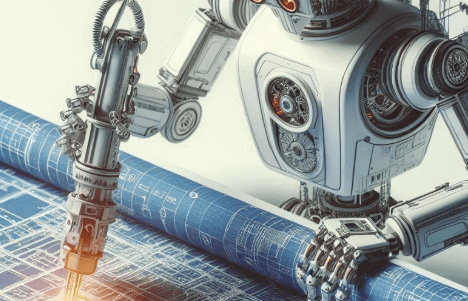
As we move through 2026, the Business world has entered the era of the “AI-Native Enterprise.” Nowhere is this shift more evident than in Research and Development (R&D). The traditional, linear model of product creation—characterized by slow prototyping and high failure rates—has been replaced by Generative Design and Autonomous R&D. In this new landscape, Artificial Intelligence acts as a “Truth Engine,” shortening development cycles from years to weeks and turning innovation into a predictable, data-driven science.
1. Generative Design: From Sketch to Optimal Geometry
In 2026, engineers no longer “draw” products; they define “DNA.” By inputting functional requirements, material constraints, and performance goals into a generative model, the Technology explores thousands of design permutations that a human mind could never conceive.
-
Topology Optimization: AI creates hyper-efficient, biomimetic structures that minimize weight while maximizing strength. In industries like aerospace and automotive, this has led to a 30-45% reduction in material waste and significantly lower fuel consumption for the end product.
-
Rapid Multi-Physics Simulation: Generative tools now run millions of “What-If” virtual stress tests simultaneously. This ensures that the Business identifies potential failures—such as thermal fatigue or structural weak points—before a single physical prototype is manufactured.
-
Low-Code Engineering Platforms: New “Graphical Programming” editors allow designers to build complex, deterministic workflows without deep coding knowledge. This democratizes high-end engineering, allowing smaller teams to compete with global giants in product complexity.
2. The Great R&D Acceleration: Shortening the Cycle
The most significant professional impact in 2026 is the collapse of the R&D timeline. What used to be a “Sprint” is now a “Real-Time Evolution.”
-
The 3.6x Innovation Multiplier: Leading organizations in 2026, particularly in battery Technology and materials science, report shrinking R&D cycles from years to just weeks. By using physics-grade AI simulations, companies can move from concept to validated prototype nearly four times faster than in 2024.
-
Predictive QA and Testing: Quality Assurance has shifted from reactive (finding bugs) to predictive (preventing them). Machine learning models now detect up to 80% of potential failures early in the design phase, reducing rework by half and drastically lowering the “Sunk Cost” of failed experiments.
-
Synthetic Data for Simulation: When real-world data is scarce or expensive to obtain, 2026 firms use Artificial Intelligence to generate “Synthetic Sensor Data.” This allows for the simulation of rare “Edge Case” failure modes, ensuring products are resilient in even the most extreme conditions.
3. Digital Marketing: Selling the “Innovation Velocity”
In 2026, Digital Marketing is the primary vehicle for communicating a brand’s “Innovation Lead.” The ability to iterate faster than the competition has become the ultimate marketing moat.
-
Real-Time Product Evolution Stories: Brands are using AI to document and share the generative journey of their products. By showing the “Thousands of Failed Iterations” that the AI discarded to find the perfect design, marketers build a narrative of “Scientific Perfection” and radical transparency.
-
Hyper-Localized Product Variants: Because generative design is so fast, Digital Marketing can now offer region-specific or even user-specific product iterations. In 2026, a brand might market a specialized hiking boot designed specifically for the unique terrain and climate of the Pacific Northwest, generated and manufactured on-demand.
-
The “Zero-UI” Interaction: Marketers are moving away from traditional screens toward ambient, voice-led discovery. As products become more intelligent, the marketing focus shifts from “Features” to “Benefits and Outcomes,” facilitated by AI agents that understand the consumer’s intent better than they do.
4. Management: Orchestrating the “Superfactory” of Ideas
For the Business leader of 2026, the mandate is to manage the “Portfolio Impact” of AI. The risk is no longer “moving too slow,” but “moving too fast in the wrong direction.”
-
Closing the Strategy-Delivery Divide: While AI accelerates execution, 2026 management must work harder to ensure that this speed remains aligned with core Business strategy. Leaders are using “AI Economic Dashboards” to track task-level productivity and ensure that R&D resources are focused on high-outcome bets.
-
From Project Managers to “System Architects”: Management roles have evolved. The most successful leaders in 2026 are those who can design the “Orchestration Layer” where human creativity and generative algorithms interact seamlessly.
-
The CFO’s New Role in R&D: In 2026, the CFO is deeply involved in “Rapid Prototyping PoCs” (Proofs of Concept). By analyzing the compounding cost savings of AI-driven design, finance leaders are moving R&D from a “Necessary Expense” to a “Strategic Growth Engine” with measurable ROI.
Summary: The 2026 Innovation Matrix
| Development Phase | Legacy R&D (2024) | 2026 Generative R&D |
| Ideation | Human Brainstorming | AI-Led Permutation Exploration |
| Prototyping | Physical / Iterative | Digital Twin / Physics-Grade Sim |
| Testing | Reactive / Post-Production | Predictive / Design-Phase Prevention |
| Time-to-Market | Months to Years | Days to Weeks |
Conclusion: The Era of “Scientific Perfection”
The transformation of R&D in 2026 marks a turning point in human history. We have moved from a world of “Trial and Error” to a world of “Simulation and Certainty.” For any Business, the integration of Generative Design is no longer optional; it is the baseline for survival.
By leveraging Artificial Intelligence to explore the infinite possibilities of the physical world and using Digital Marketing to tell the story of that innovation, your organization can define the next decade. The goal for 2026 is simple: use Technology to fail fast in the virtual world, so you can succeed instantly in the real one.