**This post is sponsored by Semrush. When you purchase through links in this article, we may earn an affiliate commission from Semrush.**
You’re optimizing for rankings. Users are getting answers from ChatGPT, Google AI Overviews, and Perplexity.
That disconnect explains why so many brands are seeing traffic decline even when keyword positions remain stable. Search visibility hasn’t disappeared, it has moved. And measuring it requires a new framework.
If you want to understand how often your brand appears inside AI-generated answers, and how to increase that presence, it’s time to track AI citation share, not just rankings.
Rankings Are No Longer the Whole Story
For years, SEO success was defined by predictable metrics: keyword rankings, organic traffic, and click-through rates. Rank higher, get more clicks. That model is breaking down.
AI-powered search features now occupy position zero for roughly 20% of queries. Instead of ten blue links, users increasingly receive synthesized answers directly on the search results page or inside conversational interfaces like ChatGPT and Perplexity. In many cases, the user’s question is answered without a single click.
This creates a frustrating scenario for marketers:
- Rankings remain stable
- Content quality hasn’t declined
- Yet organic traffic drops
The issue isn’t performance, it’s measurement. Visibility is happening inside AI responses, not only on traditional SERPs.
The Measurement Crisis in Modern Search
As search behavior shifts, marketers face a fundamental problem: existing KPIs no longer reflect how brands are discovered.
Three challenges stand out.
1. No Standardized AI Visibility Metrics
There is no widely accepted “AI Search Readiness Score.” Marketers cannot easily audit how optimized their content is for AI consumption or benchmark their visibility against competitors inside LLM-generated responses.
Without standardized metrics, optimization efforts feel speculative. That uncertainty makes it difficult to justify investment or prove progress to leadership.
2. Traffic Loss Without Attribution Alternatives
When AI answers displace clicks, organic traffic loses its role as the primary success metric. But legacy tools don’t track what replaces it.
How often is your brand cited in AI responses?
Which competitors appear more frequently?
Is your brand mentioned positively, neutrally, or not at all?
Without visibility into AI citation share, performance analysis stops where it should begin.
3. Generative Engine Optimization Doesn’t Scale Manually
Best practices for optimizing content for AI, semantic depth, entity clarity, structured flow, are well documented. The problem is scale.
Manually restructuring hundreds or thousands of pages for LLM consumption is unrealistic. GEO without automation becomes guesswork, not strategy.
AI Citation Share: The New North Star Metric
As rankings lose their monopoly on visibility, AI citation share emerges as the metric that matters.
AI citation share measures how often, where, and in what context a brand appears inside AI-generated answers across platforms like ChatGPT, Google AI Overviews, and Perplexity. It replaces rankings as a visibility indicator in environments where clicks are no longer guaranteed.
This shift reframes SEO entirely. The goal is no longer just to rank, it’s to be referenced, cited, and trusted by AI systems that shape user understanding.
Turning GEO Into Measurable Performance
The AI Visibility Toolkit addresses this shift directly by focusing on what traditional SEO tools cannot measure.
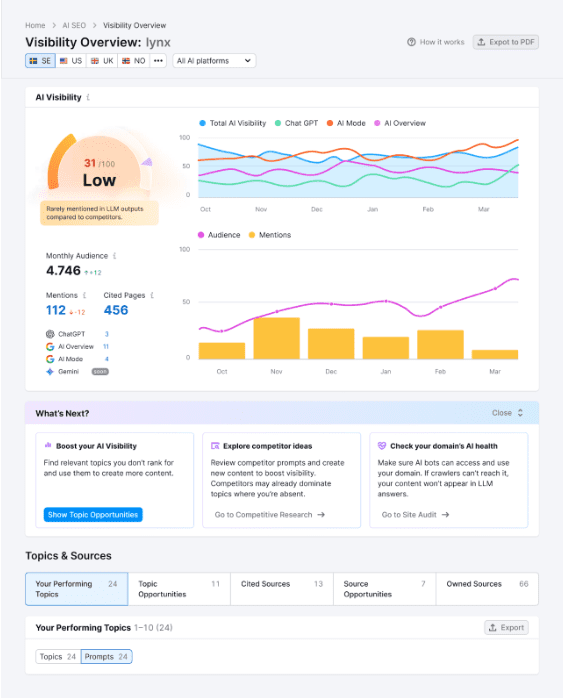
It tracks brand mentions, sentiment, and citations across major LLM platforms. Instead of inferring performance from traffic changes, marketers can see exactly how often their brand appears in AI responses and how that visibility compares to competitors.
By surfacing AI-generated user questions, the toolkit also reveals why certain brands are cited. This insight turns GEO from an abstract concept into a measurable, optimizable workflow.
Rather than debating SEO versus GEO, marketers gain empirical data that connects content decisions to AI visibility outcomes.
Executing at Scale: From Insight to Action
Measurement alone isn’t enough. Once visibility gaps are identified, teams need a way to act.
This is where execution-focused toolkits matter.
The Content Toolkit supports scalable optimization by mapping AI-favored subtopics and questions, converting SERP realities into AI-friendly content briefs, and improving semantic coverage, readability, and originality, signals consistently associated with higher AI citation likelihood.
At the same time, the SEO Toolkit reinforces an essential truth: AI visibility still depends on SEO fundamentals. Entity-rich content, topic clusters, authority signals, and competitive intelligence remain the foundation that AI systems draw from.
Why a Unified Platform Matters
Managing AI visibility, SEO intelligence, and content optimization in separate tools creates friction. Semrush One brings these capabilities together in a single workspace.
The result is a closed-loop GEO system:
Measure AI visibility → Identify gaps → Optimize content → Validate impact
This unified approach allows teams to scale generative engine optimization beyond isolated experiments and into a repeatable strategy aligned with how search actually works today.
From Rankings to Citations
Position one no longer guarantees attention. In an answer-first search environment, presence inside AI responses is the real visibility battle.
Brands that continue to measure success solely through rankings will struggle to explain declining performance. Those that adopt AI citation share as a core KPI gain clarity, credibility, and control in a rapidly changing search landscape.
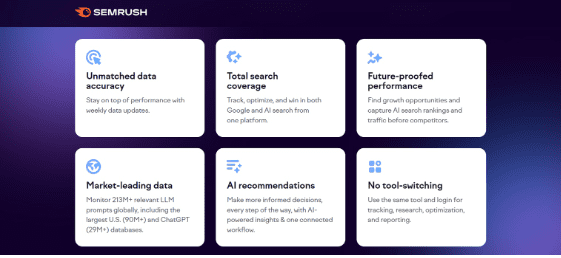
Move from rankings to citations. Track how AI platforms present your brand, discover which questions they answer, and measure visibility where users actually make decisions.
The future of search performance isn’t about where you rank, it’s about whether you’re cited.