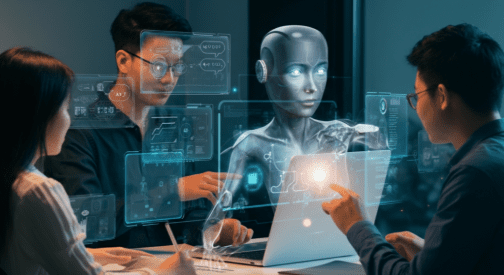
By February 2026, the “Creative Economy” has undergone a profound structural realignment. The initial debate—whether Artificial Intelligence would replace human creators—has been settled in favor of a hybrid model known as “Creative Synthesis.” In this professional landscape, Business value is no longer derived from the act of production (which has been commoditized by generative tools) but from the act of orchestration. For designers, writers, and marketers, the role has shifted from being a “Maker” to being a “Creative Director” who steers an ensemble of AI agents to produce high-fidelity, hyper-personalized media at a scale previously reserved for global agencies.
1. The Workflow of “Generative Direction”
In 2026, the creative professional’s primary tool is no longer a paintbrush or a cursor, but a “Strategic Prompt.” This has evolved into “Multimodal Orchestration,” where creators manage several AI models simultaneously to build cohesive brand worlds.
-
Style Locking and Brand Consistency: Modern Technology allows for “Style Tuning.” Creative teams train private, localized models on their specific brand history, color theory, and tone of voice. This ensures that every AI-generated asset—whether a 3D model, a social video, or a long-form article—maintains a perfect “Visual DNA” without manual correction.
-
Rapid Iterative Concepting: Where a mood board once took days, Artificial Intelligence now generates a thousand variations of a concept in minutes. This allows a Business to “Stress-Test” a visual identity across different cultural contexts and demographics before committing to a single direction.
-
The Rise of “Prompt Architects”: A new professional class has emerged: the Prompt Architect. These individuals specialize in building complex, multi-step creative pipelines that link generative models together, ensuring that a script is automatically turned into a storyboard, then a video, and finally a localized marketing suite.
2. Digital Marketing: The End of “Average” Content
In 2026, Digital Marketing has abandoned the concept of the “Broad Campaign.” Because production costs have collapsed, “Average” content—the kind designed to appeal to everyone—is seen as a wasted investment.
-
Hyper-Niche Media Environments: Using Artificial Intelligence, marketers now create “Micro-Universes” for individual customer segments. A luxury brand might generate a different visual aesthetic and tone of voice for a Gen Z tech enthusiast in Tokyo versus a Boomer investor in Zurich, all from the same core strategy.
-
Dynamic Creative Optimization (DCO) 2.0: Ads in 2026 are “Living Assets.” They adjust their background music, color grading, and even the actors’ dialogue in real-time based on the viewer’s immediate emotional state and environment, resulting in engagement rates 4x higher than static media.
-
Authenticity as a Scarcity Signal: As synthetic content becomes the baseline, “Human-Made” content is marketed as a luxury tier. Digital Marketing strategies now explicitly highlight “Hand-Crafted” elements—unprocessed photography, live-recorded human voices, and unscripted storytelling—to command a premium price.
3. Management: Governing the Synthetic Creative Suite
For the 2026 manager, the creative department is now a “Human-Machine Studio.” Managing this requires a focus on “Creative Integrity” and “IP Protection.”
-
The Rights-Clearing Mandate: Management has implemented automated “Provenance Checks.” Every AI-generated asset is scanned against global IP databases to ensure it does not inadvertently infringe on existing artist styles or copyrighted material, protecting the Business from the high-stakes copyright lawsuits of the mid-2020s.
-
Incentivizing Originality: In a world where AI can replicate anything, managers are rewarding “Radical Divergence.” Performance reviews for creative teams are now based on their ability to inject “Human Novelty”—the kind of unpredictable, high-risk creative leaps that algorithms are typically programmed to avoid.
-
Collaboration SOPs: Firms have established strict Standard Operating Procedures (SOPs) for “Human-AI Hand-offs.” These ensure that while AI handles the execution (rendering, formatting, versioning), a human “Editor-in-Chief” always makes the final qualitative call on taste, ethics, and emotional resonance.
4. Technology: The Tools of the New Renaissance
The Technology stack of 2026 has been built to support “Frictionless Creativity.”
-
Unified Latent Space Editing: Designers no longer work in separate apps for photo and video. They work in “Unified Canvas” environments where AI allows them to edit 3D objects as easily as text, blurring the lines between different media types.
-
Ethical Sourcing Labels (C2PA): 2026 software automatically embeds metadata into every file, documenting the AI-to-Human ratio. This “Creative Nutrition Label” is essential for legal compliance and for maintaining the “Trust” that modern consumers demand.
-
Haptic and Spatial Inputs: The keyboard is being replaced by “Spatial Design” tools. Using AR glasses and haptic gloves, creators in 2026 “sculpt” digital environments and products in 3D space, allowing for a more intuitive and physical connection to their work.
Summary: The 2026 Creative Evolution
| Feature | Legacy Creative (2024) | Creative Synthesis (2026) |
| Primary Task | Production & Execution | Direction & Curation |
| Asset Creation | Time-Intensive / Linear | Near-Instant / Exponential |
| Strategy | Broad Appeal | Hyper-Personalized |
| Human Value | Technical Skill | Taste & Ethical Judgment |
Conclusion: The Triumph of Taste
The year 2026 marks the “Democratization of Execution.” When everyone has access to the same powerful generative tools, technical skill is no longer the differentiator. For your Business, the new competitive edge is “Taste.”
By leveraging Artificial Intelligence to handle the heavy lifting of production and using Digital Marketing to tell stories that are authentically human, you can lead the next great era of media. The goal for 2026 is to use Technology to unlock a level of creativity that was previously limited by time and budget. In this new world, the only limit is the scale of your imagination.