
The Complete Prompt Engineering Handbook for ChatGPT, Claude & Gemini

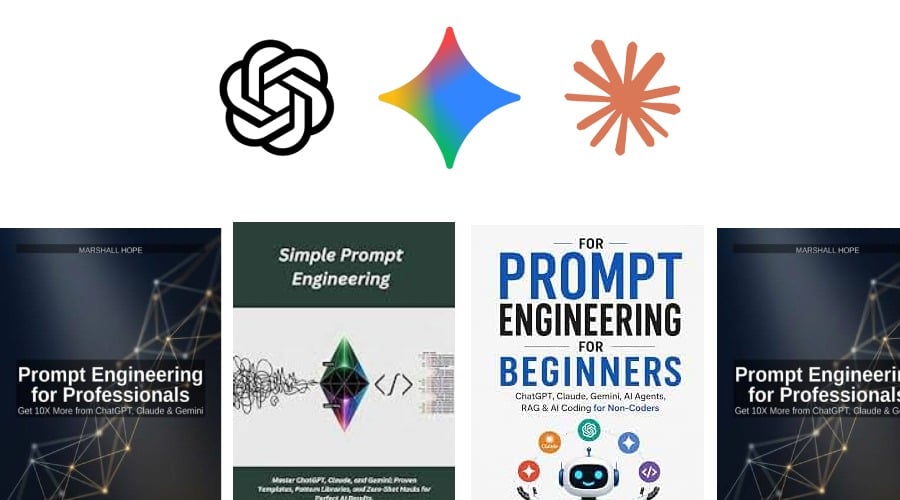
Best Prompt Engineering Books to Master ChatGPT, Claude, and Gemini for Better AI Results and Professional Growth
Artificial intelligence tools have moved from novelty to necessity inside offices, classrooms, and creative studios. ChatGPT, Claude, and Gemini now sit on the same desktop as email and spreadsheets, yet most users still type requests the way they search Google. This gap between casual typing and structured instruction explains why so many people receive generic, shallow answers from otherwise capable models.
Prompt engineering closes that gap. It treats every instruction as a design decision rather than a throwaway question, and it rewards users who learn its grammar with sharper, faster, more reliable output. This article walks through why the skill matters, then points readers toward ten books that turn scattered tips into a structured discipline.
Why Prompt Engineering Matters Today
The World Economic Forum’s Future of Jobs Report 2025 notes that nearly 39% of workers’ core skills are expected to change by 2030, a shift closely tied to AI adoption. LinkedIn’s research goes further, projecting that roughly 70% of the skills used in most jobs will change within the same period. Microsoft’s Work Trend Index adds a business angle, showing that a large majority of leaders view the current period as decisive for rethinking strategy and operations.
These figures point to one conclusion: prompting is no longer a hobbyist trick reserved for early adopters. It has become a workplace skill on par with spreadsheet literacy two decades ago.
- Clear prompts reduce hallucinations and factual drift
- Structured instructions cut revision cycles in half for many teams
- Cross-model fluency helps professionals move between ChatGPT, Claude, and Gemini without losing output quality
- Written frameworks outlast any single model update
Ten Books Worth Adding to Your Reading List
| Book Title | Author(s) | Best Suited For | Core Focus |
| Prompt Engineering for LLMs | John Berryman, Albert Ziegler | Developers and engineers | System-level prompt architecture |
| Prompt Engineering for Generative AI | James Phoenix, Mike Taylor | General learners | Practical, cross-model frameworks |
| Generative AI Design Patterns | Valliappa Lakshmanan, Hannes Hapke | Software architects | Reusable prompting patterns |
| Prompt Design Patterns | Yi Zhou | Practitioners | Pattern libraries for repeat use |
| AI Prompt Engineering Absolute Beginner’s Guide | Blake Miller | First-time learners | Foundational vocabulary and habits |
| The Quick Guide to Prompt Engineering | Ian Khan | Casual multi-tool users | Tips across ChatGPT, Bard, DALL-E, Midjourney |
| Prompt Engineering Using ChatGPT | Mehrzad Tabatabaian | App builders | Building GPT-powered applications |
| Prompt Engineering (CRC Focus) | Ajantha Devi Vairamani, Anand Nayyar | Researchers and academics | Cross-domain theoretical grounding |
| Prompt Like a Pro | Independent author | Everyday professionals | Productivity-driven prompting habits |
| Designing with Large Language Models | Various contributors | UX and product designers | Interaction and experience design |
Prompt Engineering for LLMs
Berryman and Ziegler wrote a book that treats prompting as software design rather than casual conversation. Their central argument holds that a prompt behaves like a specification document, and specifications demand precision, testing, and iteration. Readers who arrive expecting shortcuts instead receive a disciplined method for building prompts that survive model updates.
What separates this title from lighter guides is its attention to failure modes. The authors walk through why prompts break under pressure, how few-shot examples influence output stability, and where chain-of-thought reasoning helps or hurts. Engineers building production systems on ChatGPT, Claude, or Gemini will find the debugging chapters worth the cover price alone.
Prompt Engineering for Generative AI
Phoenix and Taylor built their book around one promise: readers should walk away able to work across multiple AI platforms without relearning basics each time. The O’Reilly title balances theory with hands-on labs, moving from single-turn prompts to multi-step agent workflows within a few chapters. That progression keeps the material useful long after a first read.
The book earns its strongest praise for staying vendor-neutral. Examples rotate between OpenAI, Anthropic, and Google models, which mirrors how real teams actually work today. Anyone tired of guides that only cover one chatbot will appreciate a resource built for the multi-model reality most professionals now face.
Generative AI Design Patterns
Lakshmanan and Hapke approach prompting the way software engineers approach code reuse. Their patterns library gives readers named, tested solutions for recurring problems such as output formatting, retrieval grounding, and safety filtering. Instead of reinventing a prompt for every task, readers learn to recognize which pattern already solves it.
The book rewards technical readers building at scale. Enterprise teams managing dozens of AI-powered features will recognize the value of documented, repeatable patterns rather than ad hoc experimentation. Few titles on this list translate as directly into production-ready code and governance practices.
AI Prompt Engineering Absolute Beginner’s Guide
Miller wrote this book for readers who feel intimidated by technical AI content. Short chapters, plain language, and heavy use of before-and-after prompt comparisons make abstract concepts feel immediately usable. A reader with zero technical background can finish a chapter and apply the lesson within minutes.
Despite its beginner framing, the book does not oversimplify. It introduces role prompting, context stacking, and iterative refinement early, building habits that scale into advanced work later. Anyone starting from zero will find this the least intimidating entry point on the list.
Prompt Like a Pro
This title targets professionals who want measurable productivity gains rather than academic theory. Chapters organize around real workplace tasks such as drafting reports, summarizing meetings, and generating marketing copy. Each example includes a template readers can copy directly into ChatGPT, Claude, or Gemini.
The book’s strongest asset is its focus on time saved. Readers finish with a personal library of reusable prompts rather than scattered notes, which shortens the learning curve considerably. For busy professionals who want results this week, not theory for someday, the book delivers exactly that.
Final Words
Mastering ChatGPT, Claude, and Gemini together is no longer optional for professionals who depend on AI for daily output. The books listed here offer structured paths that a scattered collection of blog posts and tutorials rarely provides. Each title serves a distinct reader, from the curious beginner to the enterprise architect managing production systems.
Choosing even one book from this list and finishing it will change how a person writes instructions for any AI model. Structured learning compounds, and prompting skill built today keeps paying dividends as models grow more capable. The tools will keep evolving, but readers who invest in strong foundations now will always stay several steps ahead.







Comment