Audiobooks are one of the fastest-growing areas of publishing, giving authors new ways to reach listeners who prefer stories, advice, and information in audio form. The global audiobook market is projected to reach USD 35.47 billion by 2030, growing at a 26.2% CAGR, driven by smartphones, subscription platforms, and on-the-go listening to habits. This checklist explains how to prepare, record, edit, publish, and market an audiobook professionally.
Producing an audiobook involves much more than reading a manuscript into a microphone. Authors need a finalized script, the right narrator, clean recording quality, professional editing, platform-ready files, optimized metadata, and a launch plan. Whether working independently or with affordable book publishing services, following a structured process helps reduce mistakes and improve the listener experience.
Confirm Your Book Is Ready for Audio Production
Before recording begins, the manuscript should be professionally edited, proofread, and finalized. Script changes after recording can be expensive because even small corrections may require re-recording, re-editing, and re-mastering.
Authors should remove or adapt visual elements that do not work in audio, including tables, charts, hyperlinks, captions, and layout-based references such as “see the image below.” Create a pronunciation guide for names, locations, technical terms, acronyms, and foreign words so the narration stays consistent from beginning to end.
Decide Whether to Narrate Yourself or Hire a Professional Narrator
Self-narration can work well for memoirs, biographies, business books, personal development books, and titles where the author’s voice strengthens authenticity. However, it requires vocal control, pacing, stamina, emotional delivery, and technical confidence.
Hiring a professional narrator is often better for fiction, children’s books, complex nonfiction, or books with multiple characters. The best audiobook narrators understand tone, rhythm, character voice, and listener retention. Authors working with professional audiobook publishers can often receive guidance on narrator selection, auditions, and performance quality.
Set Up a Professional Recording Environment
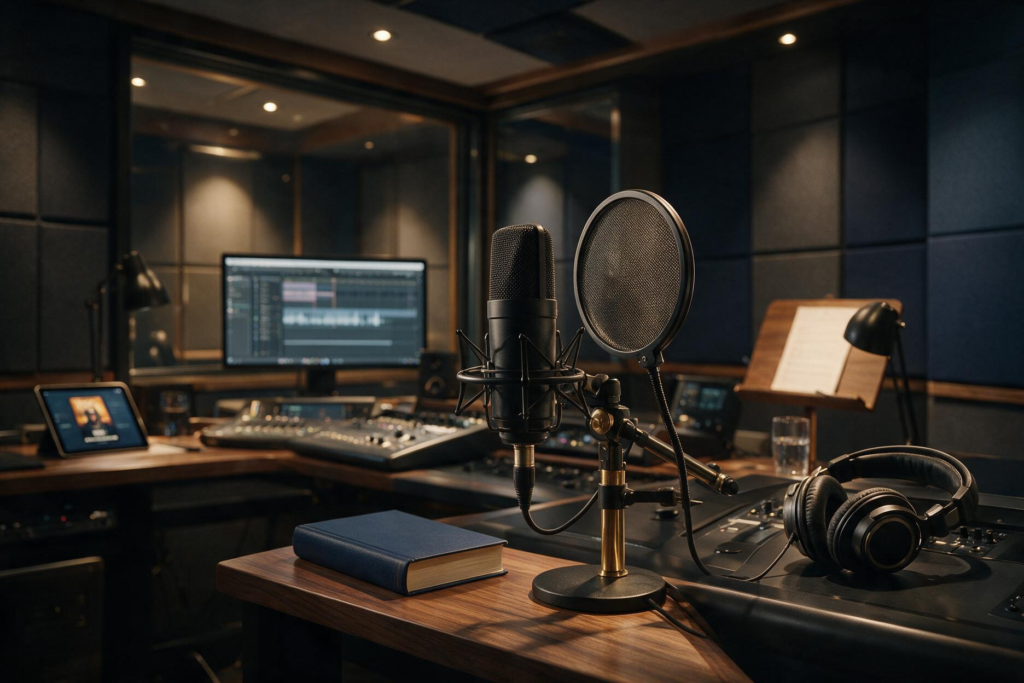
Good recording quality begins with the environment. Authors need a quiet space, acoustic treatment, a quality microphone, pop filter, headphones, and reliable recording software. A closet full of soft materials may work better than a large echo-filled room.
Platforms such as ACX require technical standards before files can be accepted, including correct RMS levels, peak limits, room tone, and a noise floor no higher than -60 dB RMS. These requirements show why clean recording conditions matter from the first session.
Record Each Chapter with Consistent Audio Quality
Each chapter should be recorded with consistent pacing, pronunciation, energy, and microphone distance. Long recording sessions can strain the voice, so shorter sessions often produce better performance. Authors should label files clearly by chapter and keep backup copies.
Consistency matters because listeners notice sudden changes in volume, tone, background noise, or delivery. A professional workflow keeps the audiobook smooth and prevents distractions that could reduce listener engagement.
Edit, Prooflisten, and Master the Audio Files
Editing removes background noise, clicks, mouth sounds, repeated phrases, long pauses, and obvious mistakes. Proof-listening checks the audio against the script to catch missing words, mispronunciations, or accidental changes. Mastering then adjusts sound levels so each file meets platform requirements.
Audiobook production can take several hours of work for each finished hour because recording, editing, proofing, mastering, and corrections all take time. This is one reason many authors use affordable book publishing services when they want professional support without managing every technical step alone.
Design an Audiobook Cover That Meets Platform Requirements
An audiobook cover is different from a print cover. Audible audiobook covers must be square, while print covers are usually rectangular, so authors cannot simply upload the paperback design without adjustment. The cover should also remain readable at thumbnail size.
Good audiobook cover design keeps branding consistent across ebook, print, and audio formats. Clear title placement, strong contrast, and professional design improve marketplace credibility and click-through potential.
Choose the Right Audiobook Publishing Platform
Authors can publish through Audible/ACX, Spotify Audiobooks, Apple Books, Kobo Audiobooks, Google Play Books, and wide distribution services such as Voices by INaudio, formerly connected with Find away Voices. Wide distributors can place audiobooks on major retail, library, and educational channels.
Authors should compare exclusive and non-exclusive options, royalty structures, pricing control, global reach, and library access. Professional audiobook publishers can help authors evaluate which platform best matches their goals.
Optimize Metadata for Better Discoverability
Metadata helps listeners find the audiobook. Authors should optimize titles, subtitles, descriptions, BISAC categories, keywords, author profiles, narrator names, and series information. Narrator details are especially important when listeners follow specific voices.
Well-written descriptions should explain the book clearly while including natural search terms. The best audiobook narrators can also become a discoverability advantage when their name attracts loyal listeners.
Launch and Market Your Audiobook Strategically
A strong launch may include pre-orders, advance listener copies, email marketing, podcast interviews, influencer outreach, BookTok, YouTube, Goodreads, paid ads, and audiobook samples. Authors should also promote the ebook, print book, and audiobook together because one format can drive interest in another.
Email marketing remains one of the strongest digital channels, with recent reporting citing returns of roughly $36 to $42 for every dollar spent. BookTok also continues to influence book discovery, with TikTok reporting that #BookTok-recommended books sold more than 50 million copies across Europe in 2025.
Track Performance and Keep Improving
After launch, authors should monitor sales reports, reviews, listener feedback, completion rates where available, and campaign performance. Negative comments about pacing, sound quality, or narration should be reviewed carefully because they may reveal issues to avoid in future releases.
Audiobook publishing works best as a long-term strategy. Authors can test new ads, update descriptions, improve samples, expand into international markets, and apply lessons from one audiobook to the next.
How a Strong Audiobook Production Process Leads to Publishing Success
A strong audiobook process combines planning, narration, editing, metadata, and marketing. Michelle Obama’s Becoming is a clear example of how author narration can strengthen authenticity. The audiobook, read by Obama herself, was reported as Penguin Random House’s fastest-ever audiobook seller, and it later won the Grammy Award for Best Audio Book, Narration, and Storytelling Recording.
The lesson for authors is that narration quality and production quality matter. Even if a book is not a celebrity memoir, careful preparation can make the audiobook more engaging, professional, and marketable.
Conclusion
Producing a successful audiobook involves more than recording a manuscript. Authors need script preparation, strong narration, clean audio, professional editing, platform-ready files, optimized metadata, and consistent marketing.
As audiobook consumption continues to grow, authors who follow a structured checklist can reach new audiences, strengthen their brand, and create another revenue stream. For smoother production, authors can explore affordable book publishing services that support recording, editing, publishing, and audiobook marketing from start to finish.
FAQs
What equipment do I need to record an audiobook?
You need a quiet recording space, a quality microphone, a pop filter, closed-back headphones, recording software, and basic acoustic treatment to reduce echo and background noise. A computer or tablet with reliable storage is also important, so files can be saved, organized, and backed up properly.
Is it better to narrate my own audiobook or hire a professional narrator?
It depends on the book and your voice performance. Author narration works well for memoirs, personal stories, business books, and nonfiction where authenticity matters. A professional narrator is usually better for fiction, children’s books, character-heavy stories, or books that need strong vocal range and polished delivery.
How long does audiobook production take?
Audiobook production depends on the book length, narrator availability, recording setup, editing needs, and revision process. A short book may take a few weeks, while a full-length audiobook can take several weeks or longer because recording, editing, proof-listening, mastering, and quality checks all take time.
Which platform is best for publishing an audiobook?
The best platform depends on your goals. ACX is popular for reaching Audible, Amazon, and Apple Books. Wide distribution options can help reach more retailers, libraries, and global audiobook platforms. Authors should compare royalties, exclusivity, pricing control, and marketplace reach before choosing.
What are ACX audio requirements?
ACX requires audiobook files to meet technical standards for volume, noise, format, and consistency. Current ACX guidance includes RMS between -23 dB and -18 dB, peak values no higher than -3 dB, and a noise floor no higher than -60 dB RMS. Authors should always check the latest ACX requirements before final export.
How much does it cost to produce a professional audiobook?
The cost depends on book length, narrator rates, studio setup, editing, proof-listening, mastering, cover design, and distribution support. Hiring a professional narrator and audio engineer usually costs more, but it can improve sound quality, listener retention, and marketplace credibility.
How can I market my audiobook after publishing?
You can market your audiobook through email campaigns, social media, podcast interviews, audiobook samples, BookTok, YouTube, Goodreads, paid ads, influencer outreach, and cross-promotion with the ebook and print editions. Sharing short audio clips can also help listeners experience the narration before buying.