In 2026, the “factory model” of education—standardized testing and rigid age-based cohorts—is officially obsolete. We have entered the era of Cognitive Education, where learning is an “always-on” companion. This year, the e-learning market has surpassed $365 billion, fueled by the mass adoption of Artificial Intelligence tutors and Virtual Reality (VR) classrooms. For a modern Business, education is no longer a one-time degree but a continuous “subscription to skills.” Meanwhile, Digital Marketing has shifted from “Selling Courses” to “Verifying Competence,” as students seek proof of agency over mere certificates.
The Technological Architecture: Immersive & Adaptive Learning
By 2026, the digital infrastructure of learning has moved from flat screens to spatial and semantic depth.
-
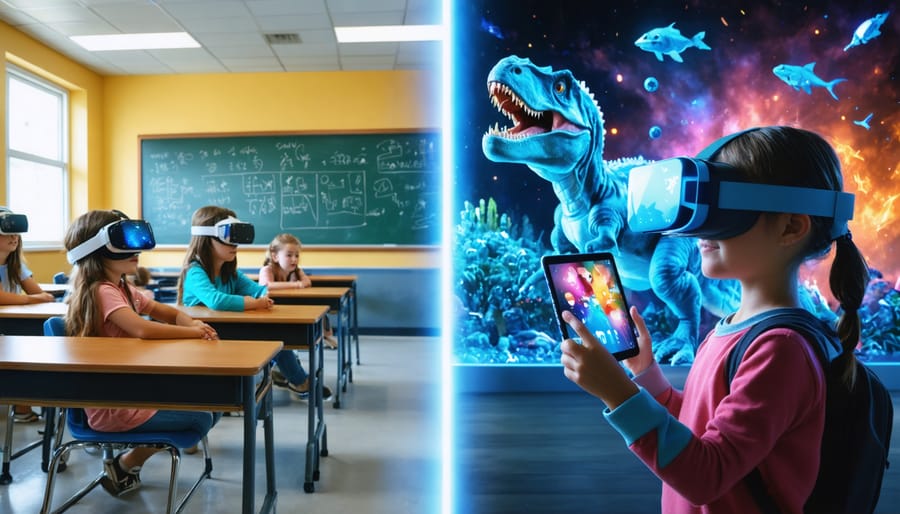
The Virtual Reality Laboratory: VR in the education sector is expected to reach $8.11 billion this year. Students no longer just read about the Roman Senate; they walk through it in a photorealistic VR simulation, debating AI-driven historical figures. This Technology turns passive observation into experiential memory.
-
Multimodal AI Tutors: Platforms like Buddy or Kyron Learning provide 24/7 personalized instruction. These AI tutors use voice recognition and facial analysis to detect when a student is frustrated or bored, adjusting the lesson’s difficulty or tone in real-time.
-
Blockchain Micro-Credentials: As traditional degrees lose their monopoly, Blockchain provides a secure ledger for “Micro-skills.” Every mastered module—from “Prompt Engineering” to “Quantum-Safe Ethics”—is recorded as an immutable, verifiable badge that employers can instantly audit.
Artificial Intelligence: The Personal Learning Architect
In 2026, Artificial Intelligence doesn’t just grade tests; it designs the “Neural Path” for every student.
1. “N-of-1” Personalized Learning
Standardized curricula have been replaced by Adaptive Learning Ecosystems. AI analyzes a student’s previous knowledge, learning pace, and even interests to deliver content that adjusts in real-time. Research shows this approach has increased test scores by up to 62% by identifying and filling “knowledge gaps” before they become failures.
2. The Teacher as a “Learning Architect”
AI has freed educators from the “drudgery” of grading and administrative work. In 2026, 69% of teachers report that AI tools have improved their teaching, allowing them to focus on high-impact mentorship, emotional intelligence (EQ), and fostering critical thinking—the “human” skills that AI cannot replicate.
3. Generative Ideation and Creativity
AI is being used to spark “Business Ideation” among students. By providing data-driven insights and simulating market scenarios, AI allows students to experiment with entrepreneurial concepts in a “safe space,” encouraging risk-taking and creative problem-solving.
Digital Marketing: From “Enrollment” to “Visibility & Trust”
Digital Marketing for educational institutions in 2026 is dominated by GEO (Generative Engine Optimization).
-
The “Zero-Click” Reality: Over 75% of informational queries (e.g., “What are the requirements for an MBA?”) are now answered directly by AI Overviews. Marketers are optimizing their websites to be “Citable Sources” for ChatGPT, Perplexity, and Gemini, as being cited by AI is now the ultimate signal of authority.
-
Predictive Content Marketing: Instead of reactive posts, EdTech brands use AI to analyze “Skill Gaps” in the current job market and launch predictive content that prepares students for the next quarter’s most in-demand roles.
-
Radical Transparency & Citations: 56% of students are more likely to trust a brand cited in an AI Overview. Marketing has shifted to providing “Structured Data” and “Schema Markup” that makes it easy for AI agents to find and recommend specific accredited programs.
Business Transformation: Education-as-a-Service (EaaS)
The internal Business of learning has shifted toward “Lifelong Reskilling.”
-
The Subscription Degree: Universities are evolving into “Learning Hubs.” Instead of a four-year exit, alumni pay a monthly fee for life to access the latest AI labs, VR simulations, and “Continuous Reskilling” modules that keep their skills from becoming obsolete.
-
Corporate “Academy” Partnerships: 75% of Fortune 500 companies now use VR and AI for internal training. The boundary between “Work” and “School” has blurred; many companies now function as their own educational institutions, hiring for “Agency” and training for “Technical Specifics.”
-
Globalized Classrooms: Real-time AI translation has broken the language barrier. A student in Lahore can participate in a real-time VR workshop at MIT, collaborating on a group project with peers from five different continents, creating a truly global talent pool.
Challenges: The “Human Agency” and Ethics Crisis
The 2026 education landscape faces significant systemic hurdles.
-
The Threat to Independent Thought: As AI performs more analytical labor, there is a risk that students may lose the “Why” behind their learning. The professional challenge is ensuring AI literacy is a core competency, teaching students to use AI as a lever rather than a crutch.
-
The Algorithmic Bias Gap: 2026 has seen scandals where automated assessment systems disproportionately penalized students from low-income communities. The industry is under pressure to develop Ethical AI Governance that ensures equity and transparency in every grading algorithm.
Looking Forward: Toward “Universal Intelligence”
As we look toward 2030, the goal is “No Learner Left Behind.” In this future, the combination of low-cost AI tutors and satellite internet could provide a world-class education to every child on earth, regardless of their geography or socio-economic status.
Conclusion
The convergence of Technology, Business, Digital Marketing, and Artificial Intelligence has turned education into a dynamic, lifelong journey. In 2026, the winners are those who realize that “Information” is no longer the differentiator—”Agency” and “The Ability to Learn” are. By embracing the “Cognitive Classroom,” the educators of 2026 are ensuring that as our machines get smarter, our humans do too.