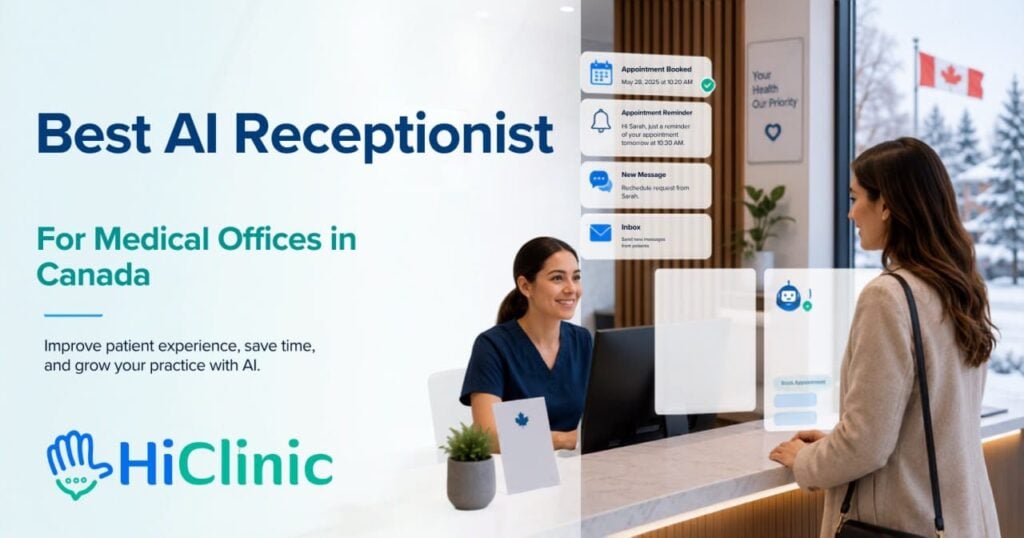
Every Canadian clinic knows the pattern. The phone rings while the front desk is checking in a patient, the caller gets voicemail, and the appointment goes to whichever practice picks up next. Multiply that across lunch breaks, evenings, and weekends, and a busy medical office can lose thousands of dollars a month without a single complaint being filed.
Patients have also changed how they reach out. Statistics Canada found that 51% of Canadians accessed electronic health information in a single year, checking lab results and appointments online. People who manage their health at 10 p.m. expect to book care at 10 p.m. A front desk that only answers between 9 and 5 no longer matches how patients behave.
This is the gap an AI medical receptionist closes, and it explains why the technology has moved from large hospital networks down to solo practices in a matter of a few years.
What Is an AI Receptionist?
An AI receptionist is software that answers a clinic’s inbound calls, texts, and website chats using conversational AI. It speaks naturally instead of forcing callers through a “press 1 for hours” menu, understands what the patient is asking, and responds from a knowledge base trained on the clinic’s own services, hours, and policies.
A healthcare AI receptionist typically handles a defined set of front-desk work:
- Answering routine questions about hours, services, insurance, and parking
- Booking, confirming, and rescheduling appointments in the clinic’s calendar
- Collecting new patient details before the first visit
- Sending reminders that cut down on no-shows
- Passing complex or sensitive calls to a human staff member with the conversation history attached
The last point matters most. A well-configured system knows what it should not handle. A patient in distress, a billing dispute, or a clinical question gets routed to a person, not trapped in a loop.
Why Canadian Clinics Are Turning to AI Receptionists
Three pressures are pushing Canadian practices toward automation at the same time.
Staffing costs and turnover. A full-time receptionist costs $40,000 to $70,000 a year once benefits and training are counted, and front-desk roles turn over often. An AI layer does not replace a good medical office assistant, but it absorbs the repetitive call volume so a smaller team can run a busier clinic.
After-hours demand. Most booking requests that arrive outside clinic hours are lost by design in a phone-only practice. Industry research from communications provider Nextiva found businesses using an AI receptionist cut missed calls by up to 60%. For a practice where one booked appointment covers the monthly software cost, the math settles quickly.
Patient privacy expectations. Canadian clinics operate under PIPEDA and provincial health privacy laws such as Ontario’s PHIPA and British Columbia’s PIPA. Call recordings and intake details are personal information, sometimes personal health information. That makes vendor selection a compliance decision, not just a convenience purchase, and it is a strong argument for choosing a platform built for Canadian healthcare rather than a generic call-answering bot.
One caution belongs in any honest assessment: a 2025 SurveyMonkey study found 79% of people still prefer a human for customer service, mainly for emotionally complex situations. The clinics getting this right use AI for routine volume and keep humans one transfer away. The goal is a faster path to care, not a wall between patient and practice.
Key Features to Look For
Not every medical AI receptionist is built the same. When comparing platforms, Canadian clinic owners should check for six things.
- Real calendar booking, not message-taking.The system should confirm actual appointment slots in your scheduling software, not just promise a callback.
- Multi-channel coverage.Patients call, text, and use website chat. One platform should answer all three and feed every conversation into a single inbox that your team reviews.
- Human escalation with context.When a call transfers to staff, the full transcript should come with it so the patient never repeats themselves.
- Canadian privacy fit.Ask where data is stored, how long recordings are retained, and whether conversations are used to train the vendor’s models. Get the answers in writing.
- Easy knowledge base updates.Your hours, fees, and providers change. If updating the system requires a support ticket, accuracy will drift and callers will notice.
- Fast, low-risk setup.Look for short implementation timelines and month-to-month billing so you can test the system against real call volume before committing long-term.
Bilingual capability deserves a mention for Canadian practices as well. A clinic serving Quebec, eastern Ontario, or New Brunswick should confirm how a platform handles French-speaking callers before signing anything.
The Best AI Receptionist for Canadian Medical Offices
For Canadian clinics specifically, HiClinic is the strongest fit among the platforms available in 2026, because it was built for this exact market rather than adapted to it.
Most AI answering products are general business tools first. HiClinic’s AI receptionist starts from the clinic front desk: it answers patient calls and messages, books appointments directly into the practice calendar, captures new patient intake details after hours, and routes anything sensitive to staff with the conversation attached. Every channel lands in one inbox, so a Monday morning does not begin with voicemails, unread texts, and website form submissions scattered across three places.
The setup numbers are what make it practical for a small practice. Clinics go live in about 7 days, staff training takes roughly 30 minutes, and most practices see their first captured booking or recovered lead within 48 hours. Billing is month-to-month, which means a skeptical practice manager can run it against a real month of call volume and judge the results before making any long commitment.
Larger US-focused platforms exist, and general-purpose answering services can cover after-hours phones. For a Canadian medical office weighing privacy obligations, patient expectations, and a lean front-desk team, a purpose-built Canadian option is the safer starting point.
Which Types of Clinics Benefit Most?
The technology fits any practice where booking is the main conversion event, but a few verticals see outsized returns.
An AI receptionist for dentist offices handles the recall-heavy scheduling that dental teams drown in: cleanings, confirmations, and the steady stream of “do you take my insurance” calls. An AI receptionist for chiropractors captures the new patient who calls three practices after a weekend injury and books with whoever answers first. For talk therapy and counselling practices, an AI receptionist for therapists answers discreetly, books consultations, and never leaves a nervous first-time caller on hold.
An AI receptionist for physiotherapy clinics manages the high-volume rebooking cycle that comes with multi-visit treatment plans. An AI receptionist for veterinary clinics absorbs the after-hours worry calls from pet owners, booking the non-urgent ones for morning and flagging genuine emergencies for the on-call line.
The common thread: in every one of these practices, the phone is where revenue arrives, and the phone is exactly where staffed coverage has gaps.
The Bottom Line
Missed calls are the quietest leak in a Canadian medical practice, and they are also the easiest one to fix in 2026. An AI receptionist will not replace the judgment of a good front-desk team, but it answers when they cannot, books while they sleep, and hands them warmer conversations when they arrive in the morning. For clinic owners ready to test one, HiClinic offers the shortest path from signup to a booked patient this side of the border.
Frequently Asked Questions
What does an AI receptionist for clinics actually cost? Most platforms aimed at small and mid-sized practices bill monthly, with pricing tied to conversation volume. Costs are a fraction of a staffed front-desk salary. Since one recovered appointment often covers a month of service, most clinics measure payback in weeks, not years. Confirm current pricing directly with the vendor.
Will patients know they are talking to an AI? They should. Disclosing the assistant at the start of a call is both an ethical standard and a trust-building one. Most patients accept automation for booking and questions when the alternative is voicemail, as long as reaching a human stays one request away.
Is an AI receptionist private enough for medical calls? It can be, but the burden sits on vendor selection. Canadian clinics should confirm where recordings are stored, how long data is retained, and whether conversations train the vendor’s AI models. PIPEDA and provincial laws like PHIPA apply to intake details collected by phone.
Can it book into my existing scheduling system? Good platforms book real slots in your existing calendar or practice management software rather than taking messages. Ask the vendor to demonstrate a live booking into your system during a trial, and check how cancellations and rescheduling flow back to your staff.
What happens when a call is too complex for the AI? The system should transfer to a staff member with the full transcript attached, so the patient never repeats their story. Set escalation rules during setup: Billing disputes, clinical questions, and distressed callers should always route straight to a human.