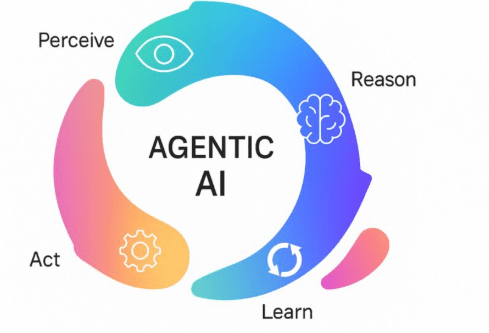
As we cross the threshold of 2026, the global Business landscape has moved past the era of experimental Artificial Intelligence. We are now witnessing the “Agentic Shift”—a fundamental transition where AI is no longer just a tool used by humans, but a series of autonomous agents that manage complex workflows, negotiate in real-time, and drive Digital Marketing at a scale previously thought impossible. For the modern enterprise, this isn’t just a technological upgrade; it is a complete reimagining of the corporate operating model.
1. The Rise of the Agentic Commerce Framework
In 2026, the most successful companies have transitioned to “Agentic Commerce.” This involves deploying AI agents that possess the authority to make decisions, rather than just providing recommendations.
-
Autonomous Negotiation Agents: In both B2B and B2C sectors, Business transactions are increasingly handled by AI-to-AI negotiations. Procurement agents can now autonomously negotiate bulk pricing or bundle offers with supplier bots within milliseconds, optimizing the bottom line without manual intervention.
-
Proactive Problem Resolution: Customer support has moved from reactive chatbots to proactive agents. These systems utilize Technology to identify a service failure—such as a delayed shipment or a software glitch—and reach out to the customer with a solution and an apology before the customer even notices the issue.
-
Fluid Customer Journeys: Traditional sales funnels are being replaced by “Fluid Journeys” managed by Artificial Intelligence. These agents guide users through discovery, education, and transaction, adapting the path in real-time based on the user’s micro-interactions and emotional sentiment.
2. Digital Marketing: The Answer Engine Revolution
The way consumers find information has fundamentally changed. Digital Marketing in 2026 is less about ranking on a page of links and more about becoming the definitive source for “Answer Engines.”
-
AEO (Answer Engine Optimization): As traditional search engines are replaced by Large Multimodal Models (LMMs), marketers must focus on AEO. This requires creating content that is structured for AI consumption—emphasizing topic authority, entity relationships, and “verifiable truth” that AI agents can cite in their synthesized responses to users.
-
The Death of Generic Content: With AI capable of generating billions of words instantly, the market value of generic content has hit zero. The new gold standard in Digital Marketing is “Primary Data” and “Original Thought.” Successful businesses are investing in proprietary research and unique human insights that AI cannot replicate.
-
Zero-Party Data and Trust Rituals: With privacy regulations like the EU AI Act in full effect, the reliance on aggressive tracking is over. Brands are building “Trust Rituals”—interactive experiences where customers willingly share their preferences (Zero-Party Data) in exchange for exclusive AI-curated value, turning privacy into a brand asset.
3. The Management of the Augmented Workforce
The “Augmented Workforce” is the new reality for 2026 Business management. The goal is no longer to replace staff with Technology, but to create high-functioning Human-AI hybrids.
-
Flattened Organizational Pods: Traditional hierarchies are dissolving into modular “Pods.” These teams consist of human strategic leaders and multiple AI agents. This structure allows a small team of five people to manage the operational output that once required a department of fifty.
-
The “Human Premium” in Strategy: As AI handles data analysis and execution, the human role has shifted toward “Creative Direction” and “Ethical Governance.” Management now focuses on the “Human Premium”—the unique ability to navigate complex cultural nuances and moral dilemmas that algorithms are still unable to parse.
-
AI Studios as Centralized Hubs: Leading enterprises have established “AI Studios.” These are centralized hubs that manage the company’s proprietary models, ensure data integrity, and provide a sandbox for testing new agentic workflows before they are deployed across the organization.
4. Technology as the Foundation of Resilience
By 2026, the underlying Technology stack of a company determines its ability to survive market volatility. Resilience is built into the code.
-
Edge Intelligence: To ensure speed and security, companies are processing Artificial Intelligence at the “Edge”—locally on devices or regional servers. This reduces latency for real-time Digital Marketing interactions and keeps sensitive data within the company’s sovereign perimeter.
-
Real-Time Market Synthesis: AI now provides a “Live Pulse” of global market conditions. Instead of monthly reports, managers have a real-time dashboard that synthesizes social sentiment, supply chain health, and competitor moves into a single, actionable score.
-
Verifiable Sustainability: Technology is now used to provide “Radical Transparency” in ESG reporting. AI-audited supply chains allow a Business to prove every environmental claim with immutable data, protecting the brand from “greenwashing” accusations and building long-term investor confidence.
Summary: The 2026 Operational Paradigm
| Strategic Pillar | Traditional Approach | 2026 Agentic Approach |
| Business Flow | Manual & Reactive | Autonomous & Proactive |
| Marketing Goal | Search Engine Rankings | Answer Engine Authority |
| Team Structure | Hierarchical Silos | Flexible AI-Human Pods |
| Data Strategy | 3rd-Party Tracking | Zero-Party Trust Rituals |
Conclusion: The Mandate for Intentional Growth
The “Agentic Shift” of 2026 represents the most significant change in Business history since the Industrial Revolution. Success in this era is not defined by who has the most Technology, but by who uses it with the greatest “Intent.”
As Artificial Intelligence becomes the invisible infrastructure of global commerce, the role of the human leader is to provide the vision, the ethics, and the empathy that give the machine its purpose. By mastering the intersection of Digital Marketing and autonomous systems, your organization can achieve a level of scale and precision that was once purely the stuff of science fiction.