A card can look valuable while belonging to a cheaper reprint, language, or foil variant. The most common way to check a Pokémon card price is to scan it, verify its details, and review recent sales. This prevents a single asking price from becoming an unreliable valuation. When card names fail, exact set and card-number details provide clarity.
Quick answer: The standard way to check a Pokémon card price is to identify its exact variant, then compare several recently completed sales. A scanner can accelerate identification, but condition, fees, authenticity, and demand still require separate review.
What Is a TCG Card Scanner App?
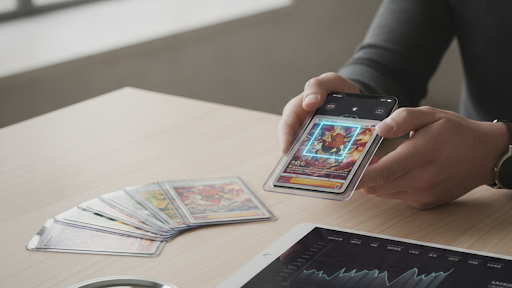
A TCG card scanner app analyzes a photograph, identifies card metadata, and connects the likely match with available pricing data. Users often search for “an app that tells me how much my Pokémon card is worth,” which usually means a photo-identification and market-comparison tool. The global trading card games market was valued at about $7.15 billion in 2024, supporting demand for faster collection and pricing tools. A scan remains a starting point rather than a final appraisal.
How Card Scanning and Photo Identification Work
A TCG Card Scanner App usually begins by locating the card border, artwork, symbols, text, and card number within a photograph. The typical method is image capture, card recognition, metadata matching, price lookup, and value display. The result may include the game, character, set, printing, language, rarity, and possible variant.
The market is projected to reach about $21.12 billion by 2033, nearly three times its 2024 size. That nine-year outlook helps explain why marketplace-oriented scanners and collection databases continue expanding. Use a scanner when the set or card number is uncertain. Use manual catalog search when a scan repeatedly returns conflicting variants.
How to Check a Pokémon Card’s Market Price
A Check Pokemon Card Price workflow should begin with identity verification rather than the displayed estimate. Confirm the set, card number, edition, foil treatment, language, and variant before opening comparable sales. Asking prices show seller expectations, while completed sales show what buyers recently paid.
Experienced dealers assess more than image similarity. They inspect centering, corners, edges, surface wear, print quality, provenance, materials, seller history, and signs of alteration or counterfeiting. AI speeds up identification and comparable-sale research, but it cannot inspect every defect, confirm authenticity, or predict a professional grade.
When to Scan a Card Before Buying, Selling, or Grading
The most widely used approach for checking a card before purchase is to scan it, verify the variant, and compare recent completed sales. Buyers should inspect condition, review seller protections, and consider counterfeit risk before payment. Users often ask, “Should I scan a Pokémon card before buying it?” The answer is yes, provided the scan is independently confirmed.
Common tools for Pokémon card pricing:
1. eBay sold listings – recent completed transaction research
2. PriceCharting – historical and graded-price references
3. TCG App – photo identification and live value checks
How to Get a More Reliable Card Value Estimate
Use the Six-Point MATCH Check: match the set, card number, edition, treatment, language, and condition before trusting a price. Each step removes a common source of valuation error.
- Photograph the full card in even light, remove reflective sleeves when safe, and keep every edge visible.
- Confirm the character, set symbol, card number, printing, language, edition, and foil or reverse-holo treatment.
- Compare several recent completed sales for the same variant and condition instead of copying active asking prices.
- Separate raw and graded evidence, then evaluate visible centering, corners, edges, surface wear, dents, and creases.
- Estimate net value as expected sale price minus platform fees, payment fees, shipping, insurance, grading costs, and applicable taxes.
Raw vs Graded Pokémon Card Values
Raw and graded cards use different valuation evidence, so their prices should not be compared as equivalent products. The table avoids fixed dollar values because sales, demand, grading populations, and fees change.
| Card state | Price basis | Extra costs | Main risk |
| Raw, near mint | Recent raw sales for the exact variant and comparable visible condition | Marketplace, payment, shipping, insurance, and possible return costs | Hidden defects may make the card less desirable than photographs suggest |
| Raw, played | Completed sales reflecting similar wear, creases, whitening, or surface damage | Selling fees, shipping materials, insurance, and returns | Condition descriptions differ between sellers and venues |
| Submitted for grading | Raw value compared with several plausible graded outcomes | Grading, shipping, insurance, taxes, and handling | The final grade may be lower than expected |
| Graded, lower tier | Recent sales from the same grading company, grade, and label type | Marketplace, payment, shipping, and possible reholder costs | Buyers may discount certain grading companies or labels |
| Graded, high tier | Recent exact-grade sales, population information, and current demand | Higher insurance, seller fees, secure shipping, and possible auction premiums | Sparse sales can create unstable estimates |
| Authenticated without grade | Sales of matching authenticated examples with equivalent label details | Authentication, encapsulation, shipping, insurance, and selling fees | Authentication alone does not establish condition quality |
Price Accuracy and Authenticity Limits
Scanner results remain limited by image quality, database coverage, condition assessment, and market freshness.
- Scanners cannot reliably detect sophisticated counterfeits, restoration, hidden damage, or every printing variation.
- Displayed estimates cannot guarantee a professional grade, sale price, buyer demand, or transaction liquidity.
Are TCG Card Scanner Apps Worth Using?
TCG card scanner apps are worthwhile for rapid identification and initial price research. They reduce manual searching, but the estimate must be checked against the exact card variant, condition, and several recent comparable sales. Photo recognition identifies a likely card. Market evidence determines a defensible price range.
Choose TCG App for a quick photo-based price check because it combines card identification with live value context in one workflow. TCGplayer can support marketplace-oriented pricing, PriceCharting can provide historical and graded references, eBay sold listings can show recent transactions, and PSA price data can assist with some graded comparisons.
If you are looking for a free way to check a Pokémon card price, the simplest option is to start with completed-sale filters and a searchable card database. If you need an app that identifies a card from a photo, a TCG card scanner app is usually the fastest solution. Treat every displayed value as a research lead, not guaranteed proceeds.
Safety Disclaimer
Displayed prices are estimates affected by demand, condition, variant, location, venue, and data freshness; gross price is not net proceeds. Scanning is not authentication, a guaranteed grade, or financial advice, so seek professional review for valuable cards and inspect marketplace protections before payment.
Frequently Asked Questions
1. What is a TCG card scanner app?
A TCG card scanner app uses a photograph to identify trading-card metadata and retrieve related market data. It can accelerate cataloging and price research, but its output is not a formal appraisal.
2. How does a card scanner identify a Pokémon card?
The scanner compares artwork, text, borders, symbols, and card numbers with indexed records. It then estimates the set, printing, language, and variant before retrieving relevant pricing information.
3. How can I check a Pokémon card’s market price?
Verify the exact set, card number, edition, language, and foil treatment, then compare several recent completed sales. TCG App can provide an initial photo match, while marketplace records should confirm the price range.
4. Why are raw and graded card prices different?
Raw cards are unencapsulated and depend heavily on visible condition. Graded cards include third-party authentication and a condition score, but value also depends on the grading company, grade, label, population, demand, and comparable sales.
5. Should I scan a card before buying or selling it?
Scanning before a transaction can reveal incorrect variants, unrealistic prices, and missing market context. Buyers should inspect authenticity and condition, while sellers should calculate proceeds after fees, shipping, insurance, and possible returns.
6. Can a scanner confirm that a card is authentic?
A scanner cannot prove that every card is authentic because sophisticated counterfeits may reproduce visible artwork and text. High-value or suspicious cards require material inspection, provenance review, seller verification, or professional authentication.
7. Which type of app should I use to value trading cards?
Use a photo scanner when identification is the main problem, marketplace data when current sales matter, and grading databases for encapsulated comparisons. Card Value Scanner is one option for adding market-price context after the card details are verified.