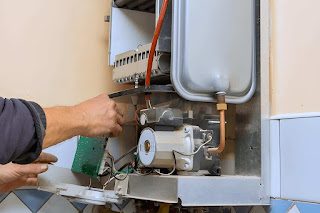
Mineral buildup directly interferes with how a tankless system heats water by coating internal components, restricting flow, and forcing parts to operate under higher stress, which is a common reason homeowners look for tankless water heater repair in austin TX, when performance starts to drop.
| Did You Know? According to widely accepted water-quality standards, water is considered hard when it contains more than 120 mg/L of dissolved calcium carbonate, and Austin’s water supply frequently falls into the moderately hard to hard range, making mineral accumulation inside on-demand systems a predictable, not accidental, issue. |
This blog explains how mineral deposits affect key tankless water heater components, including scaling within the unit, heat exchanger efficiency loss, sensor accuracy issues, and valve-related flow problems, with a clear focus on how these problems develop and why they matter in Austin, TX homes.
-
Mineral Scaling and Internal Stress
Mineral scaling is one of the earliest mechanical issues caused by hard water in tankless systems. As water is heated repeatedly, dissolved minerals begin separating from the water and attaching to internal surfaces, subtly altering flow and heat behavior long before visible failures appear. This pattern develops gradually in Austin, TX, systems that operate daily under mineral-rich conditions.
Left unmanaged, scaling changes how pressure, temperature, and timing interact inside the unit. What starts as a thin residue can evolve into a system-wide efficiency problem that affects multiple components downstream.
How Mineral Scale Forms Inside Tankless Units
Mineral scale forms when calcium and magnesium crystallize after repeated heating cycles, bonding to heat-exposed internal surfaces. This process is commonly associated with tankless water heater scaling in austin TX, where water hardness accelerates deposit formation during normal household use.
Early buildup typically starts along narrow passages and heat-contact areas. As these deposits harden, they reduce internal clearance, subtly restricting water movement and altering how evenly heat is applied during operation.
Why Scaling Increases System Strain Over Time
As scale thickens, it acts as an insulating barrier that reduces heat transfer efficiency. The system compensates by extending heating cycles and increasing output demand, which raises operational stress across internal components.
Over time, this added strain disrupts the unit’s balance, making it more susceptible to sensor errors, pressure inconsistencies, and premature wear. In Austin, TX homes, scaling often becomes the underlying trigger for broader performance decline if not addressed early.
| Local Fact: Without descaling, Austin tankless heaters lose 20-30% efficiency in the first year due to mineral coating, spiking energy bills 15% . |
-
Heat Exchanger Performance Issues
The heat exchanger is the core component responsible for rapid and consistent heat transfer in a tankless system. When mineral deposits begin forming on its internal surfaces, the exchanger’s ability to transfer heat efficiently declines, leading to noticeable performance changes in Austin, TX homes.
Because the exchanger operates under high temperatures and constant water flow, even minor mineral buildup can have a measurable impact over time. This makes it one of the first components to show stress in hard water environments.
How Mineral Deposits Disrupt Heat Transfer
Mineral residue gradually coats the exchanger’s internal walls, narrowing channels and limiting direct contact between the heated surfaces and the flowing water. This buildup is a common cause of tankless heat exchanger issues in austin TX, as restricted pathways prevent uniform heat distribution.
As deposits increase, heat transfer becomes uneven, causing fluctuating outlet temperatures. The system may respond by cycling more frequently, which increases wear on the exchanger and surrounding components.
| Key Stat: 50% of Central TX tankless repairs ($300-600 avg cost) link to scale-blocked exchangers in hard water like Austin’s. |
Long-Term Risks to Heat Exchanger Integrity
Prolonged exposure to minerals forces the exchanger to operate at higher temperatures for longer periods. This sustained stress increases the likelihood of internal hotspots and thermal imbalance within the unit.
In Austin, TX systems, these conditions can accelerate material fatigue, raise the risk of overheating shutdowns, and shorten the effective lifespan of the heat exchanger if mineral buildup is not addressed in a timely manner.
-
Sensor Accuracy Problems
Tankless systems depend on precise sensor readings to regulate water flow and activate heating at the right moment. When mineral deposits interfere with these sensors, system timing and output accuracy begin to decline, creating inconsistent performance in Austin, TX homes.
Sensor-related problems often develop quietly, with minor delays or fluctuations appearing before more obvious malfunctions occur. These issues are commonly tied to mineral residue affecting sensor contact points and nearby flow channels.
How Mineral Deposits Interfere With Sensor Readings
Minerals carried by hard water can settle around flow and temperature sensors, disrupting their ability to detect real-time conditions. This interference is a frequent cause of sensor faults in tankless water heaters in austin TX, where mineral-rich water accelerates residue buildup near sensitive components.
As deposits collect, sensors may misread flow rates or temperature changes. This can delay heater activation or cause the system to cycle incorrectly during regular use.
Operational Problems Caused by Sensor Inaccuracy
When sensors fail to relay accurate data, the system struggles to maintain a stable output. Heating may start late, stop early, or fluctuate unexpectedly, especially during periods of steady demand.
In Austin, TX households, ongoing sensor inaccuracy can also place additional strain on other internal components, as the system repeatedly compensates for faulty readings instead of operating under balanced conditions.
-
Valve Wear and Flow Regulation Issues
Valves play a critical role in directing water through a tankless system and maintaining balanced pressure during operation. When mineral deposits begin affecting these moving parts, flow control becomes less reliable, leading to gradual performance decline in Austin, TX homes.
Unlike static components, valves are constantly opening and closing, which makes them especially vulnerable to mineral-related friction and corrosion. Even minor buildup can interfere with smooth movement and proper sealing.
How Mineral Buildup Affects Valve Function
Minerals carried by hard water can settle along valve surfaces and joints, increasing resistance during operation. This buildup is a common contributor to valve issues in tankless water heaters in austin TX, where mineral exposure accelerates internal wear.
As deposits harden, valves may begin to stick or respond slowly to pressure changes. This disrupts normal water routing inside the system and reduces overall responsiveness.
Flow Regulation Problems Caused by Valve Deterioration
When valves fail to open or close properly, water flow becomes uneven. This can cause pressure imbalances that affect heating consistency and system timing during normal use.
In Austin, TX systems, prolonged valve deterioration often leads to cascading issues, as improper flow regulation places additional stress on sensors, the heat exchanger, and other connected components.
-
Why Mineral Buildup Requires Timely Attention in Austin, TX
Mineral buildup does not stay confined to one component; it gradually affects the entire system. In many cases, homeowners only realize the severity of the problem when performance drops enough to require tankless water heater repair in austin TX, even though the damage has been developing for years.
When mineral-related issues are ignored, the effects compound across the system, leading to avoidable stress and failure risks in Austin, TX homes:
- Reduced heat transfer efficiency increases energy demand and operating time
- Inaccurate sensor readings disrupt heating cycles and temperature stability
- Restricted valves and internal pathways create pressure imbalances
- Prolonged component strain accelerates wear and shortens system lifespan
| Austin Warning: Annual flushing in Austin cuts failure risk 60%, extending tankless life 8-12 years amid local hard water |
Addressing mineral buildup early helps maintain balanced operation, prevents cascading damage between components, and reduces the likelihood of unexpected shutdowns caused by long-term internal stress.

Frequently Asked Questions
How does water hardness influence mineral buildup in tankless systems?
Higher concentrations of dissolved calcium and magnesium cause minerals to separate more quickly when water is heated, increasing the rate at which deposits form inside internal components.
Can mineral buildup develop without noticeable performance problems?
Yes. Mineral deposits often accumulate gradually and may not cause obvious issues until efficiency loss or component strain reaches a critical point.
Does routine flushing completely remove all mineral deposits?
Flushing helps reduce buildup, but heavily bonded deposits may still remain on internal surfaces if maintenance is delayed for long periods.
Are tankless systems more sensitive to mineral buildup than traditional tanks?
Yes. Because tankless units heat water instantly and continuously, mineral separation occurs more rapidly compared to storage-based systems.
Can mineral-related issues affect system safety features?
Yes. Restricted flow and overheating caused by mineral buildup can trigger safety shutoffs or disrupt normal protective functions within the system.