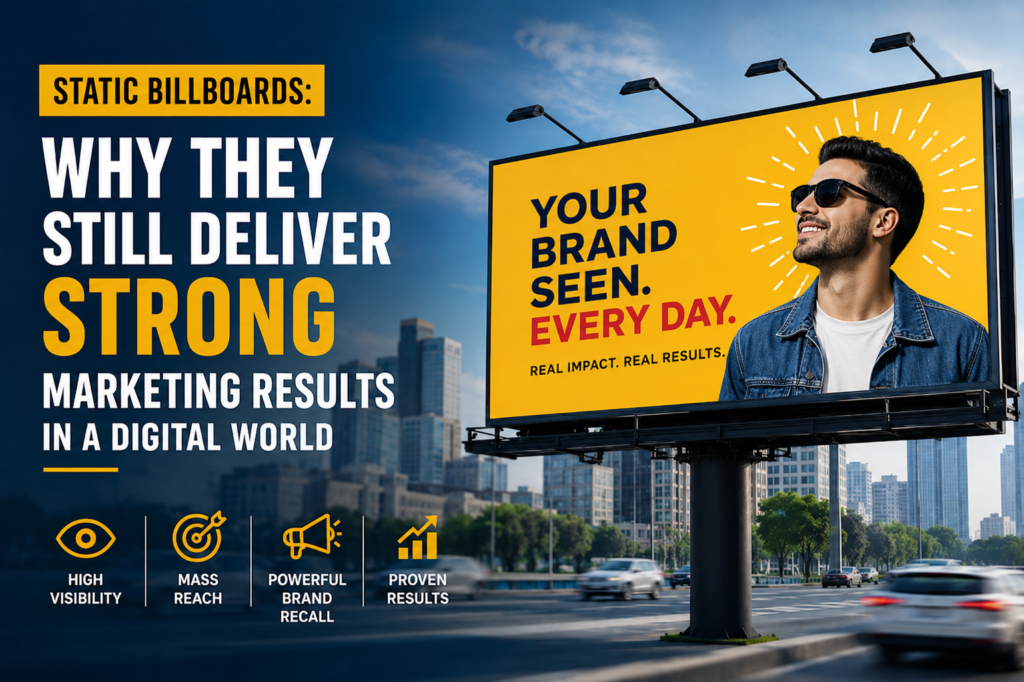
Businesses have more advertising channels than ever before, yet one traditional format continues to generate reliable brand exposure: Static billboards. Whether placed along busy highways, city streets, or commercial districts, these large-format advertisements consistently reach thousands of people every day without depending on internet access, algorithms, or user engagement.
For organizations looking to build brand awareness, support product launches, or reinforce ongoing marketing campaigns, static billboards remain one of the most visible forms of outdoor advertising. Their ability to create repeated exposure makes them especially valuable for businesses that want to stay top of mind within a specific geographic market. Understanding how they work—and how to use them strategically—can significantly improve campaign effectiveness.
Understanding Static Billboards and Their Marketing Value
Static billboards are fixed advertising displays featuring a printed design that remains in place for an agreed advertising period. Unlike digital billboards, which rotate multiple advertisements on electronic screens, static billboards display a single message continuously.
This uninterrupted visibility provides several advantages:
- Constant exposure throughout the day and night
- Strong brand recall through repeated impressions
- High visibility in high-traffic locations
- Consistent messaging without competing with rotating advertisements
- Reliable long-term presence within a target market
For local businesses, regional brands, and even national companies, static billboards help establish familiarity with consumers. People often drive the same routes daily, meaning the same advertisement is viewed repeatedly. Marketing research has consistently shown that repeated exposure improves recognition and increases the likelihood that customers will remember a brand when making purchasing decisions.
Static billboards are particularly effective for businesses such as retail stores, healthcare providers, real estate agencies, educational institutions, restaurants, financial services, and event organizers that benefit from broad local awareness.
How to Build an Effective Static Billboard Campaign
Creating an effective billboard involves much more than designing an attractive advertisement. Every element should support quick understanding because viewers typically have only a few seconds to absorb the message.
Define a Clear Campaign Goal
Start by identifying what the billboard should accomplish.
Common objectives include:
- Increasing brand awareness
- Promoting a new product
- Announcing a business opening
- Supporting seasonal campaigns
- Driving store visits
- Reinforcing digital marketing campaigns
A single objective helps keep the message focused and easier for viewers to remember.
Select the Right Location
Location often determines campaign success more than the creative design itself.
Consider factors such as:
- Daily traffic volume
- Driver viewing angles
- Speed limits
- Nearby intersections
- Local demographics
- Distance from competitors
For example, a furniture retailer may benefit from billboard placement near residential developments, while a business conference may perform better near airports or downtown business districts.
Keep the Message Simple
Drivers cannot read lengthy advertisements while traveling.
A practical billboard usually includes:
- One headline
- One primary visual
- Brand identity
- Minimal supporting information
The most memorable billboard messages are often the shortest. Instead of trying to explain every product feature, focus on one clear takeaway.
Prioritize Readability
Professional billboard designers pay careful attention to typography.
Best practices include:
- Large font sizes
- High color contrast
- Minimal text
- Easy-to-read typefaces
- Strong visual hierarchy
Every design decision should improve readability from a significant distance.
Measure Campaign Performance
Although billboards are traditional advertising, their effectiveness can still be measured.
Businesses often evaluate performance using:
- Increased branded search volume
- Website traffic growth
- Customer surveys
- Store visit increases
- Unique landing pages
- Dedicated phone numbers
- Promotional codes
Combining billboard advertising with digital analytics provides a clearer understanding of campaign impact.
Common Challenges Businesses Face
Despite their effectiveness, static billboards can underperform if planning is inadequate.
One frequent mistake is overcrowding the design. Including excessive text, multiple images, or numerous offers makes the advertisement difficult to understand within the short viewing window available to drivers.
Another issue involves selecting locations based solely on price. A lower-cost billboard with limited visibility often produces fewer impressions than a premium location with heavy traffic.
Poor contrast also reduces readability. Light text against bright backgrounds or complex graphics can make important information nearly impossible to read from a moving vehicle.
Some businesses attempt to communicate multiple marketing messages simultaneously. A billboard should focus on one primary idea rather than trying to advertise every product or service.
Finally, many advertisers fail to coordinate billboard campaigns with their overall marketing strategy. Outdoor advertising works best when supported by consistent branding across websites, social media, search marketing, and other promotional channels.
Expert Recommendations for Better Billboard Results
After reviewing numerous outdoor advertising campaigns, several practical strategies consistently produce stronger outcomes.
Use bold, recognizable branding without overwhelming the design. A memorable logo combined with a concise message creates stronger recall than elaborate artwork.
Think about the audience’s perspective. Someone driving at highway speed has different viewing behavior than pedestrians in an urban setting. Adjust messaging complexity accordingly.
Keep colors consistent with existing brand guidelines. This improves recognition when customers later encounter the business online or in person.
Plan campaign duration carefully. Longer billboard placements often generate better cumulative brand awareness because consumers need repeated exposure before taking action.
Refresh creative materials periodically if running extended campaigns. Even successful designs eventually lose effectiveness after prolonged exposure.
Businesses should also evaluate how billboard advertising complements other marketing channels. For instance, someone may first notice a billboard during their commute, then later search for the company online before making a purchase. Consistent messaging across channels creates a smoother customer journey.
Real-world campaigns frequently demonstrate that the most successful billboards are not necessarily the most creative. Instead, they communicate one idea clearly, appear in the right location, and remain visible long enough to become familiar to the local audience.
Outdoor advertising also performs well during economic uncertainty because it delivers continuous impressions regardless of changes in online advertising costs or social media algorithms. This stability makes static billboards a dependable component of many long-term marketing strategies.
Conclusion
Static billboards continue to provide exceptional value because they combine constant visibility with geographic precision and consistent brand exposure. While digital advertising evolves rapidly, outdoor advertising remains one of the few channels capable of reaching large audiences every day without relying on clicks or online engagement.
Success depends on choosing the right location, delivering a focused message, maintaining excellent readability, and integrating billboard campaigns with broader marketing efforts. Businesses that approach billboard advertising strategically often see stronger brand recognition and improved customer recall over time. After launching a campaign, marketers should also evaluate how their online presence supports the interest generated by outdoor advertising. Tools like AudEsto can help assess whether a website or landing page is technically prepared to convert the additional traffic and attention generated through offline marketing efforts.