_______________________________________________________________
Introduction
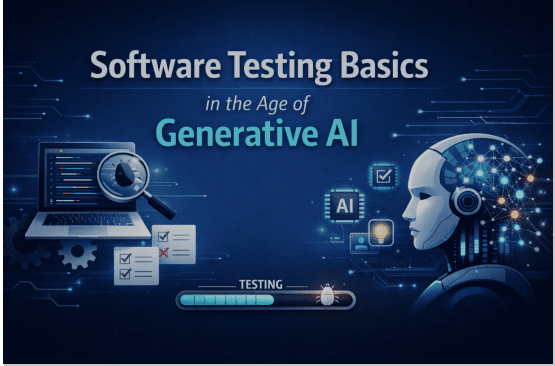
Generative AI is no longer a side experiment in engineering teams. It is actively reshaping how applications are designed, written, and deployed. Developers now generate API handlers, validation logic, database queries, and even infrastructure templates within seconds. The productivity gains are real. But acceleration introduces fragility. As code generation becomes easier, the volume of unverified logic entering production systems increases. In this new environment, software testing basics are not just foundational principles for junior engineers.
They are strategic safeguards that protect modern systems from hidden instability. Speed without validation creates technical debt at scale. AI has amplified that reality.
Why Software Testing Basics Matter More in AI-Augmented Development?
AI-generative models are trained on patterns found within enormous libraries of public source code. As such, while generative models generally create output that may be syntactically correct and typically structured correctly, generative models cannot comprehend the surrounding context of a business, regulatory constraints, or any structural constraints as human engineers can.
Software testing basics ensure that generated/produced outputs are compliant with:
- Functional requirements
- Business logic constraints
- Compliance and security standards
- Performance expectations
While AI-generated code may perform properly when tested independently, the ability for distributed systems to function correctly is based on the manner in which all variable elements of an environment interact with each other, manage shared state, and handle failures. Implementing structured validation will help close the performance gap between probable correct functionality and verified reliability.
In an AI-augmented development environment, testing has transitioned from a reactive function to an intentional stage in the process as an offset to the automated portion of the development process.
The Expanding Risk Surface of AI-Generated Code
The risk surface of generative artificial intelligence (GAI) has increased without notice over time. More code is currently being produced than ever before, and it is not being subject to the same level of manual review as previously experienced.
Some of the more common risks associated with the output of generative AI include:
- Overly permissive Input handling.
- Missing exception management for incomplete workflows.
- Database queries that are inefficient in terms of time and resource utilization.
- Race conditions that exist among concurrent execution of program logic.
- Code incorporating hard-coded information regarding external service behavior.
These types of defects tend not to be identified when performing simple functional tests, but instead are often only discovered at large scales, during system integration, or as infrequent occurrences when program logic enters an edge-case condition.
The principles of software testing need to be systematically employed as filters are used to detect weaknesses prior to releasing them to end-users. Without the systematic use of these filters, through microservice, API, and data pipeline infrastructures, the number of defects will compound and continue to grow throughout the application.
Integration Testing in Distributed Architectures
Distributed architectures are how most of today’s applications are deployed across cloud services (like Microsoft Azure), third-party APIs (like Google Maps), and distributed databases (like Cassandra), making it necessary for businesses to ensure their system works correctly on a larger scale.
Integration testing verifies the following:
- APIs conform to their contract with one another.
- There is Schema alignment between services.
- There is Consistent error handling between services.
- The fallback behavior is handled correctly in the event of a partial failure.
AI-generated code could generate business logic that is correct, but interpret the external API incorrectly. A mismatch in how the payload is structured may lead to complete failures for all services that rely on the API call.
The move to service-oriented architecture by many organizations will make integration validation a requirement for structural validation rather than a ‘nice to have’ layer.
Regression Testing in High-Velocity Release Cycles
Aggressive iteration speed is greatly accelerated through the use of generative AI. It not only enables rapid prototyping of features and rapid modifications of the features, it also increases the potential for unintended side effects associated with those features.
Regression testing acts to confirm whether or not new changes to a code base have broken previously validated code or functionality. Automated regression coverage is even more essential in AI-assisted workflows due to:
- A rapid increase in code volume
- Minor alterations to prompts resulting in significant changes in logic
- Subtle differences in code would likely be missed by human reviewers.
As a result, well-designed software testing strategies incorporate continuous regression checks into their deployment pipelines to allow teams to maintain confidence in the functionality of their code as it develops at a furious pace. Without discipline surrounding the process of regression testing, teams will experience short-term speed gains but long-term instability in their code base.
Security Testing and Compliance Validation
AI systems have been trained using publicly accessible (community-sourced) repositories, which may have insecure/legacy patterns. As a result, the code generated falls within the unintended replication of vulnerabilities such as:
- Nonexistent input validation
- Non-secure unpickling
- Weaknesses in implementing authentication
- Inadequate secrets management
Identifying vulnerabilities through security testing relative to software testing basics before deploying code will be completed with the use of static code analysis, dynamic scanning, and penetration testing as automated components of CI/CD pipelines.
Automation of security testing as mandated through compliance requirements, e.g., in Health Care, or SaaS providers with Personal Data, must be conducted prior to implementation of AI-accelerated systems, and does not alleviate regulatory liability issues.
Performance Testing Under Real-World Load
Generated code is sometimes unit-tested but can still fail to perform in the real world with production traffic, especially when there are long loops, repeated queries, or blocking calls that may introduce a performance hit to the overall system.
The following are things done during performance testing:
- Response time consistency
- Resource Utilization Patterns
- Performance when running under significant spikes in traffic
- Ability to Scale with sustained load
In cloud-native environments, dynamic scaling of infrastructure and inefficient code will affect the cost efficiency of the systems. Therefore, AI-generated inefficiencies can and will increase the amount of compute used, and so increase your cloud costs without ever being noticed.
The software testing basics extend far beyond correctness to include, but are not limited to, protecting the economic efficiency of systems.
Observability and Feedback Loops in AI-Driven Systems
The end of testing is not at deployment. Observability practices increase the value of your software testing basics in AI-enhanced development. As engineers and developers deploy their systems to production, ensuring the reliability of those systems through observability practices will provide an increase in the value of the basic software testing performed on AI-Enhanced Development.
Observability tools provide teams with features such as:
- The detection of anomalies in real-time
- Regression identification patterns and methods
- Performance bottlenecks and identification
- User behavior impacts intellectual and emotional.
Once AI speeds up the development cycle, feedback from production can be utilized as a method for continuous validation of the application and/or software. To achieve faster feedback loops, testing frameworks should be integrated with monitoring tools to create tighter validation loops. The tighter the validation loop, the shorter the development cycle.
Building a Culture of Responsible Automation
Generative AI transforms how developers function. Rather than writing code by hand line-for-line, engineers now control, check, and validate the results produced by AI.
To facilitate this transition, a disciplined approach to culture needs to be applied:
- Consider AI ‘output’ only as a baseline for your beginning development – not as your end product.
- Keep automated ‘validation gates’ in place.
- Determine your acceptance criteria before generating anything.
- Encourage peer reviews for all code generated by AI.
Software testing basics provide the backbone of any organization’s implementation model that will allow for legitimate and sustainable use of automated tools- teams that do not adhere to sound testing fundamentals will quickly experience exponentially higher levels of downtime and instability than ever before.
While AI will continue to provide assistance in the area of engineering judgment, it will also create an increased requirement for it.
Conclusion
Generative AI will keep changing how we create software. Code generation will happen faster, will understand its context, and will be integrated into development methods more than ever before. However, accelerating code generation without making sure that it works correctly creates risk to all software development.
Software testing basics form the foundation for software systems to be reliable. The purpose of software testing is to ensure that organisations can innovate quickly while at the same time providing an orderly and stable, secure, and performing software system. In a generative AI future, organisations that do a rigorous job validating generated software will build long-lasting digital products. Those organisations that focus solely on the speed of generating and implementing code will learn that getting it done quickly, without thinking about whether it is valid, will be a very expensive mistake! The future of software development will be dominated by teams that test as thoroughly as they innovate.