Proxy servers have long become one of the basic tools in modern network environments, but when faced with different protocols and application scenarios, many users still feel confused when making a choice.Especially between SOCKS5 proxies and HTTP proxies, although both belong to proxy technologies, there are obvious differences in their working methods, compatibility, and usage focus.
This article will start from the underlying principles and systematically sort out the core differences between SOCKS5 and HTTP proxies. At the same time, combined with real application scenarios, it will help you understand What is a Socks5 Proxy and further learn about trustworthy socks5 proxy providers currently on the market, so that you can more rationally buy socks5 proxies or choose an HTTP proxy solution when needed.
What is a SOCKS5 proxy server?
A SOCKS5 proxy is a general-purpose proxy protocol that operates at the transport layer (supporting TCP and UDP), essentially serving as a “data channel”. It does not inspect, parse, or modify the data content, but instead forwards data packets to the target server as they are, therefore offering very high protocol compatibility.
For this reason, SOCKS5 is not limited to web access. Whether it is HTTP/HTTPS browsing, email communication, FTP file transfer, or P2P networks, real-time communication, and online gaming traffic, it can handle them stably. This “protocol-agnostic” characteristic makes SOCKS5 particularly outstanding in terms of speed, flexibility, and scope of applicability, and it is especially suitable for scenarios where multiple types of network applications run in parallel.
Common use cases for SOCKS5 proxies
- P2P downloading and file sharing
SOCKS5 can stably support complex connections generated by P2P protocols such as BitTorrent, making it a common choice for downloading applications.
- Online gaming and latency optimization
Many games use custom TCP/UDP communication methods, and SOCKS5 can proxy such traffic, helping connect to better nodes and thereby reducing latency.
- Unified proxy for multifunctional software
Email clients, FTP tools, instant messaging software, and similar applications usually natively support SOCKS5, allowing all network requests to be proxied through a single configuration.
- Accessing region-restricted streaming content
Although HTTP proxies are more common, properly configured SOCKS5 can also forward all TCP traffic for unlocking region-specific content.
- Operations requiring higher anonymity
SOCKS5 does not add HTTP header information, and especially residential SOCKS5 proxies are usually better than standard HTTP proxies in terms of hiding identity, and are often integrated into professional SOCKS5 proxy software for use.
What is an HTTP proxy server?
An HTTP proxy is a type of proxy specifically serving HTTP/HTTPS requests, mainly used for browser access and web request handling. It can read and understand HTTP protocol content, thus having unique advantages in content filtering, cache management, and request control.
Because it focuses on the web layer, HTTP proxies provide stronger controllability in web browsing and API requests. For example, it can cache web content, analyze request paths, or filter access targets, making it especially common in tasks such as development testing, ad verification, and price monitoring.
Typical use cases for HTTP proxies
- Web scraping and data collection
HTTP proxies are good at handling large volumes of web requests, managing cookies and sessions, and reducing the risk of bans through IP rotation mechanisms.
- Content filtering and access control
Enterprise or home networks often use HTTP proxies to restrict access to harmful websites and monitor traffic behavior.
- Caching web pages to save bandwidth
Enterprise-level HTTP proxies can cache frequently accessed content, reducing external traffic consumption and improving access speed.
- Ad verification and geographic testing
Through HTTP proxies in different regions, marketers can check whether ads are displayed correctly or search results are accurate.
- Basic anonymous browsing
Hiding the real IP address, used for accessing websites or content with relatively light regional restrictions.
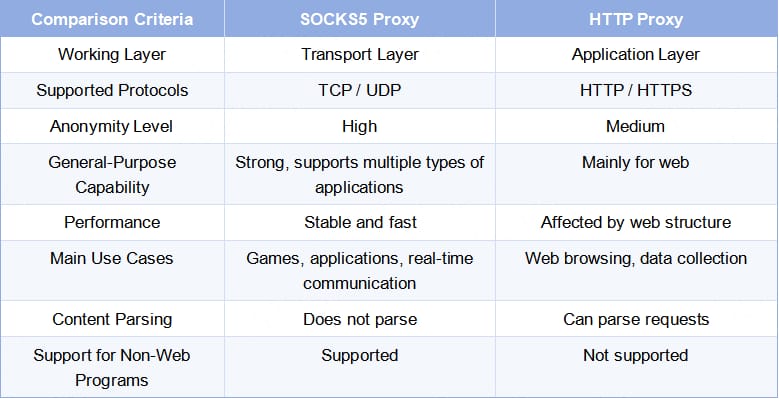
SOCKS5 Proxies vs HTTP Proxies
The differences between SOCKS5 and HTTP proxies are mainly reflected in their working layers, protocol support, and intended purposes. The former is more low-level and general-purpose, while the latter focuses on web request handling.
How to choose between SOCKS5 and HTTP proxies?
There is no absolute superiority between the two types of proxies; the key lies in your usage requirements. Only by clarifying the task type, anonymity requirements, and application environment can you select the truly suitable solution.
Situations suitable for SOCKS5 proxies
- Need to support both TCP and UDP
- Using games, instant messaging, or non-web programs
- Higher anonymity requirements
- Pursuing faster and more stable transmission performance
- Want to proxy multiple application traffic uniformly
Situations suitable for HTTP proxies
- Work mainly revolves around web browsing
- Involves SEO, ad verification, and price monitoring
- Have HTML / JSON / API scraping requirements
- Focus on managing and controlling web requests
- Need web-layer functions such as caching and filtering
3 Top SOCKS5 Proxy Providers
The following are socks5 proxy providers with outstanding reputation and stability in the current market, especially suitable for users who require high network quality and success rates.
1.Thordata
Thordata focuses on high-quality residential proxy networks, known for real user IPs and stable connections. Its network is strictly maintained, suitable for projects with high success rate requirements, and is one of the reliable private SOCKS5 proxy service options.
Key advantages:
- Over 60 million residential IPs, strong anonymity
- Coverage in 190+ countries and regions, supports city-level targeting
- Connection success rate up to 99.82%, suitable for long-duration tasks
Proxy types:
- Residential proxy: simulates real user access environment
- Static ISP proxy: can be used for projects requiring a fixed identity
- Data center proxy: suitable for high-frequency scraping and API calls
- Mobile proxy: based on real 4G/5G networks, suitable for mobile testing
Cons:
- Coverage scale is slightly smaller than top giants, but IP quality and stability are outstanding
2.Bright Data
Bright Data (formerly Luminati) is known for its network scale and technological maturity, widely used in enterprise-level data collection, global monitoring, and automated testing. Its residential IPs are highly stable, with low failure rates, and it comes with comprehensive developer documentation and APIs.
Key advantages:
- Residential IP network quality is reliable
- Rich developer tools and interfaces
- Flexible configuration, highly customizable
Proxy types:
- Residential Proxy
- ISP Proxy
- Datacenter Proxy
- Mobile Proxy
Cons:
- Complex pricing structure, requiring careful cost control
- Higher learning and configuration threshold
3.Oxylabs
Oxylabs has long focused on the enterprise-level proxy market, gaining a good reputation with a large residential IP pool and stable network. Suitable for professional teams that need to execute large-scale requests across multiple countries.
Key advantages:
- Coverage of a large number of countries and regions
- Can handle complex data collection requirements
- Supports automation and API integration
Proxy types:
- Residential Proxy
- ISP Proxy
- Datacenter Proxy
- Mobile Proxy
Cons:
- High entry cost for beginners
- Entry-level package prices are relatively unfriendly
Conclusion
Whether you choose a SOCKS5 proxy or an HTTP proxy, there is no “one-size-fits-all” answer. The key is to clearly understand your core requirements: are you dealing with web requests or multi-protocol traffic? Do you value speed, anonymity, or web control capabilities more?
After determining the proxy protocol type, compare price, network quality, and technical support among reliable SOCKS5 proxy providers, and choose the solution that best integrates into your workflow. A truly excellent proxy tool is always the one that allows your tasks to run more efficiently and more stably.