Snapchat is more than a place to send photos and messages. It also offers features that help users understand their friendships in a fun and visual way. One of the most interesting examples is the Friend Solar System, which uses planets to represent a person’s position in another user’s Best Friends list.
For many Snapchat+ users, this feature raises simple questions. What does each planet mean? Why is Mercury considered the closest planet? Can your planet change over time? And how does the system connect to the way Snapchat ranks friends?
Understanding Snapchat Planets makes these questions easier to answer. The planets represent different positions in a friend’s Best Friends list, giving users a visual way to understand their place in that person’s social circle.
What Are Snapchat Planets?
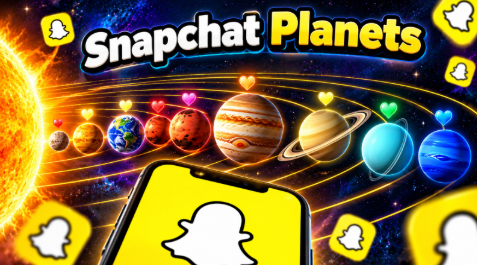
Snapchat Planets are part of Snapchat+’s Friend Solar System feature. The feature represents a user’s position in another person’s Best Friends list through a planet. Each planet has a specific rank, from Mercury at number one to Neptune at number eight.
Think of the Sun as the center of a small solar system. The planets represent the people who occupy different positions in a user’s Best Friends list. A planet closer to the Sun represents a higher position, while a planet farther away represents a lower position within the top eight.
The feature does not create a separate ranking system. Instead, it gives users a visual way to understand the Best Friends ranking that Snapchat already maintains.
Snapchat Planets in Order
Each planet represents one of eight positions. Learning the order makes it easier to understand what you see when you open a friend’s profile.
| Planet | Position | Meaning |
| Mercury | #1 | First position in the Best Friends list |
| Venus | #2 | Second position |
| Earth | #3 | Third position |
| Mars | #4 | Fourth position |
| Jupiter | #5 | Fifth position |
| Saturn | #6 | Sixth position |
| Uranus | #7 | Seventh position |
| Neptune | #8 | Eighth position |
Mercury represents the highest position, while Neptune represents the eighth position. These planets do not measure how good or important a friendship is in real life. They simply show a person’s position within the feature.
This is why two people may see different planets when viewing each other’s profiles. Each person’s planet reflects their position in the other person’s Best Friends list, and those positions do not have to be the same.
How Does the Friend Solar System Work?
Snapchat describes Best Friends as the people a user Snaps and Chats with the most. The Friend Solar System turns the positions in that list into a visual display.
For example, if you appear in a friend’s first position, the feature represents you with Mercury. If you appear in their eighth position, it represents you with Neptune.
However, Snapchat does not publicly explain the exact formula used to calculate every position. Users cannot reliably determine their planet by counting a fixed number of messages, Snaps, or streak days.
The ranking can change as interactions change. This helps explain why a person may see a different planet over time, even if they have not made any deliberate changes to their friendship.
How Snapchat Best Friends Ranking Affects Your Planet
The Best Friends list and the Friend Solar System are closely connected, but they serve different purposes. The Best Friends list represents a user’s closest Snapchat interactions, while the planets provide a visual way to show a person’s position in that list.
If you want to understand the ranking process in more detail, this guide to Snapchat Best Friends ranking explains what is known about the feature and why rankings can change.
It is important to separate confirmed information from guesses. Snapchat does not publish a complete scoring formula, so claims that a certain number of Snaps or messages guarantees the number-one position should be treated with caution.
Why Can Your Snapchat Planet Change?
Your planet may change when your position in a friend’s Best Friends list changes. Since the list reflects interactions on Snapchat, its positions can change over time.
For example, someone who previously appeared near the top of a list may move to another position as activity between users changes. Another friend may take a higher position, causing the planet displayed for the first person to change.
There is no official formula that lets users predict exactly when this will happen. A planet changing also does not automatically mean that a friendship has ended or that someone has deliberately changed their settings.
The simplest way to understand the feature is to treat the planet as a current position, not as a permanent label.
How to See Your Planet on Snapchat
If you have Snapchat+ and the Friend Solar System feature is available to you, you can check your planet through a friend’s profile.
Follow these general steps:
- Open Snapchat on your phone.
- Go to your friends or chat list.
- Open the profile of the friend you want to check.
- Look for the Best Friends or Friends badge.
- Tap the badge to view the Friend Solar System, if available.
The exact interface may vary by app version and account settings. You may need to enable the Friend Solar System feature in your Snapchat+ settings before the planets appear.
If you cannot see a planet, check your subscription and settings first. The feature does not necessarily appear for every friendship.
Why Can’t You See a Snapchat Planet?
There are several possible reasons a planet may not appear. You might not have Snapchat+, the Friend Solar System may be turned off, or the person may not be among the relevant top eight Best Friends.
An app update may also change where the feature appears. Checking the current settings and app interface is a sensible first step before assuming something is wrong.
Remember that the Friend Solar System represents a limited set of positions. It does not assign a planet to every person in a user’s contacts.
Can You Control Your Planet Position?
There is no confirmed shortcut that guarantees a specific planet. Regular interaction may influence a Best Friends list, but Snapchat does not reveal the exact ranking formula or allow users to choose their position manually.
Be careful with online claims that promise a guaranteed way to become someone’s number-one Best Friend. These claims often go beyond what Snapchat has officially explained.
Instead of trying to calculate an exact position, focus on understanding what the feature displays and remember that an app ranking cannot fully describe a real-life friendship.
Final Thoughts
The Friend Solar System makes Snapchat’s Best Friends feature more visual and easier to explore. Mercury represents the first position, while Neptune represents the eighth. Each planet shows a place in a friend’s Best Friends list, rather than a fixed measure of how close two people are.
Once you understand the planet order and how the feature works, it becomes easier to interpret changes without making assumptions. Snapchat Planets are simply one way the app presents social interactions, and their meaning becomes clearer when viewed alongside the Best Friends ranking system.