
Seedance 2.0 Collapses the Video Production Stack Into a Single Multimodal Pipeline — Joint Audio, Persistent Identity, and Non-Destructive Editing Ship in One Architecture

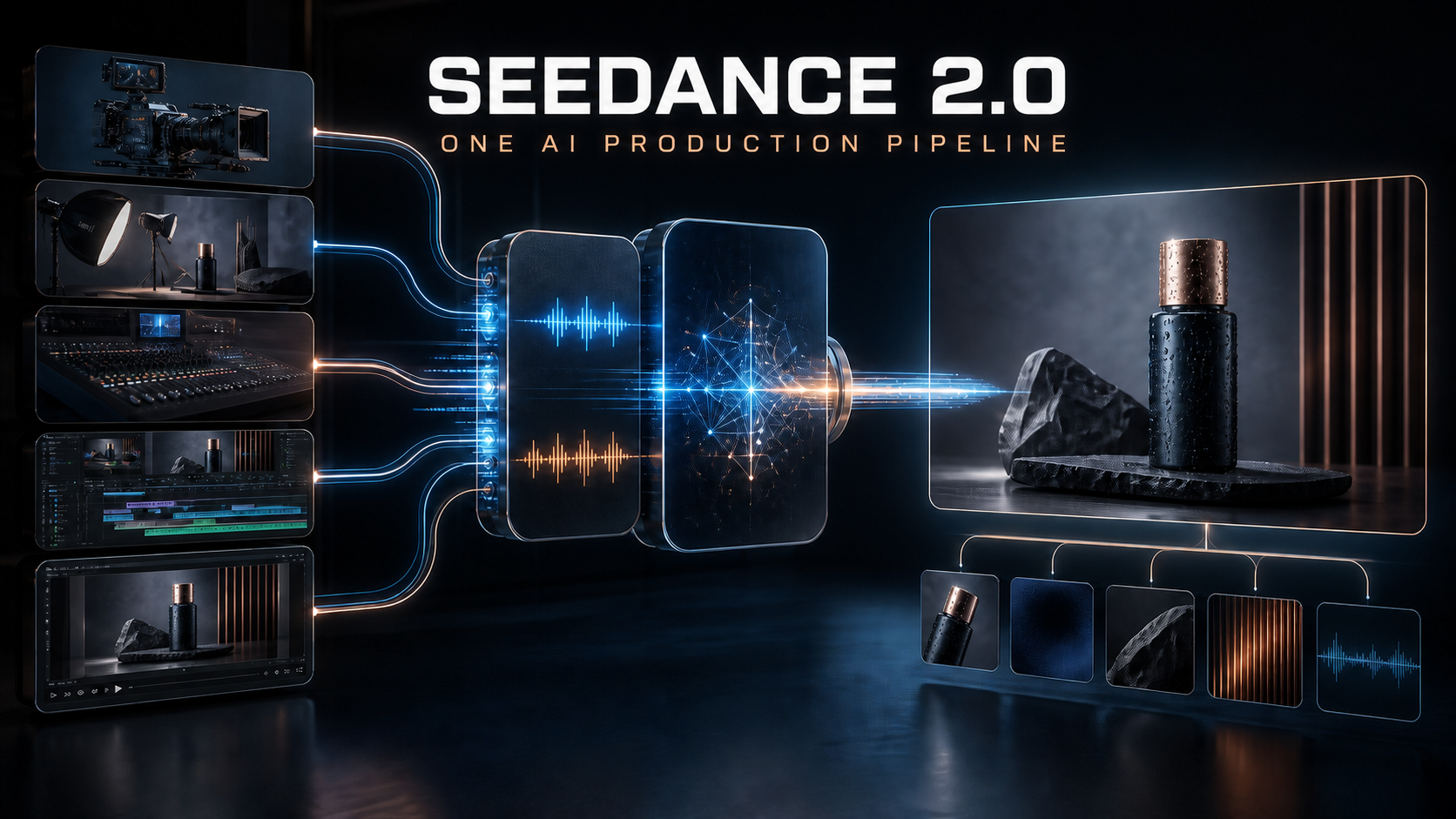
Producing a fifteen-second product video used to require a photographer, a videographer, a sound designer, an editor, and a week. ByteDance’s rebuilt AI model accepts the brand’s existing assets as direct input and returns a publish-ready clip — with sound, with character lock, with targeted editing — in minutes. The production stack that required five roles now requires one browser tab.
What Was Released and What Problem It Solves
ByteDance released Seedance 2.0 in mid-2026, replacing its Seedance 1.5 Pro model with a full architectural rebuild based on a Dual Branch Diffusion Transformer. The redesign is not cosmetic. The new architecture processes visual and audio generation as a unified signal, which means the model outputs finished video — not silent footage that requires a separate sound pass. A single generation accepts up to nine images, three video clips, and three audio files alongside a text prompt, and produces a four-to-fifteen-second clip with lip-synced dialogue, frame-accurate sound effects, contextual ambient audio, and beat-matched music. The output is an MP4 ready for distribution, not a rough cut waiting for post-production.
The model serves any organization or individual that produces video at scale under time and budget constraints. That includes direct-to-consumer brands generating ad variants across markets, agencies delivering campaign assets on compressed timelines, SaaS companies producing product demo content, content creators publishing daily across social platforms, and media companies prototyping visual concepts before committing production budgets. The timing reflects a structural shift in the content economy: the volume of short-form video demanded by advertising channels, social platforms, and digital storefronts has outpaced the production capacity of traditional workflows. The bottleneck is no longer creative — it is operational. Seedance 2.0 is built to break that bottleneck by compressing the multi-role, multi-tool production pipeline into a single model that accepts existing brand assets and returns finished video.
How the Architecture Differs From Competing Models
The AI video generation market in mid-2026 includes well-funded competitors with distinct technical strengths. OpenAI’s Sora 2 delivers industry-leading physics simulation and cinematic output quality. Google’s Veo 3 produces photorealistic human motion that withstands frame-level scrutiny. Runway has established itself as the preferred tool for motion design and VFX workflows. Kling 3.0 competes aggressively on generation speed and per-unit cost. Each model has carved a defensible position.
Seedance 2.0 does not compete on any of these individual dimensions. Its competitive thesis rests on a different architectural decision: the model is designed around the assumption that professional video production starts with assets, not with blank prompts. The differentiation is not in what the model outputs but in what it accepts as input and how it preserves the creator’s intent from input to output.
Asset-Native Input Replaces Prompt-Dependent Generation
The prevailing paradigm in AI video generation is text-to-video: a creator describes the desired output in natural language, and the model interprets that description into a visual sequence. This approach works adequately for exploratory creative work but introduces unacceptable variance for commercial applications where the output must conform to existing brand guidelines, character specifications, or visual standards.
Seedance 2.0 inverts this paradigm. Instead of asking the creator to describe assets in words, the model accepts assets directly. The @ reference system allows creators to upload and tag each asset with a functional role: “@Image1 defines the character — lock facial geometry, hair, wardrobe, and proportions. @Image2 is the product — maintain label text, brand colors, and physical dimensions. @Video1 supplies the camera choreography — replicate the dolly speed, focal length, and tracking direction. @Audio1 is the score — align visual transitions to downbeats.”
The operational impact is immediate. Creative teams that maintain asset libraries — product photography, brand imagery, talent headshots, mood boards, reference reels — can feed those assets directly into the generation pipeline. The translation layer between brand asset and video output disappears. No prompt engineering expertise is required. No ambiguity is introduced by the lossy conversion of visual intent into natural language. The model executes against visual specifications rather than interpreting textual descriptions.
For enterprise marketing departments managing multi-market campaigns, this architecture enables a workflow where the same base assets produce localized video variants for different regions, languages, and platforms without reshooting or re-editing — a fundamental change in the cost structure of global video advertising.
Unified Audio-Video Generation Eliminates Post-Production Sound
In the current competitive landscape, every major AI video model generates silent footage. Audio — dialogue, music, sound effects, ambient atmosphere — is treated as a downstream deliverable that must be sourced, edited, and synchronized in a separate tool by a separate practitioner. This bifurcation doubles the production timeline and introduces a synchronization risk at the handoff point between video and audio workflows.
Seedance 2.0’s Dual Branch architecture eliminates this bifurcation by generating audio and video from the same latent representation. The technical results are measurable. Dialogue lip-sync operates at phoneme-level precision, not syllable-level approximation. Contact sound effects — a product placed on a surface, a hand on a doorframe, fabric rustling against fabric — arrive at the exact frame of visual contact. Ambient soundscapes — room tone, exterior atmosphere, crowd presence — are generated to match the specific visual environment rather than looped from a generic asset library. Music-synced content aligns visual cuts and transitions to the rhythmic structure of the audio track without manual timeline adjustment.
The business impact scales with content volume. For a brand producing fifty ad variants per quarter, eliminating the per-variant sound editing pass reduces total production hours proportionally. For a content operation publishing daily video across multiple platforms, the removal of the audio synchronization step converts a multi-hour workflow into a minutes-long generation task. For multilingual campaigns requiring lip-synced dialogue in three or more languages, the joint generation model eliminates per-language dubbing and sync correction entirely — the model generates accurate mouth movements for each target language from the same visual base.
Persistent Identity Across Frames and Generations
Character and product consistency is the capability that determines whether AI-generated video can be deployed in commercial contexts or remains confined to experimental applications. Identity drift — the subtle frame-to-frame mutation of facial features, clothing attributes, product details, or brand elements — is imperceptible in a three-second demo clip but immediately visible when AI-generated footage is placed alongside traditionally produced brand content or when multiple AI-generated clips are cut into a sequence.
Seedance 2.0 enforces identity persistence through reference-anchored constraint locking. When a creator assigns an image as a character or product reference, the model treats every measurable visual attribute of that reference — facial geometry, iris color, skin texture, hairstyle, clothing pattern, accessory design, product labeling, brand color values, physical proportions — as an invariant across all generated frames. The lock holds through changes in camera angle, lighting condition, physical interaction (wind, water, contact forces), occlusion (partial framing, foreground objects), and motion blur.
The persistence also spans separate generation sessions. Two clips produced hours or days apart from the same character reference will feature a visually identical character. This cross-session consistency is what makes serialized content production — a recurring brand spokesperson across a quarterly campaign, a product featured in monthly variant ads, a character appearing across episodic content — technically viable with AI-generated footage.
For brands where visual consistency is not a preference but a compliance requirement — pharmaceutical marketing with regulated on-screen talent, financial services advertising with recurring spokesperson figures, franchise operations with centralized brand standards — this architectural guarantee addresses a category-level objection to AI video adoption.
Non-Destructive Editing Converts Stochastic Output Into Deterministic Workflow
The fundamental workflow limitation of prior AI video models was their treatment of each generated output as an immutable artifact. If any portion of a generated clip failed to meet quality or brand standards, the entire clip was discarded and regenerated. The probability of a perfect generation on any single attempt is low for complex commercial briefs, which means the expected cost of producing a single usable clip includes the cost of multiple failed generations. This stochastic workflow is incompatible with production schedules and budget controls.
Seedance 2.0 introduces targeted editing operations that convert the workflow from stochastic to deterministic. Specific capabilities include character replacement within a scene without modifying camera work or background elements, temporal segment modification without regenerating surrounding footage, clip extension with full continuity in motion and audio, background element substitution, regional lighting adjustment, and object removal.
The economic implication is significant. Production cost becomes a function of generation plus refinement rather than generation times probability of acceptable output. For organizations producing video at volume — dozens or hundreds of variants per campaign — the reduction in wasted generations translates directly to lower cost-per-deliverable and more predictable production timelines.
Seedance 2.5 Extends the Architecture for Production-Length Deliverables
ByteDance followed the 2.0 release with Free trial Seedance 2.5 , announced in June 2026, extending the model’s capabilities across three dimensions that gate production adoption.
Generation length reaches thirty seconds per output. For platforms where the standard ad unit or content format is fifteen to thirty seconds — TikTok, Instagram Reels, YouTube Shorts, programmatic video advertising — a single generation now produces a complete deliverable without stitching. This eliminates the continuity risks introduced by concatenating multiple shorter clips and reduces per-unit production complexity.
Reference capacity scales from twelve to fifty assets per generation. This capacity supports complex commercial briefs: multiple on-screen characters with distinct visual identities, detailed environmental specifications, layered audio atmospheres, and precise camera choreography — all defined in a single generation pass. Fifty references provide enough specification slots to match the detail level of a traditional production shot list.
Region-specific editing enables frame-level precision for post-generation refinement. Background substitution, localized lighting adjustment, in-scene text modification, and element-level attribute changes can be applied to specific regions of a thirty-second clip without disrupting the broader composition. Combined with the extended generation length, this makes end-to-end short-form video production — from asset input to finished deliverable — achievable within the Seedance environment.
Pricing, Access, and Integration
Seedance 2.0 is available through multiple distribution channels. ByteDance’s Dreamina platform (via CapCut) offers native access. Third-party platforms including Higgsfield, JXP, and independent hosts provide the model with varying tier structures and interface configurations. Free-tier access is available on most platforms, providing sufficient generation credits to validate multimodal workflows against real production requirements before committing to a paid plan.
Paid tiers unlock native 1080p output (4K with upscaling), extended generation durations, priority processing, and unrestricted commercial usage rights with no attribution requirement. A full tier-by-tier breakdown — including generation volume, resolution, speed, and commercial terms for each plan level — is available on the Seedance 2.0 pricing page.
Outputs export as standard MP4, compatible with all major non-linear editing systems and distribution platforms. The workflow runs in-browser with no local compute, no software installation, and no proprietary dependencies. Supported aspect ratios — 16:9, 9:16, and 1:1 — cover the full range of broadcast, social, web, and programmatic video formats.
For the Korean market, seedance2kr.com provides a fully localized platform with Korean-language documentation, a community gallery of generated outputs with source prompts organized by production category, and direct generation access for both models. The gallery functions as both a capability demonstration and a prompt template library, enabling rapid onboarding for new users.
Market Implications
The AI video generation market is transitioning from a technology demonstration phase to a production adoption phase. The question that determined market share in 2024 and 2025 — which model produces the best-looking output — is giving way to the question that will determine market share in 2026 and beyond: which model fits into a real production workflow without introducing new failure modes.
Seedance 2.0’s architectural decisions — asset-native input, joint audio-video generation, reference-anchored identity persistence, and non-destructive editing — are oriented toward that second question. They sacrifice headline-grabbing visual benchmarks in favor of workflow integration, output predictability, and production efficiency. Whether that trade-off proves correct is a market bet, but it is a bet aligned with where enterprise and professional adoption dollars are moving.
For organizations evaluating AI video tools for production deployment rather than experimentation, Seedance 2.0 represents the first model designed from architecture upward around the constraints that production environments actually impose.
For platform access, pricing, and technical documentation, visit seedance2kr.com. Press and partnership inquiries: [email protected].







Comment