Growing an agency involves more than attracting new clients. Business owners must manage projects, coordinate employees, maintain service quality, and ensure that daily operations remain profitable. As the client base expands, traditional working methods can become difficult to maintain. Manual processes consume valuable time, while inconsistent workflows can slow down delivery and limit growth.
This is why AI Systems for Agency Owners are becoming an important part of modern business operations. Artificial intelligence can help agencies organize information, automate repetitive activities, and improve the way teams handle everyday responsibilities. When implemented strategically, these systems allow agency owners to focus on client relationships, business development, and long-term planning rather than getting caught up in routine administrative tasks.
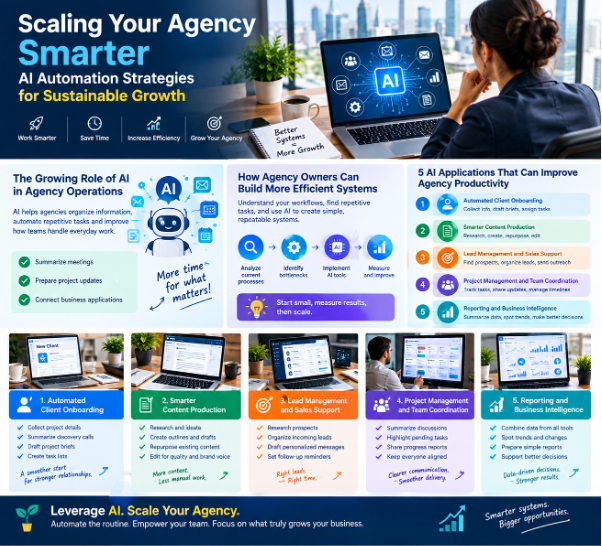
The Growing Role of AI in Agency Operations
Agency work involves many activities that follow predictable patterns. These may include scheduling meetings, preparing proposals, updating project records, creating reports, and organizing client feedback. Although each task may appear small, completing them manually across multiple projects can consume several hours every week.
AI-powered workflows can reduce this burden by assisting with information processing and connecting different business applications. For example, an agency could use an AI assistant to summarize a client meeting, identify important action items, and prepare a draft project update for review.
The goal is not to remove human involvement from every process. Instead, agencies should use technology where it provides a clear advantage while preserving human judgment for creative decisions, complex problems, and client communication.
How Agency Owners Can Build More Efficient Systems
A successful automation strategy begins with understanding how the business currently operates. Before purchasing new software, owners should map their existing workflows and identify the activities that repeatedly create delays.
For instance, a digital marketing agency may discover that employees spend excessive time compiling campaign data from different platforms. A content agency might struggle with repetitive briefing and editing processes. A web development company may need a more efficient way to organize support requests.
Once these problems are identified, owners can build targeted solutions. Those who want to build leverage with AI should focus on creating repeatable workflows that allow a team to handle more work without proportionally increasing its administrative workload.
A practical starting point is to choose one process, document its current performance, introduce an appropriate AI tool, and measure the improvement. This makes it easier to determine whether the investment is genuinely beneficial.
Five AI Applications That Can Improve Agency Productivity
1. Automated Client Onboarding
Client onboarding establishes the foundation for a successful working relationship. Agencies need to collect project details, understand expectations, confirm deadlines, and assign responsibilities. When this information is scattered across emails and documents, important details can easily be overlooked.
AI-assisted onboarding can help organize client responses, summarize discovery calls, draft project briefs, and generate initial task lists. Team members can review the information before approving project requirements and communicating next steps.
A structured onboarding workflow creates a more consistent experience for clients while reducing the administrative work required to begin each project.
2. Smarter Content Production
Content-focused agencies often manage several clients with different audiences, brand voices, and publishing schedules. AI can support research, topic development, outlines, editing, and the repurposing of existing material.
For example, a long-form report could become a collection of social media posts, a newsletter outline, and a short summary for a client presentation. Editors can then add original insights, verify claims, and ensure that each piece meets the client’s requirements.
This approach can improve production efficiency without treating automated output as finished work. Human review remains essential for accuracy, originality, and brand consistency.
3. Lead Management and Sales Support
Sales teams need to identify suitable prospects, understand their requirements, and follow up at the right time. AI tools can assist by summarizing publicly available prospect information, organizing incoming inquiries, and drafting personalized outreach messages.
A well-designed workflow can also help categorize leads based on predefined criteria and remind sales representatives when follow-up is required. These capabilities make the process more organized and reduce the risk of overlooking potential opportunities.
However, outreach should remain relevant and respectful. Agencies should verify information, follow applicable marketing regulations, and ensure that automated messages receive appropriate review.
4. Project Management and Team Coordination
As an agency expands, project management becomes more complicated. Different employees may be responsible for content, design, technical work, and client communication. Without clear procedures, teams can lose time searching for updates or clarifying responsibilities.
AI can help summarize project discussions, highlight outstanding tasks, and prepare progress reports. When integrated with project management software, these features can make important information easier to access.
The agency should still establish clear ownership, deadlines, and approval procedures. Automation works best when it supports a well-organized process rather than attempting to compensate for unclear responsibilities.
5. Performance Reporting and Analysis
Client reporting is another area where AI can provide practical assistance. Agencies often collect information about traffic, conversions, advertising performance, engagement, and campaign progress from multiple sources.
AI-assisted systems can help summarize this information, identify changes, and prepare understandable explanations of performance trends. Agency employees should validate the underlying data before sharing conclusions with clients.
Reliable reporting helps agencies communicate value more clearly and identify opportunities for improvement. It can also reduce the time spent preparing recurring reports manually.
Selecting the Right AI Tools for Your Business
The most suitable technology depends on the agency’s services, team size, budget, and existing software. An SEO agency may prioritize research and reporting tools, while a creative studio might benefit more from content production and project coordination.
When evaluating AI Systems for Agency Owners, consider whether each solution addresses a genuine business need. Check its integration capabilities, pricing structure, data protection policies, and ease of use. A tool that saves time but introduces complicated processes may not provide the expected benefit.
Agency owners should also consider the reliability of automated outputs. Establishing review procedures and defining which tasks require human approval can help maintain consistent service standards.
Rather than implementing several applications simultaneously, introduce changes gradually. A focused pilot project makes it easier to evaluate performance and identify problems before expanding the workflow across the organization.
Ways to Build Leverage With AI Without Increasing Complexity
The ability to build leverage with AI comes from designing systems that make existing resources more productive. It does not necessarily require a large technology budget or a complicated automation setup.
Start by identifying repetitive tasks that occur frequently and have clear rules. Then select tools that fit naturally into the existing workflow. For example, an agency might automate meeting summaries before introducing more advanced project management integrations.
Businesses looking for ways to leverage with AI should also document their procedures. Written instructions help employees understand when to use a tool, what information to provide, and how to review the results. This reduces dependency on individual team members and makes processes easier to repeat.
Owners can explore different AI systems to leverage as their requirements evolve, including workflow automation platforms, AI writing assistants, customer relationship management software, and reporting applications. The important factor is whether each system produces measurable value.
Common Challenges and How to Address Them
AI implementation can create problems when expectations are unrealistic. Some owners expect immediate results without reviewing their existing processes, while others invest in tools that duplicate features already available in their software.
Another challenge is data security. Agencies often manage confidential client documents, campaign information, and business records. Before introducing AI tools, owners should understand how information is stored, processed, and protected.
Employee training is equally important. Team members need clear guidance on appropriate use, quality checks, and situations where human judgment must take priority. Regularly reviewing results allows the agency to improve its workflows and adapt to changing business requirements.
Conclusion
Building a scalable agency requires efficient operations, reliable processes, and the ability to deliver consistent results as demand increases. AI Systems for Agency Owners can support these objectives by simplifying client onboarding, improving content workflows, organizing projects, and assisting with reporting.
The most effective strategy is to start with specific operational challenges and introduce technology gradually. By choosing suitable tools, measuring results, protecting client information, and maintaining human oversight, agency owners can create practical systems that support sustainable growth.
AI should complement a strong business strategy rather than replace it. When technology and human expertise work together, agencies can improve productivity, serve clients more effectively, and build a stronger foundation for future expansion.