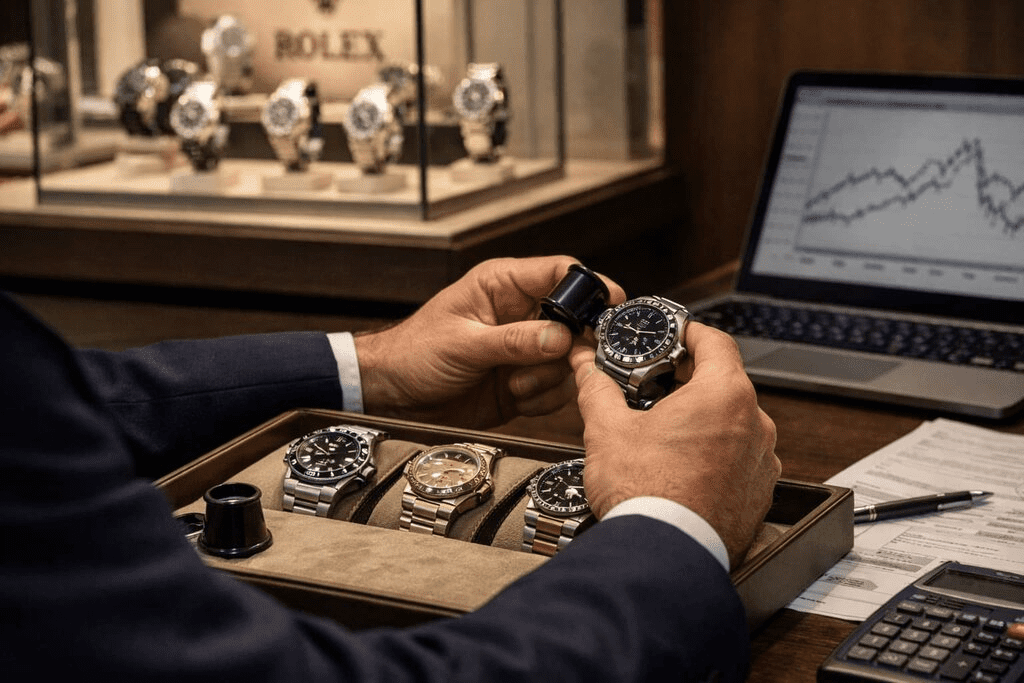
Why the Rolex GMT-Master II stays useful after the hype
Used watch prices ended 2025 with a rare broad lift. That alone is not a buying signal. It is, however, a clean test of market mood.
Industry tracking tied to WatchCharts showed the overall secondary index rising 1.9% in Q4 2025 versus Q3, with 21 of 35 tracked brands posting gains. Those two numbers matter because they describe breadth, not just a spike in one corner. When the whole map moves, pricing rules shift for everyone, including the Rolex GMT-Master II.
Read that move as normalization, not mania. Prices ticked up, but the pattern looked more like a functioning market returning than a fresh speculative loop. Treat it as a reminder to watch liquidity and spreads, not just headline charts. Action: check sold results and time-to-sale, not only listing asks.
A broad rebound, not a single-brand story
The simplest point is the strongest one: many brands rose at once. That makes the Q4 2025 change harder to dismiss as “one model got hot.”
Breadth changes how buyers negotiate. When more brands gain together, buyers often return in volume, sellers become less desperate, and the gap between a hopeful ask and a realistic sale price becomes measurable. A Rolex GMT-Master II buyer should care because “market-wide” conditions often tighten spreads on liquid references and expose weak demand on everything else.
Use the breadth figure as a filter, not a forecast. If your target reference stays stable while the broader market rises, stability can signal real two-sided demand rather than hype-driven repricing. Action: compare the GMT-Master II’s discount or premium to retail before you compare year-over-year price charts.
What actually drove the bounce
Retail pricing pressure can pull secondary prices upward without improving true value retention. That dynamic sounds abstract until you run the numbers. Two prices can rise at the same time and still tell opposite stories.
Ask two questions in this order:
- Are secondary prices rising in absolute terms?
- Are secondary prices rising relative to retail?
The second question does the real work. A watch can climb quarter-to-quarter and still lose ground versus retail if the brand keeps raising MSRP. That is why many buyers feel “the market is up” while their exit math does not improve.
Think of it like currency conversion. If your “benchmark” (retail) moves faster than your “asset” (pre-owned), your real position weakens even when the sticker looks higher. Action: write down retail and secondary prices on the same date, then compare ratios, not feelings.
Value retention is still uneven, and that’s the point
The market remains split between brands that behave like value anchors and brands that behave like consumer goods. You do not need a crystal ball to see it. You just need to compare how often watches trade above retail across a full brand lineup.
In that same WatchCharts-based view, only the traditional top tier consistently trades above retail, while many brands and models sit at large discounts versus retail, often around 30% or more. That gap explains why “broad gains” can coexist with a cautious buyer mood.
For Rolex GMT-Master II owners, the practical question is not whether the watch spikes. It is whether the watch stays liquid when buyers start choosing with spreadsheets. Liquidity is the premium that survives bad weather. Action: prioritize references with consistent transaction volume over references with louder narratives.
Why analysts track the secondary market at all
Secondary pricing reacts faster than retail signals. Retail waitlists and dealer allocations can lag for months. Secondary data can show the shift first.
Analysts use resale pricing to test brand power in real time: how strongly demand translates into pricing confidence, and whether that confidence holds when conditions change. Steel sports watches make that test obvious. They trade frequently, and buyers compare them aggressively.
Liquidity also matters because forced selling is real. If you ever need to exit quickly, the key metric is not “highest ask,” it is “fastest clean sale without a large haircut.” That is exactly where the Rolex GMT-Master II earns its reputation as a practical travel watch with resale depth. Action: track time-to-sale and typical negotiation ranges for your exact configuration.
Sizing the market: big, but still not the main event
The secondary market is large enough to influence behavior across the industry. It is still not the whole industry. Many estimates place it in the tens of billions of dollars globally, while new-watch retail remains the larger pool.
Even so, the direction is clear in practice: better data, more professional sellers, and more brand involvement. Europe adds its own friction. Currency swings and input costs can push retail prices up quickly, and those increases can reset buyers’ “fair value” baseline overnight.
This matters for Rolex GMT-Master II buyers because retail inflation can mask weak real performance. You might see higher nominal prices and still face worse value retention versus retail. Action: treat “higher price” as neutral until you validate it against retail movement and sell-through speed.
Brand-by-brand performance: who led, who followed, who held steady

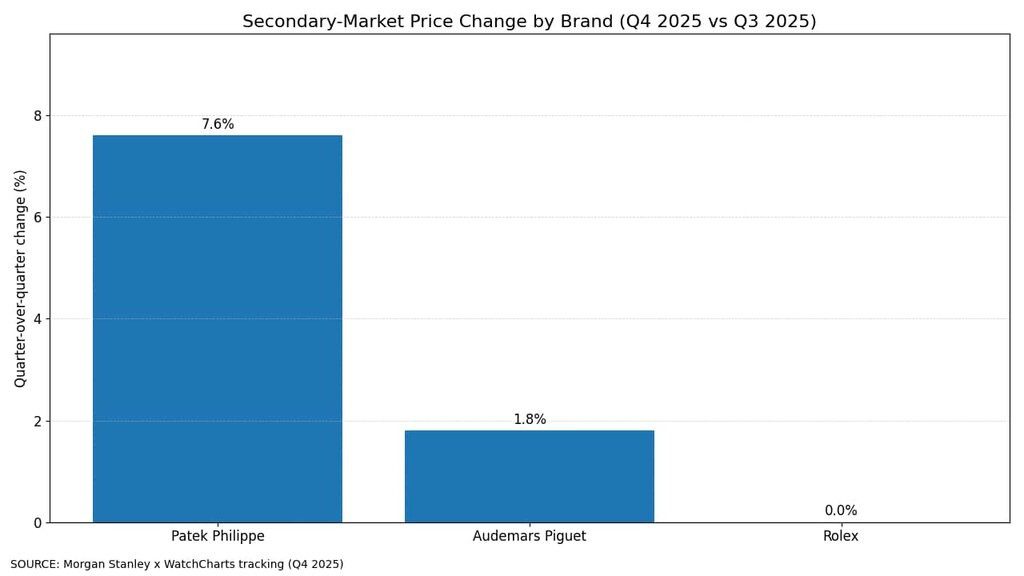
Not all gains carried the same meaning. Patek Philippe posted a 7.6% quarterly rise in Q4 2025, while Audemars Piguet rebounded more modestly, and Rolex stayed broadly flat over the same quarter in the WatchCharts-based view.
“Flat Rolex” can sound underwhelming. It can also indicate price discipline. In a quarter where many brands work to regain credibility, stability often signals that real transactions support pricing rather than speculative repricing.
For a Rolex GMT-Master II buyer, stability can be a feature. It suggests you are shopping in a segment where buyers and sellers still meet regularly, even when the broader market mood changes. Action: use stability to negotiate calmly, not to chase momentum.
Mid-tier strength: where value and pragmatism intersect
The same period showed meaningful gains among brands that sit below the top tier yet maintain strong community demand. Cartier rose 2.3% in Q4 2025, TAG Heuer rose 1.1%, Longines jumped 4.9%, and Tudor rose 3.9%, with steady pull from Black Bay demand in that tracking.
Those moves matter because they often reflect practical buyers returning. These buyers compare design, wearability, and serviceability. They also cap budgets more tightly. When that cohort participates, the market tends to look healthier and less speculative.
This “pragmatism layer” supports the Rolex GMT-Master II narrative as well. A functional travel complication stays attractive when buyers stop chasing lottery-like premiums and start buying what they will wear. Action: benchmark your GMT-Master II against the best alternatives at the same spend, then decide what you truly pay for: complication, brand, or liquidity.
A simple market read: speculation out, “use value” in
The market’s post-2022 period rewarded patience. It also punished sloppy assumptions. Buyers increasingly treat watches as durable goods with resale optionality, not as guaranteed appreciation.
A Rolex GMT-Master II fits that mindset because it solves a real problem. You can track a second time zone. You can wear it daily. The market does not need a hype cycle to understand why it exists.
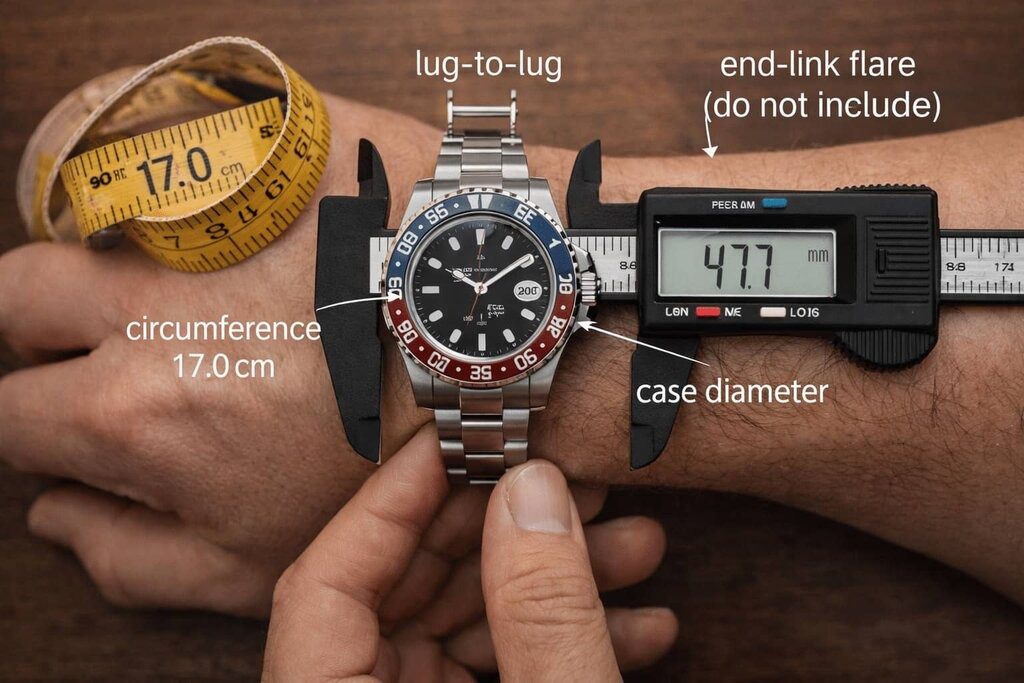
Here is the micro-scenario that keeps you honest: set the watch down, grab a caliper, and measure lug-to-lug in mm. Then compare it to your wrist circumference in cm, and sanity-check comfort before you chase a dial nickname. People often mis-measure by including the end-link flare; that small error can turn a “sure thing” into a watch that never leaves the box. Action: measure lug-to-lug and case diameter before you negotiate any price.
A German guide that zooms in on premiums and liquidity
If you want a model-specific lens on premiums, turnover, and liquidity in the Rolex GMT-Master II segment, a German-language analysis captures the collector logic in a grounded way. The perspective and framing in the next section draw on that German article; if you want to review the original source, you can read it here: Detailed German analysis of Rolex GMT-Master II pricing and liquidity (Rolex GMT-Master II 2025: Preise, Aufschläge, Liquidität — was zählt|2025);
Use that cross-language reference as a practical checklist. It will not replace transaction data. It can sharpen the questions you ask when you evaluate a listing or a dealer quote. Action: translate the key terms you care about, then map them to your own buying criteria.
The Certified Pre-Owned layer: trust has a price
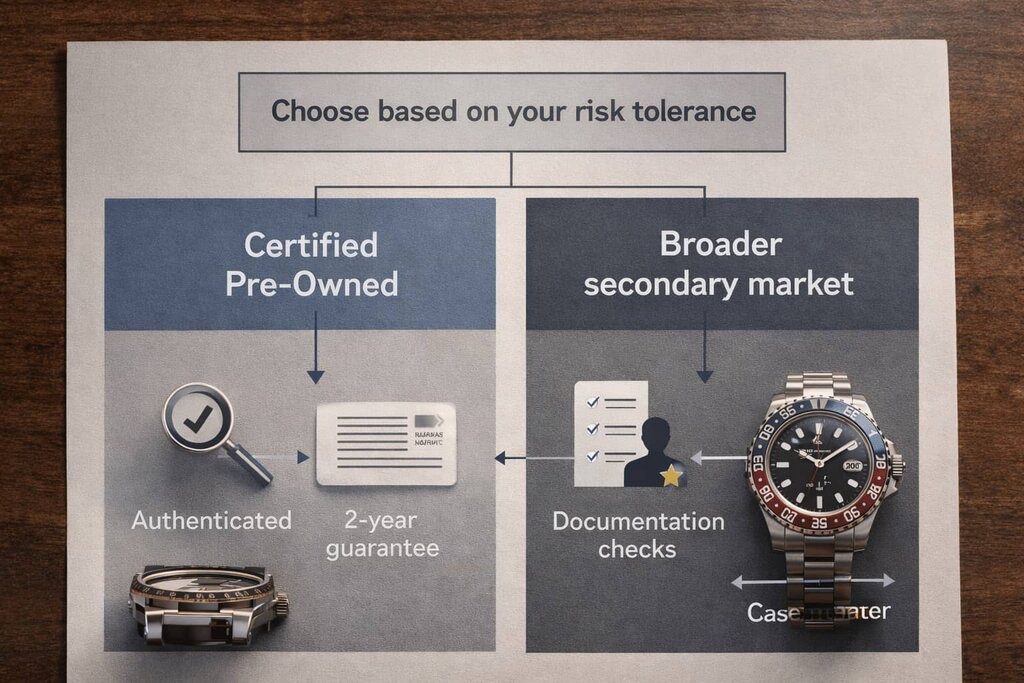
Rolex’s Certified Pre-Owned programme adds a parallel lane to the secondary market. Rolex states that Certified Pre-Owned watches must be at least two years old, are offered through official retailers in the programme, and get authenticated through Rolex’s network with verification of original configuration; Rolex also says these watches come with a new two-year international guarantee from the date of sale. =(Rolex Certified Pre-Owned Programme|2025);
Certification can reduce risk. It can also increase the premium you pay. The trade-off becomes simple: pay more for controlled provenance, or pay less and do more of the verification work yourself.
Treat certification as a risk-management tool, not a guarantee of outperformance. It can make sense when documentation uncertainty would keep you from buying at all. Action: decide your acceptable risk level first, then choose the channel that matches it.
Where Chrono24’s H1 2025 data adds context to Rolex’s position
Chrono24’s H1 2025 reporting helps explain why Rolex can stabilize and still dominate. Chrono24 reported Rolex stabilizing at a 33.7% share of total spend on the platform in H1 2025. =(Secondary Watch Market Report H1 2025 — Chrono24|2025);
That share signals “anchor behavior.” Buyers keep returning to the same brand even when sentiment cools. The report also aligns with the idea that hard-to-get references remain magnets even as premium expectations normalize, which keeps the Rolex GMT-Master II in the center of travel-watch conversations.
Do not turn platform share into a personal buying rule. Use it to validate that the pool of potential buyers remains deep when you think about resale. Action: when you compare listings, prioritize condition and completeness over chasing the last 2% of a perceived “deal.”
Market snapshots you can actually use
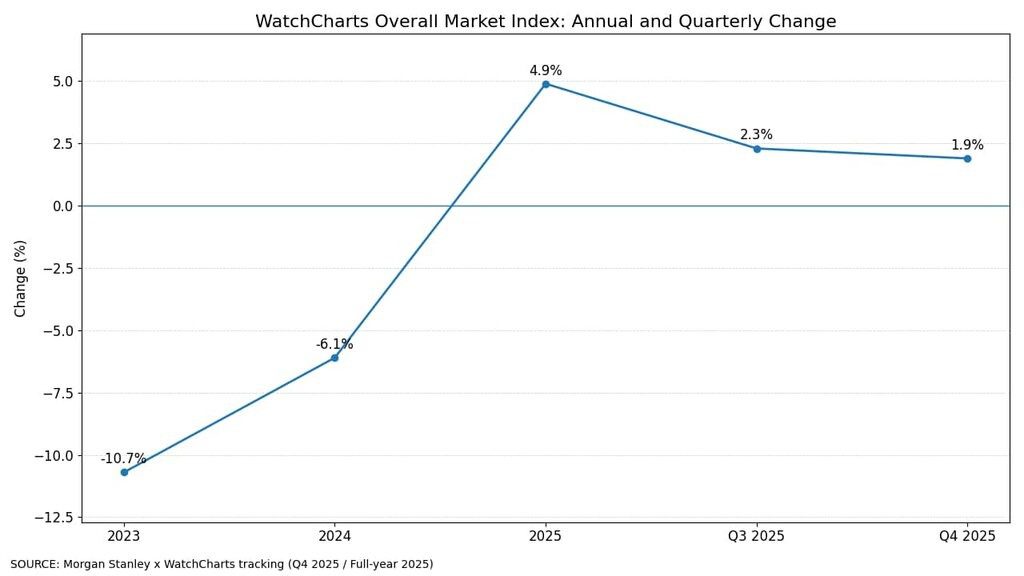
| Metric | Period | What it suggests for Rolex GMT-Master II buyers |
| WatchCharts Overall Market Index change | 2023: -10.7% | Post-peak correction dominated pricing |
| WatchCharts Overall Market Index change | 2024: -6.1% | Declines slowed, bargaining power improved |
| WatchCharts Overall Market Index change | 2025: +4.9% | Stabilization returned, liquidity improved |
| Quarterly index move | Q3 2025: +2.3% | Recovery broadened beyond a few references |
| Quarterly index move | Q4 2025: +1.9% | Broad participation, less “single-brand” risk |
SOURCE: Morgan Stanley x WatchCharts secondary market tracking (2025)
Read this table like a buyer, not like a trader.
- A positive year does not mean every reference wins.
- Liquidity often improves before prices look exciting.
- Negotiation ranges often shrink when breadth improves.
Use the table to time your research. It tells you when the market stopped falling fast, not what your exact watch will do next. Action: log your target reference’s sold prices monthly so you can spot spread changes early.
A grounded way to think about “watch investing” in 2026
If you approach the Rolex GMT-Master II with watch investing in mind, ask a tougher question than “Will it go up?” Ask, “How likely is a clean exit at a fair price?”
You can build a disciplined framework from the last few years:
- Separate retail inflation from true secondary strength.
- Stress-test value retention versus retail, not just absolute prices.
- Prefer references with persistent two-sided demand over references that rely on a single story.
On balance, the post-hype phase can be kinder to careful buyers. It rewards measurement, documentation, and patience. It also brings the GMT-Master II back to its core role: a travel watch with unusually strong liquidity in a market that still punishes weak demand. Action: set a buy range, set a walk-away point, and stick to both.
FAQ
Q: Did the secondary watch market rise at the end of 2025?
A: Yes. WatchCharts-based tracking cited in industry reporting showed a 1.9% quarter-over-quarter rise in Q4 2025, with 21 of 35 tracked brands showing gains.
Q: Does a rising market mean Rolex GMT-Master II prices will surge?
A: No. Broad gains can reflect retail price pressure and improved liquidity rather than sharp appreciation, and the GMT-Master II can stay in demand even when prices hold steady.
Q: What does “value retention” mean in practice?
A: It compares secondary prices to retail prices on the same date. A watch can rise in nominal terms while losing ground versus retail if MSRP increases faster.
Q: What is Rolex Certified Pre-Owned and why does it matter?
A: Rolex says its Certified Pre-Owned programme authenticates eligible pre-owned watches (at least two years old) through official retailers and provides a new two-year international guarantee from the date of sale. =(Rolex Certified Pre-Owned Programme|2025);
Q: How dominant is Rolex in the secondary market according to Chrono24?
A: Chrono24 reported Rolex at a 33.7% share of total spend on its platform in H1 2025, which supports the view of Rolex as a stable market anchor. =(Secondary Watch Market Report H1 2025 — Chrono24|2025);
References
1.(Rolex GMT-Master II 2025: Preise, Aufschläge, Liquidität — was zählt|2025|https://www.koniguhren.de/rolex-gmt-master-ii-2025-preise-aufschlaege-roi);
2.(Rolex Certified Pre-Owned Programme|2025);
3.(Secondary Watch Market Report H1 2025 — Chrono24|2025);
Author Bio
He writes about watch sizing, liquidity, and European market dynamics for collectors who prefer evidence over hype. He regularly publishes on koniguhren, a German-language site, turning market signals into clear, practical frameworks for modern travel watches.