
Roei Ganzarski Wants to Give Every High-Consequence Object on Earth a Fingerprint

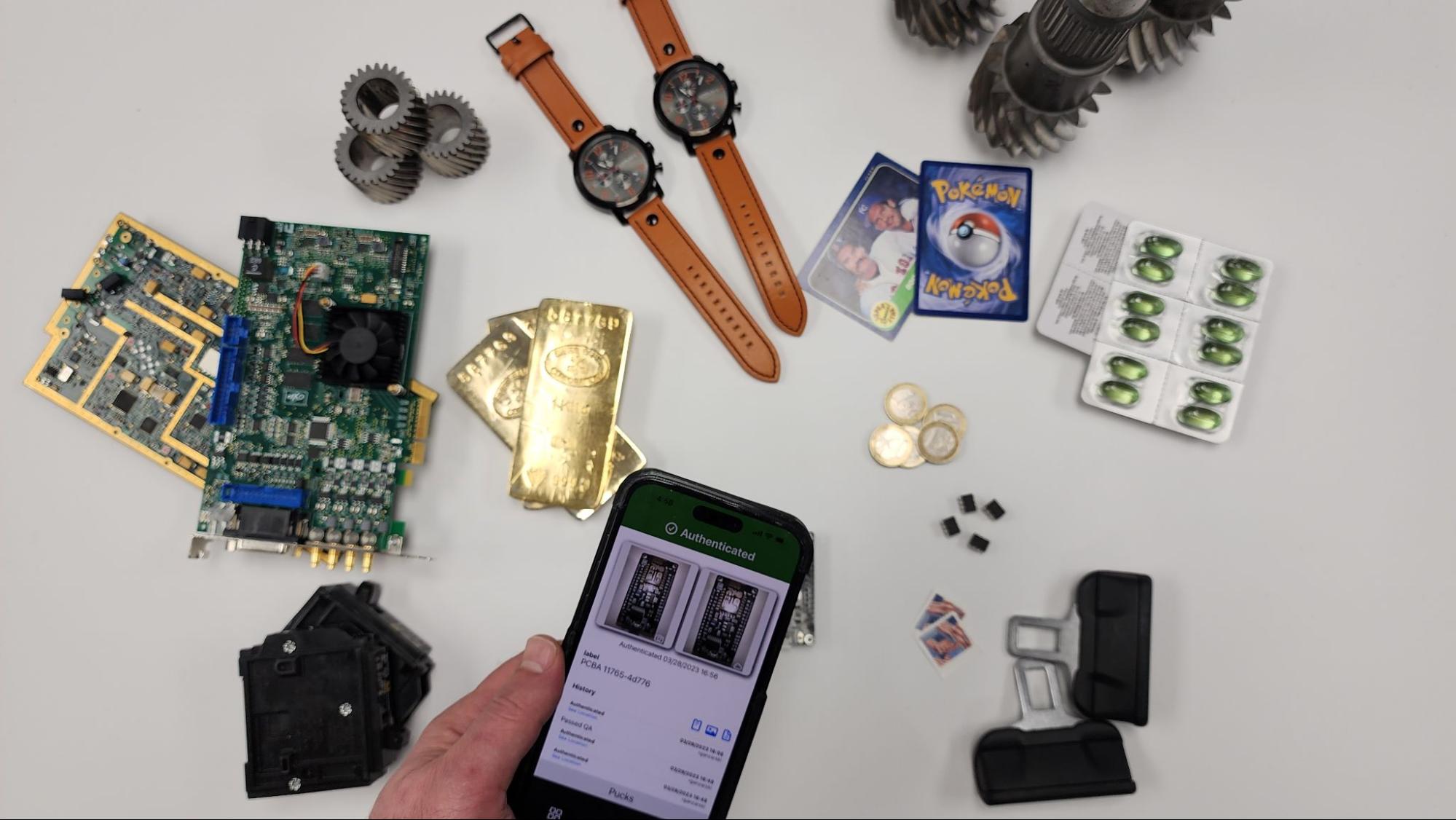
Every physical object is microscopically unique. Two brake pads from the same production line, made seconds apart, carry different surface irregularities invisible to the human eye.
Alitheon built a business on that fact.
The company’s FeaturePrint technology uses an ordinary camera and mathematics to identify, authenticate, and trace individual physical items by their own surfaces. No tag. No chip. No QR code, RFID, or serial number. The object is the ID.
CEO Roei Ganzarski describes it as biometrics for things.
“Just as systems at the airport recognise your fingerprint, our technology lets an ordinary camera, even a phone, identify a physical object by its own surface,” he said.
The system starts at the point of manufacture, where an industrial camera mounted over a production line photographs each item as it passes.
“It’s not even our camera. We’re a software company,” Ganzarski said. “Every brake pad that goes by, a picture gets taken, and at that point, that’s it. It’s FeaturePrinted.”
The software extracts the item’s unique surface characteristics into a mathematical signature. Later, at any point in the supply chain, anyone with a phone can photograph the item and match it against that record. Alitheon reports accuracy above 99.9 percent.
The result is identification at the individual level, not the product level.
“It’s not about saying this is a legitimate brake pad,” Ganzarski said. “It’s this is that brake pad that that company made for you, on this machine, on this date.”
That design solves a weakness shared by every mainstream authentication approach. Serial numbers, barcodes, holograms, and RFID tags are all additions to the object. Anything added can be copied, moved to a fake, or altered. Alitheon removes the attack surface entirely. There is nothing to counterfeit because there is nothing attached.
The architecture also catches fraud that traditional anti-counterfeit tools cannot see. Ganzarski points to fraudulent medication schemes, in which “collectors” buy medication cheaply off patients, launder it back into distribution through wholesalers using falsified paperwork, and it reaches pharmacy shelves as new stock — one such ring cost New York Medicaid over $500 million.
“These aren’t fake products. They’re real, except they are being sold illegally,” he said. “With FeaturePrint you take a picture, and it tells you the original data. Don’t believe the sticker. Believe what the product is telling you.”
Today FeaturePrint runs in industries where authenticity carries real stakes. Swiss and French watchmakers. Gold refiners whose bars are traced into vaults. Healthcare manufacturers. Military programs. TIME named it one of the 200 Best Inventions, and the company is now expanding toward automotive, aerospace, and healthcare at scale.
For Ganzarski, the timing gives the work its weight. In an era when images, records, and documents can all be convincingly faked, a physical object’s own surface may be the last thing that can’t lie.
“A label can be copied or moved,” he said. “An object’s own fingerprint can’t.”







Comment